


ASTM A109: Cold Rolled Carbon Steel Strip Testing Services
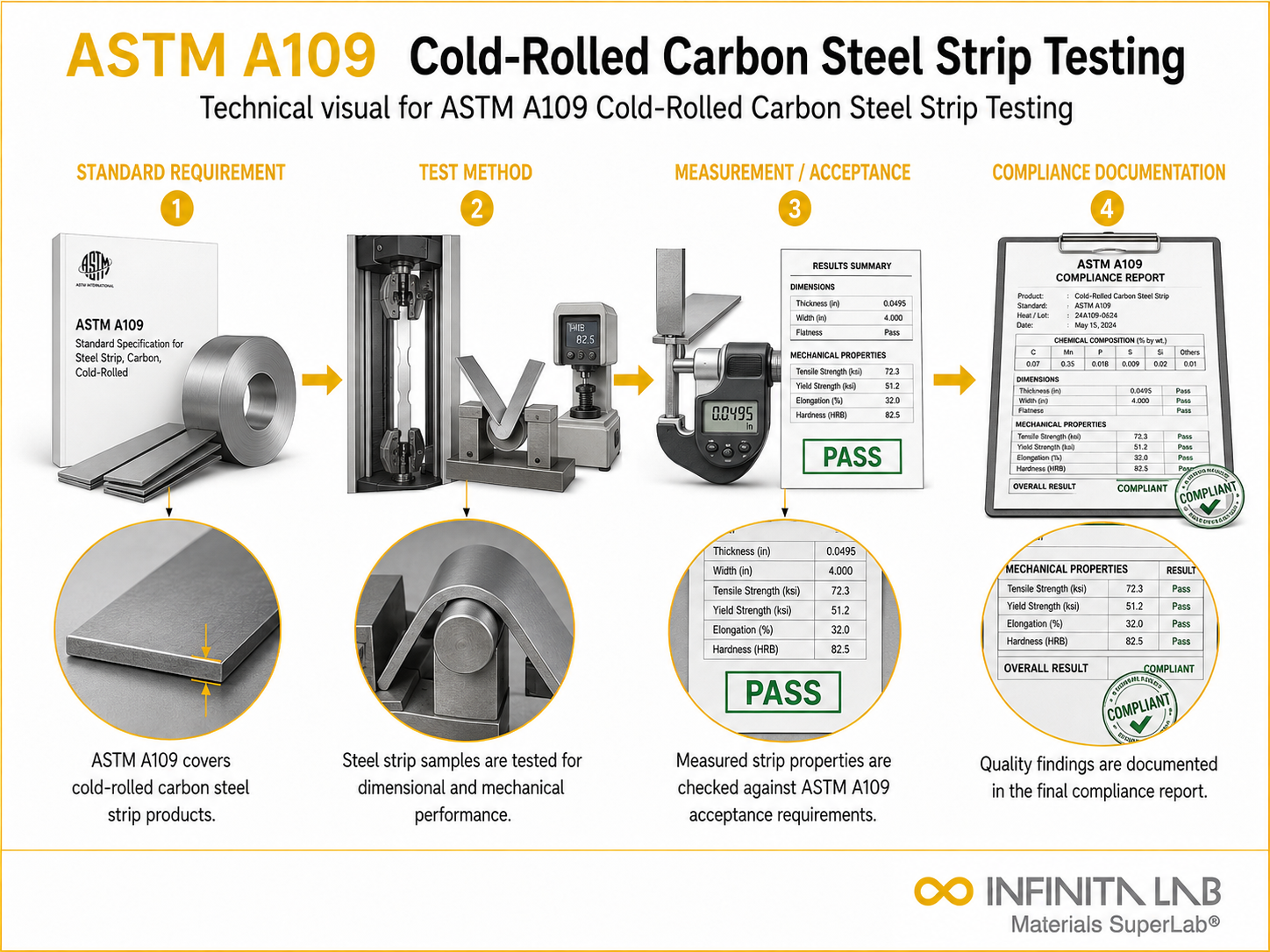
ASTM A109/A109M aims to determine specifications that aim to cover cold-rolled carbon steel strips in cut lengths or coils, furnished to closer tolerances than cold-rolled carbon steel sheets, with specific temper, with a specific edge of specific sizes. The values are rounded or rationalized for determining conformance with this specification,
TRUSTED BY


Get ASTM A109 compliant results — request your cold rolled carbon steel strip testing quote
- Overview
- Scope, Applications, and Benefits
- Test Process
- Specifications
- Instrumentation
- Results and Deliverables
What Is ASTM A109 Cold Rolled Carbon Steel Strip?
ASTM A109/A109M is a standard specification that covers cold-rolled carbon steel strip with a maximum carbon content of 0.25 percent. It defines requirements for chemical composition, mechanical properties, dimensions, and surface finish, ensuring consistent quality for various industrial applications.
This specification is widely used in manufacturing industries such as automotive, construction, and appliances, where precision, formability, and strength are essential. It supports quality assurance and standardization, enabling reliable performance of steel strip in forming, stamping, and fabrication processes.

Applications and Benefits of ASTM A109 Cold Rolled Carbon Steel Strip Testing
Scope
ASTM A109/A109M specifies requirements for cold-rolled carbon steel strip, ensuring consistent mechanical properties, chemical composition, and dimensional tolerances.
- Applicable to low-carbon cold-rolled steel strip
- Defines chemical composition and mechanical properties
- Covers surface finish and dimensional tolerances
- Supports forming, stamping, and fabrication applications
- Ensures compliance with ASTM standards
- Includes various grades and tempers of steel strip
- Suitable for commercial and structural applications
Applications
- Automotive components manufacturing
- Appliance and equipment parts
- Metal stamping and forming operations
- Construction and structural applications
- General engineering uses
Benefits
- Ensures consistent material quality
- Provides good formability and ductility
- Supports high-precision manufacturing
- Enhances product reliability and performance
- Meets industry and regulatory standards
Our ASTM A109 Testing Procedure
Material Sampling
Steel strip samples are selected as per standard guidelines for testing.
1Chemical Analysis
Composition is analyzed to verify carbon and alloy content compliance.
2Mechanical Testing
Tensile strength, yield strength, and elongation are measured.
3Dimensional & Surface Inspection
Thickness, width, and surface finish are evaluated.
4ASTM A109 Test Parameters and Requirements
| Parameter | Details |
|---|---|
| Material | Cold-rolled low-carbon steel strip (≤0.25% C) |
| Thickness | Typically thin gauge strip (varies by grade) |
| Mechanical properties | Tensile strength, yield strength, elongation |
| Surface finish | Matte or bright finish |
| Temper | Various tempers (soft to hard) |
| Tolerances | Defined thickness and width tolerances |
| Testing | Chemical and mechanical verification |


- Spectrometer for chemical analysis
- Universal testing machine (UTM)
- Micrometer and thickness gauges
- Surface inspection tools
- Hardness tester
Equipment and Instrumentation Used for ASTM A109 Testing
What You Receive: Test Report, Data, and Certification
- Chemical composition report
- Mechanical property data
- Dimensional inspection results
- Surface quality evaluation
- Compliance certification as per ASTM A109/A109M
ASTM A109 Cold Rolled Carbon Steel Strip FAQs
ASTM A109/A109M is a standard specification for cold-rolled carbon steel strip with a maximum carbon content of 0.25%. It defines requirements for composition, mechanical properties, and dimensions for industrial applications.
The standard specifies a maximum carbon content of 0.25%. This ensures good ductility, formability, and suitability for cold-forming operations.
The steel strip is available in different tempers ranging from soft to hard. These tempers define the material’s strength and formability characteristics for specific applications.
Cold rolling improves surface finish, dimensional accuracy, and mechanical properties. It enhances the strength and quality of the steel strip compared to hot-rolled materials.
Surface finish affects the appearance and performance of the steel strip. A smooth and uniform finish is important for applications such as coating, painting, and forming.
Why Choose Infinita Lab for Cold Rolled Carbon Steel Strip Testing
At the core of this breadth is our network of 2,000+ accredited laboratories across the USA, offering access to over 10,000 testing methods and analytical services. From advanced materials characterization (SEM, TEM, RBS, XPS) to mechanical, chemical, environmental, biological, and standardized ASTM/ISO-compliant testing, we deliver unmatched flexibility, specialization, and scale. You are never limited by geography, facility, or methodology — Infinita Lab connects you to the right expertise and testing solution, every time.

Need ASTM A109 Cold Rolled Carbon Steel Strip Testing You Can Rely On?
Send query us at hello@infinitalab.com or call us at (888) 878-3090 to learn more about our services and how we can support you.



Request a Quote
Submit your material details and receive testing procedures, pricing, and turnaround time within 24 hours.
 Quick Turnaround and Hasslefree process
 Confidentiality Guarantee
 Free, No-obligation Consultation
 100% Customer Satisfaction
