


ASTM D1076: Rubber Latex Specification Testing Services
In this ASTM D 106, The breadth of the five types of latex is limited by this specification, which also specifies the testing procedures to be used for the required qualities. These testing techniques could be applied to refereeing or production control.
TRUSTED BY


Get ASTM D1076 compliant results — request your rubber latex specification testing quote
- Overview
- Scope, Applications, and Benefits
- Test Process
- Specifications
- Instrumentation
- Results and Deliverables
What Is ASTM D1076 Rubber Latex Specification?
ASTM D1076 provides standard specifications for rubber latex concentrates, including natural rubber latex and its derivative grades. The specification covers the physical and chemical property requirements that rubber latex must meet for use in industrial, medical, and consumer product manufacturing.
Compliance with ASTM D1076 ensures consistency in raw material quality, helps manufacturers select the appropriate grade of latex for specific applications, and supports traceability and regulatory compliance across the latex supply chain.

Applications and Benefits of ASTM D1076 Rubber Latex Specification Testing
Scope
ASTM D1076 defines the quality requirements and standardised test methods for natural rubber latex concentrates, ensuring consistency in composition, stability, and processing performance. The specification covers key physicochemical parameters that directly impact latex handling, storage, and end-use properties.
It evaluates:
- Total solids content – Overall solid material present in the latex
- Dry rubber content (DRC) – Actual rubber fraction excluding non-rubber components
- Alkalinity (as NH₃) – Ammonia content used for preservation and stabilisation
- Mechanical Stability Time (MST) – Resistance to coagulation under mechanical stress
- KOH number – Measure of alkali-reactive constituents
- Volatile Fatty Acid (VFA) number – Indicator of latex degradation and microbial activity
- Coagulum content – Amount of pre-coagulated rubber particles present
Applications
- Natural rubber latex glove manufacturing (medical and industrial)
- Dipped rubber goods (condoms, balloons, catheters)
- Adhesive and sealant formulation
- Foam rubber production
- Carpet backing and textile finishing
Benefits
- Ensures raw material consistency and quality
- Enables grade-based selection for specific end uses
- Supports regulatory compliance for medical-grade products
- Facilitates supplier qualification and incoming inspection
- Provides a common technical language for buyers and suppliers
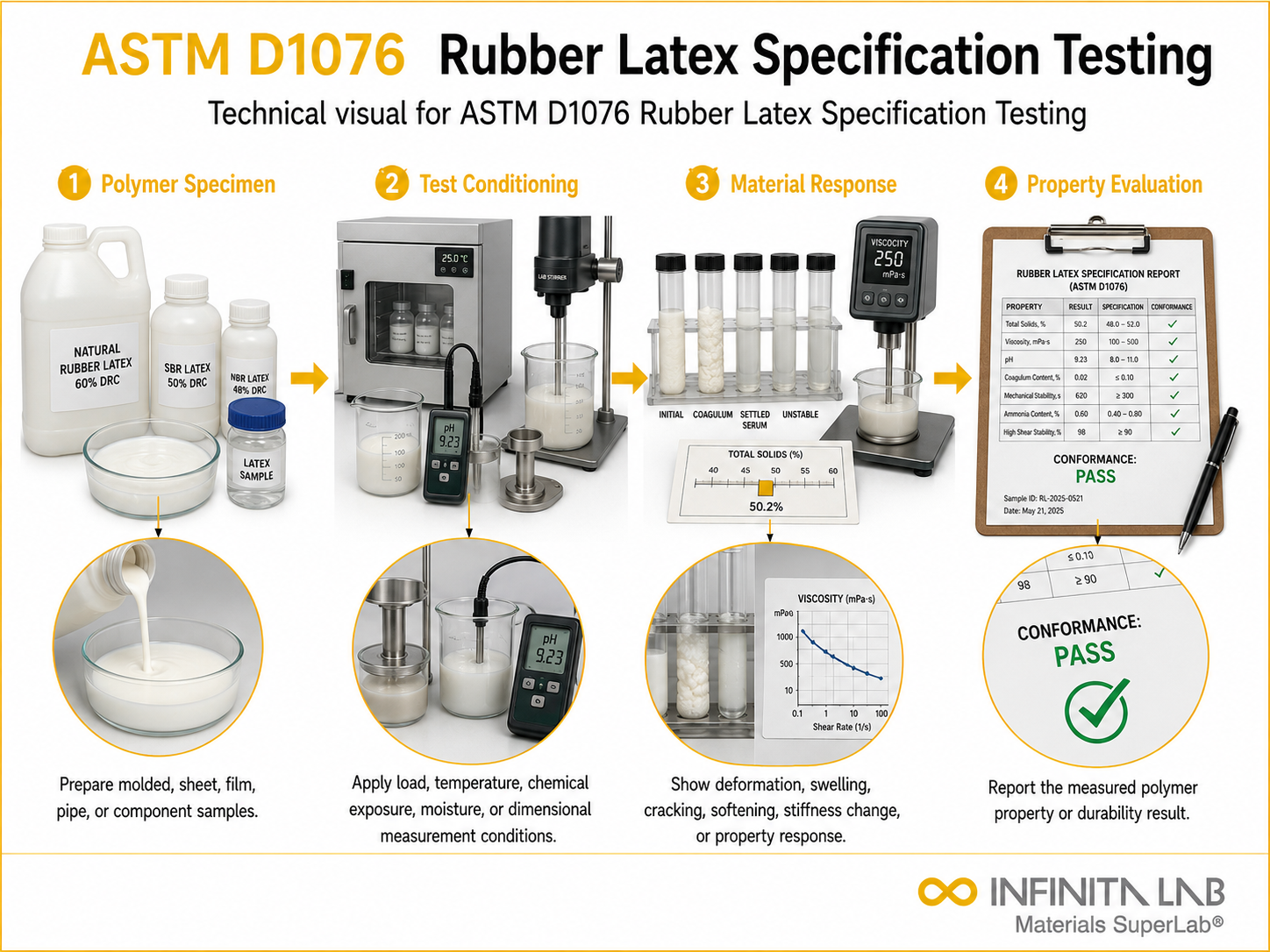
Our ASTM D1076 Testing Procedure
Sample Reception & Conditioning
Samples are logged and conditioned at 27 ± 1 °C as per ASTM D1076.
1Physical Testing
Solids, dry rubber content, alkalinity, and viscosity are measured.
2Stability & Chemical Testing
MST, KOH number, VFA number, and coagulum content are evaluated.
3Compliance Check
Results are compared with ASTM D1076 limits and a pass/fail report is issued.
4ASTM D1076 Test Parameters and Requirements
| Parameter | Details |
|---|---|
| Material | Natural rubber latex concentrates (HA, LA, XA, PA grades) |
| Key Parameters | Total solids, DRC, NH₃, MST, KOH no., VFA no., coagulum |
| Total Solids Range | ≥61.5% (HA grade, typical) |
| MST Requirement | ≥650 s (HA grade, typical) |
| Test Methods Referenced | ASTM D1076 with referenced sub-methods |


- Analytical balance and drying oven (solids content)
- pH/titration equipment (alkalinity, KOH number)
- Mechanical stability tester (MST)
- Viscometer
- Filtration and coagulum determination apparatus
Equipment and Instrumentation Used for ASTM D1076 Testing
What You Receive: Test Report, Data, and Certification
- Measured values for all D1076 parameters
- Grade classification result
- Specification compliance table (pass/fail per parameter)
- Certificate of conformance (upon request)
- Full test report with method references
ASTM D1076 Rubber Latex Specification FAQs
ASTM D1076 covers several grades including HA (high ammonia), LA (low ammonia), XA (extra low ammonia), and PA (preserved with alternative biocides), each with specific minimum property requirements.
MST measures the latex's resistance to premature coagulation during mechanical processing (e.g., pumping, mixing). A higher MST indicates better processing stability, which is critical for dipping and foam manufacturing.
Total solids content includes all non-volatile components (rubber and non-rubber solids), while dry rubber content represents only the rubber hydrocarbon fraction. Both are key quality indicators specified in ASTM D1076.
ASTM D1076 is specifically written for natural rubber latex concentrates. Synthetic latexes (SBR, NBR, etc.) are governed by separate ASTM standards appropriate to each polymer type.
Samples should be stored in sealed containers at 27 °C, protected from freezing and direct sunlight. Ammonia-preserved (HA) samples should not be diluted or contaminated before testing.
Why Choose Infinita Lab for Rubber Latex Specification Testing?
At the core of this breadth is our network of 2,000+ accredited laboratories across the USA, offering access to over 10,000 testing methods and analytical services. From advanced materials characterization (SEM, TEM, RBS, XPS) to mechanical, chemical, environmental, biological, and standardized ASTM/ISO-compliant testing, we deliver unmatched flexibility, specialization, and scale. You are never limited by geography, facility, or methodology — Infinita Lab connects you to the right expertise and testing solution, every time.

Need ASTM D1076 Rubber Latex Specification Testing You Can Rely On?
Send query us at hello@infinitalab.com or call us at (888) 878-3090 to learn more about our services and how we can support you.



Request a Quote
Submit your material details and receive testing procedures, pricing, and turnaround time within 24 hours.
 Quick Turnaround and Hasslefree process
 Confidentiality Guarantee
 Free, No-obligation Consultation
 100% Customer Satisfaction
