


Thermal Insulation Testing Services
Thermal Insulation Testing measures R-value, thermal conductivity (λ), and U-value for insulation materials used in building envelopes, industrial pipework, HVAC systems, and cryogenic applications — supporting product certification, energy code compliance, and procurement specification per ASTM, ISO, and ASHRAE standards.
TRUSTED BY


Get compliant results — request your thermal insulation testing quote
- Overview
- Scope, Applications, and Benefits
- Test Process
- Specifications
- Instrumentation
- Results and Deliverables
What Is Thermal Insulation?
The insulating capability of a material is quantified by its thermal conductivity, which governs the rate of heat transfer. Thermal insulation testing is conducted in controlled environments to evaluate an insulation material’s resistance to heat flow in accordance with standards such as ASTM E285, ASTM C549, ASTM C553, and ASTM C739.
In addition to thermal conductivity, insulation performance is influenced by factors including density, thickness, specific heat capacity, and thermal bridging. Materials with higher thermal resistance provide better insulation efficiency, while flexible insulation materials are preferred for applications involving complex geometries or confined spaces.
Moisture and humidity can significantly reduce the performance of insulation materials, particularly fibrous insulation such as mineral wool and fiberglass. When moisture infiltrates the material, insulating air pockets are partially replaced by water, increasing heat transfer and lowering thermal resistance. Therefore, evaluating materials under both dry-state and wet-state conditions is important for accurately assessing long-term insulation performance in humid or moisture-prone environments.

Applications and Benefits of Thermal Insulation Testing
Scope
Thermal insulation testing assesses the heat-transfer characteristics of insulating materials under controlled thermal conditions. This evaluation yields quantitative data essential for determining insulating efficacy and thermal resistance.
Thermal insulation testing evaluates:
- Thermal conductivity of insulation materials
- Thermal resistance and heat transfer behaviour
- Influence of material density and thickness
- Insulating efficiency under steady-state conditions
Applications
Thermal insulation testing is used wherever heat retention, energy efficiency, and temperature control are critical for product performance and operational reliability:
- Construction & building materials — evaluation of wall insulation, roofing systems, glazing materials, insulation panels, and energy-efficient building assemblies designed to reduce heat transfer
- Automotive systems — testing of battery insulation, cabin insulation materials, engine compartment thermal barriers, and heat shields exposed to elevated operating temperatures
- Aerospace & defense — characterization of lightweight thermal protection materials, insulation blankets, and high-temperature barrier systems used in aircraft and defense applications
- Electronics & electrical systems — assessment of insulating materials, thermal barriers, and enclosure systems used to manage heat generation in electronic devices and power systems
- Industrial equipment & energy systems — measurement of insulation efficiency in furnaces, pipelines, process equipment, storage tanks, and heat exchangers operating under thermal stress
- R&D and material development — comparative insulation performance analysis across formulations, densities, coatings, thicknesses, and manufacturing processes during new material development
Benefits
- Measures real-world insulation performance — thermal insulation testing evaluates how effectively a material reduces heat transfer under controlled operating conditions, helping engineers optimize thermal efficiency and temperature stability.
- Supports energy efficiency and thermal management — accurate insulation data helps reduce energy loss, improve system efficiency, and maintain stable operating temperatures in demanding applications.
- Enables material and product optimization — test data helps engineers optimize density, thickness, coatings, fillers, and insulation system design to achieve targeted thermal performance.
- Improves product reliability and safety — effective insulation materials help prevent overheating, thermal degradation, temperature fluctuations, and heat-related component failure.
- Supports product qualification and compliance — documented thermal insulation test results are commonly used for product validation, regulatory compliance, and performance certification.
- Early-stage QC — identifies variations in insulation quality, thermal conductivity behavior, density consistency, or material defects before products enter production or field use.
Our Testing Procedure
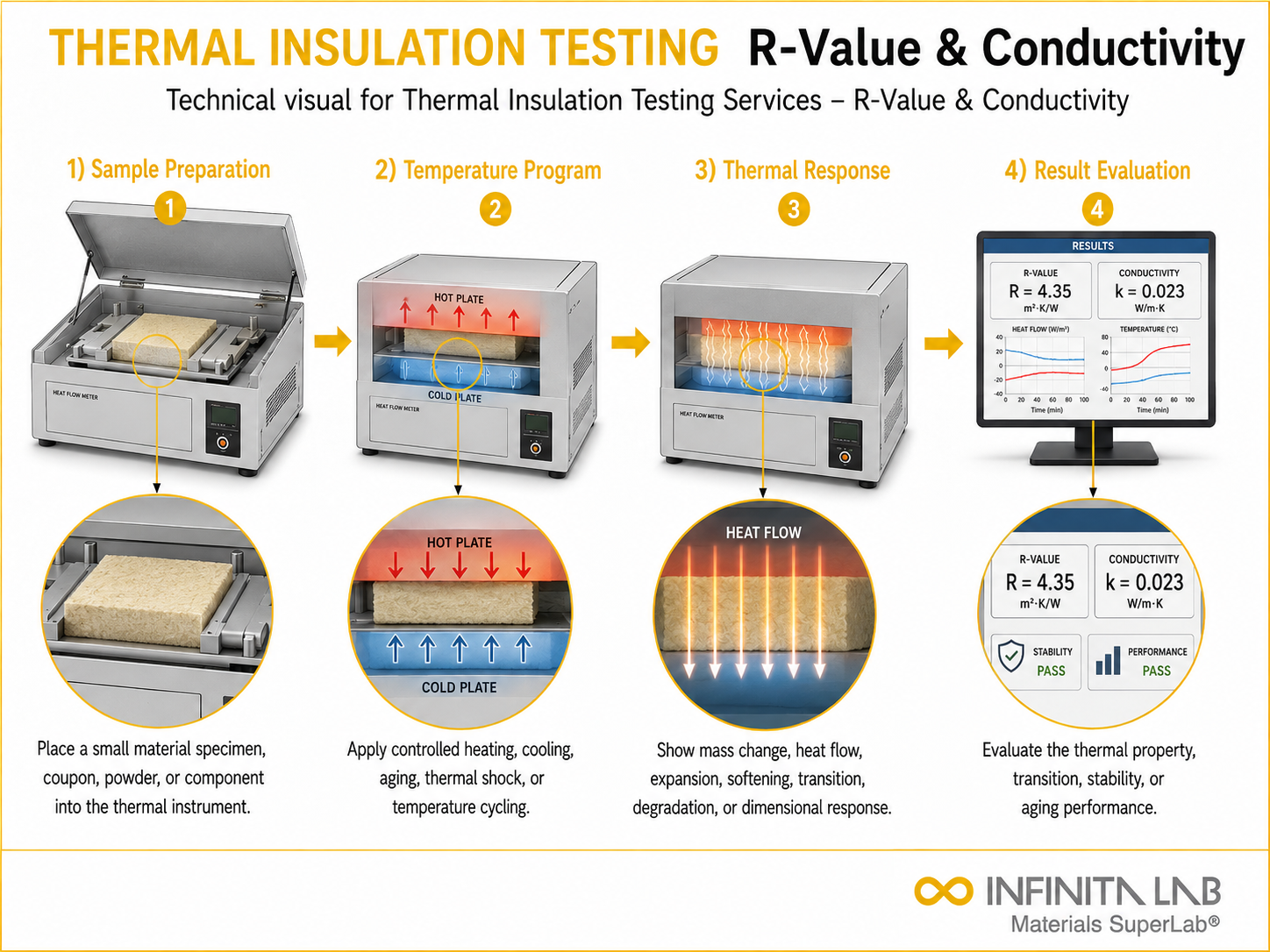
Sample Preparation & Conditioning
Insulation specimens are prepared to the required dimensions and conditioned before testing.
1Specimen Installation
The specimen is installed in the test apparatus to ensure proper contact for heat flow measurement.
2Heat Application
Controlled heat is applied to establish steady-state heat flow through the specimen.
3Data Recording & Evaluation
Temperature differences and heat-flow data are recorded to determine insulation performance.
4Test parameters and requirements
| Parameter | Details |
|---|---|
| Standards | ASTM C177, C518, C335, C740, C1289 · ISO 8301, 8302 |
| Specimen size | C518: min 305 × 305 mm; C177: min 610 × 610 mm; C335: per pipe diameter and apparatus |
| Applicable Materials | Thermal insulation materials |
| Test Temperature Range | −196°C to +650°C depending on method |
| Measurement Mode | Steady-state heat flow |
| Specimen Thickness | As provided or specified |
| Conditioning Environment | Controlled temperature and humidity |
| Measured Outputs | Thermal conductivity and thermal resistance |


- Heat Flow Meter (HFM) apparatus
- Temperature sensors or thermocouples
- Controlled heat source
- Specimen holding fixtures
- Data acquisition and recording system
- Calibration and verification equipment
Equipment and Instrumentation Used for Testing
What You Receive: Test Report, Data, and Certification
Thermal Insulation FAQs
The thermal insulation test is a process that determines the effectiveness of a material in preventing the flow of heat. The test is useful in identifying whether temperature regulation can be achieved.
The thermal insulation test usually involves the measurement of thermal conductivity, thermal resistance, heat flow rate, and temperature gradient. These are the factors that measure the effectiveness of the insulation materials in restricting the heat transfer.
Thermal insulation testing ensures that the materials used are effective in preventing unwanted heat transfer, thereby reducing energy consumption. Proper testing ensures that the designer chooses the right insulation material that can prevent heating and cooling losses.
Factors that affect test results include material composition, density, thickness, moisture content, temperature difference, and contact conditions. Careful preparation of the specimens and controlled conditions are necessary for obtaining consistent and accurate thermal performance data.
R-value measures the thermal resistance of a specific material thickness and increases proportionally with thickness. Thermal conductivity (λ) is an intrinsic material property independent of thickness — it is the fundamental engineering parameter used to calculate R-value for any given thickness. U-value (thermal transmittance) is the inverse of total assembly R-value and accounts for all layers, air films, and surface resistances in a building assembly. For material comparison and procurement, λ is the most useful metric; for code compliance of a specific product, R-value is required; for whole-assembly performance, U-value applies.
Why Choose Infinita Lab for Thermal Insulation Testing?
At the core of this breadth is our network of 2,000+ accredited laboratories across the USA, offering access to over 10,000 testing methods and analytical services. From advanced materials characterization (SEM, TEM, RBS, XPS) to mechanical, chemical, environmental, biological, and standardized ASTM/ISO-compliant testing, we deliver unmatched flexibility, specialization, and scale. You are never limited by geography, facility, or methodology — Infinita Lab connects you to the right expertise and testing solution, every time.

Looking for an Accredited Partner for Thermal Insulation Testing?
Send query us at hello@infinitalab.com or call us at (888) 878-3090 to learn more about our services and how we can support you.



Request a Quote
Submit your material details and receive testing procedures, pricing, and turnaround time within 24 hours.
 Quick Turnaround and Hasslefree process
 Confidentiality Guarantee
 Free, No-obligation Consultation
 100% Customer Satisfaction
