


ASTM E415: Carbon Low Alloy Steel Spark OES Testing Services
Accredited ASTM E415 carbon low alloy steel spark OES testing from Infinita Lab, performed to the exact standard requirements - accurate, reproducible results with full documentation for compliance, R&D, and quality control programs.
TRUSTED BY


Get ASTM E415 compliant results - request your carbon low alloy steel spark OES testing quote
- Overview
- Scope, Applications, and Benefits
- Test Process
- Specifications
- Instrumentation
- Results and Deliverables
What Is ASTM E415 Carbon Low Alloy Steel Spark OES?
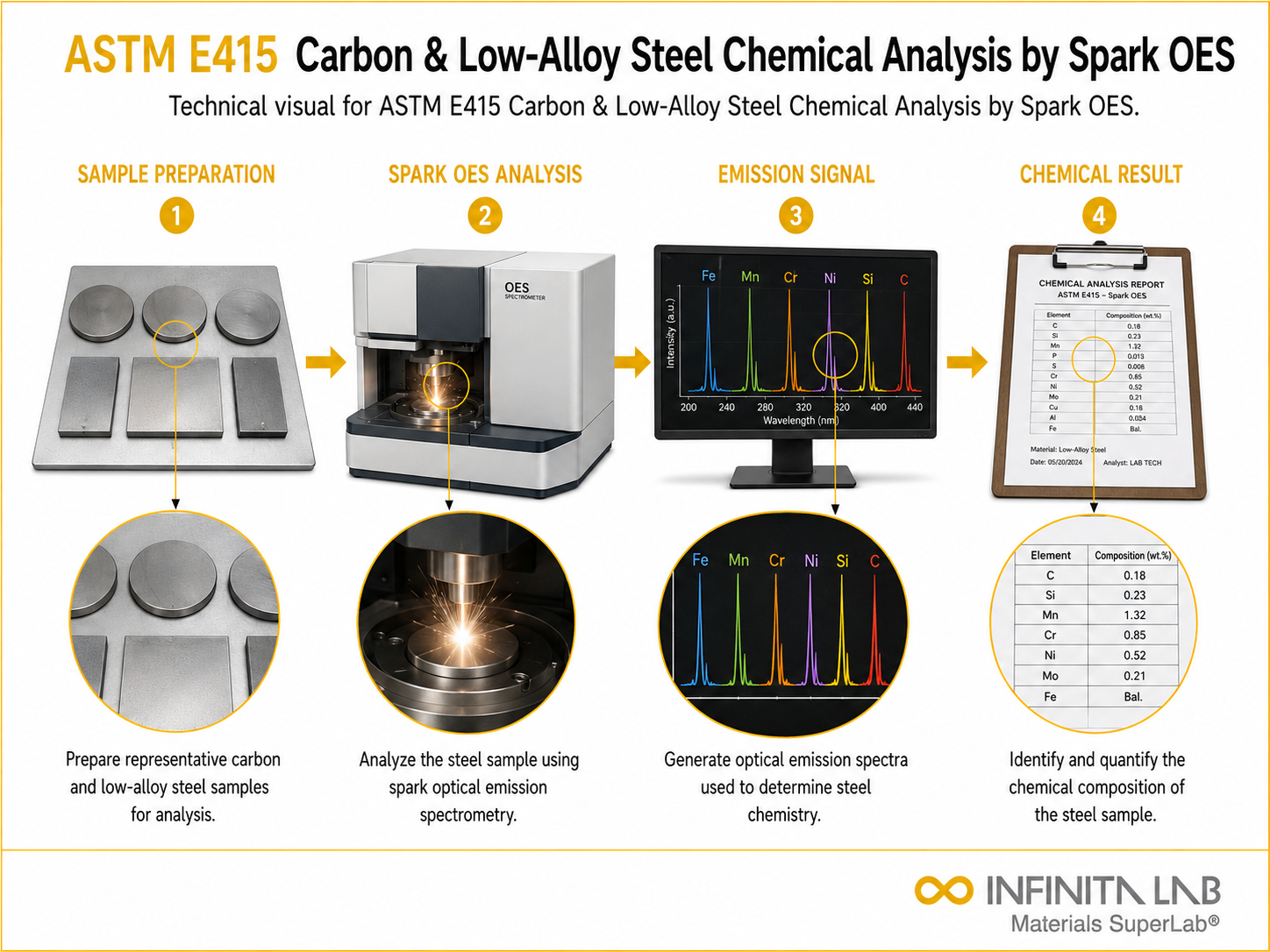
ASTM E415, Standard Test Method for Analysis of Carbon and Low-Alloy Steel by Spark Atomic Emission Spectrometry, is the industry-standard procedure for determining the elemental composition of carbon and low-alloy steel using spark optical emission spectrometry (spark OES). The method covers the simultaneous determination of a broad slate of alloying and residual elements — including carbon, manganese, phosphorus, sulphur, silicon, chromium, nickel, molybdenum, copper, aluminium, titanium, vanadium, and others depending on grade and instrument configuration — making it a primary tool for confirming that a heat, lot, or finished steel product meets its specified chemistry.
In spark OES, a controlled high-voltage electrical spark is discharged between an electrode and a prepared flat surface of the metal sample, typically under a purge of high-purity argon gas to exclude atmospheric oxygen and nitrogen and to allow detection of ultraviolet-emitting elements such as carbon, phosphorus, and sulphur. The spark vaporises and excites atoms at the sample surface, causing each element present to emit light at wavelengths characteristic of its atomic structure. An optical spectrometer disperses and measures the intensity of these emission lines, and a calibration built from certified reference materials converts the measured intensities into elemental concentrations, reported in weight per cent.
ASTM E415 matters to manufacturers, mills, and fabricators because it delivers fast, accurate, and repeatable chemical composition verification directly on solid metal, without the time and sample destruction required by wet-chemical methods. It is worth noting that ASTM E415 is the companion standard to ASTM E1086, which applies the same spark OES principle specifically to austenitic stainless steel; E415 is reserved for carbon and low-alloy steel grades, and selecting the correct standard for the material family being tested is essential to accurate, defensible results.

Applications and Benefits of ASTM E415 Carbon Low Alloy Steel Spark OES Testing
Scope
- ASTM E415 covers the analysis of carbon and low-alloy steels by spark atomic emission spectrometry for both production control and product certification purposes.
- The method determines a wide range of alloying and residual elements, commonly including carbon, manganese, phosphorus, sulphur, silicon, chromium, nickel, molybdenum, copper, aluminium, titanium, and vanadium, with additional elements available depending on the calibration and instrument.
- It applies to carbon steels, low-alloy steels, structural and engineering steels, and related mill products such as billets, blooms, bars, plates, forgings, and castings.
- Test specimens must present a clean, flat, homogeneous metal surface, free of oxide, scale, rust, oil, and other surface contamination, and of sufficient size to seat properly on the spark stand.
- The technique is a companion method to ASTM E1086, which addresses austenitic stainless steel; the two standards share the same spark OES principle but are calibrated and validated for different alloy families.
- ASTM E415 supports heat analysis and melt chemistry control during steelmaking, allowing producers to adjust composition before casting or further processing.
- It is widely used for incoming material verification and positive material identification (PMI) to confirm that received steel matches its certified mill test report or purchase specification.
- Results generated under ASTM E415 are used to demonstrate conformance to material specifications such as ASTM, SAE, and other grade-defining standards for carbon and low-alloy steel.
- The method supports quality assurance programs, failure investigations, and research and development efforts where confirmed elemental chemistry is required.
- Because the test is rapid and largely non-destructive to the bulk part, it is well suited to high-volume production environments as well as one-off verification of critical components.
Applications
- Steel mill process and heat chemistry control during melting, refining, and casting operations.
- Incoming raw material inspection and positive material identification (PMI) at fabrication and manufacturing facilities.
- Foundry quality control for castings produced from carbon and low-alloy steel.
- Structural steel fabrication and construction, confirming grade compliance for beams, plates, and connections.
- Automotive component and supply-chain verification for carbon and low-alloy steel parts.
- Pipeline, oil and gas, and pressure vessel component testing to confirm material grade and chemistry.
- Third-party audits, dispute resolution, and material certification for buyers, sellers, and end users of steel products.
Benefits
- Delivers rapid, on-site chemical composition results, typically within seconds to a few minutes per sample.
- Provides simultaneous multi-element analysis from a single spark burn, reducing turnaround time compared to sequential wet-chemical methods.
- Offers high accuracy and repeatability when calibrated against certified reference materials matched to the steel grade family.
- Requires only a small, prepared surface area, minimising damage to the parent part or product.
- Generates defensible, traceable data suitable for certification, compliance documentation, and audit support.
- Supports both routine production control and one-time verification testing within the same standardized method.
Our ASTM E415 Testing Procedure
Specimen Preparation
Steel specimens surface-ground or machined to expose a clean, flat analytical surface per ASTM E415 preparation requirements.
1Instrument Standardization
Spectrometer standardized against certified reference materials to establish calibrated intensity-to-concentration relationships before analysis.
2Optical Emission Analysis
Electrical spark discharge applied to specimen surface; emitted light collected and resolved by spectrometer for element-specific intensity measurement.
3Data Analysis & Reporting
Elemental concentrations calculated from measured intensities and assessed against specification limits for test compliance result.
4ASTM E415 Test Parameters and Requirements
| Parameter | Details |
|---|---|
| Applicable Materials | Carbon steel and low-alloy steel wrought, cast, and forged products per ASTM E415 analytical scope |
| Measurement Technique | Optical emission spectrometry (OES) with electrical spark excitation source and polychromator or CCD detector |
| Analytical Elements | C, Mn, Si, P, S, Cr, Ni, Mo, V, Cu, Al, Ti, Nb, and additional alloying and residual elements per calibration |
| Calibration Standards | Certified reference materials traceable to NIST or equivalent national metrology standards per ASTM E415 requirements |
| Measured Outputs | Elemental concentration values (wt%), analytical uncertainty estimates, and specification compliance result |


- Spark optical emission spectrometer – excites the sample surface and measures characteristic emission spectra to determine elemental composition.
- Spark stand and excitation source – holds the sample in position and generates the controlled high-voltage spark discharge.
- Surface grinder or milling equipment – prepares a clean, flat, representative test surface free of oxide and contamination.
- Certified reference materials (CRMs) – used to calibrate and verify instrument accuracy for carbon and low-alloy steel grade families.
- High-purity argon gas supply – purges the spark chamber to exclude atmospheric gases and support detection of UV-emitting elements.
- Data acquisition and processing software – converts measured spectral intensities into elemental concentrations and compiles results.
- Reference standards and specification documentation – used to compare measured chemistry against applicable material grade requirements.
Equipment and Instrumentation Used for ASTM E415 Testing
What You Receive: Test Report, Data, and Certification
- A formal test report documenting the elemental composition of the tested sample in weight per cent.
- Comparison of measured chemistry against the applicable material specification or purchase order requirement.
- Identification of the sample’s steel grade classification, where applicable, based on measured composition.
- Supporting documentation on calibration, reference materials, and instrument standardisation used during testing.
- Traceable records suitable for quality assurance, compliance audits, and customer or regulatory review.
- Guidance and consultation on result interpretation from experienced materials testing personnel.
ASTM E415 Carbon Low Alloy Steel Spark OES FAQs
ASTM E415 is the standardized optical emission spectrometry method for determining elemental composition of carbon and low-alloy steel — exciting specimen surfaces with electrical spark discharge and measuring characteristic emission intensities to calculate elemental concentrations.
ASTM E415 analyzes carbon, manganese, silicon, phosphorus, sulfur, chromium, nickel, molybdenum, vanadium, copper, aluminum, titanium, and niobium in carbon and low-alloy steel grades.
An electrical spark discharge excites atoms on the steel specimen surface, causing them to emit light at element-specific wavelengths. A spectrometer measures emission intensities and calculates elemental concentrations from calibrated reference relationships.
Steel specimens require surface grinding or machining to a clean, flat, oxide-free analytical surface to ensure consistent spark discharge and accurate elemental emission measurement per ASTM E415 requirements.
ASTM E415 chemical analysis is commonly required by steel product specifications, structural fabrication standards, and pressure vessel codes for heat composition verification. Confirm requirements against your applicable steel specification and design standard.
ASTM E415 uses spark atomic emission spectrometry to simultaneously determine alloying and residual elements in carbon and low-alloy steel.
The latest active edition listed by ASTM is ASTM E415-21, titled Standard Test Method for Analysis of Carbon and Low-Alloy Steel by Spark Atomic Emission Spectrometry.
ASTM E415 is intended for carbon and low-alloy steels, not specifically stainless steel. Stainless steel analysis generally requires a method applicable to its composition and grade, such as ASTM E1086 for austenitic stainless steels.
Why Choose Infinita Lab for Carbon Low Alloy Steel Spark OES Testing
When your Carbon Low Alloy Steel Spark OES results have to hold up - for compliance, a customer audit, or an engineering decision - ASTM E415 accuracy and an unbiased third-party report matter more than price. Infinita Lab routes your ASTM E415 carbon low alloy steel spark OES testing to ISO/IEC 17025-accredited U.S. partner labs with hands-on method experience, so you get defensible data, transparent reporting, and turnaround times built around your project deadline - not ours.

Need ASTM E415 Carbon Low Alloy Steel Spark OES Testing You Can Rely On?
Send query us at hello@infinitalab.com or call us at (888) 878-3090 to learn more about our services and how we can support you.



Request a Quote
Submit your material details and receive testing procedures, pricing, and turnaround time within 24 hours.
 Quick Turnaround and Hasslefree process
 Confidentiality Guarantee
 Free, No-obligation Consultation
 100% Customer Satisfaction
