


Thermal Conductivity Testing for Liquids & Fluids
Thermal conductivity of liquids testing evaluates the ability of a liquid to transfer heat under controlled conditions and is used for thermal system design, fluid selection, and performance optimization in engineering applications. It helps determine temperature-dependent heat transfer behavior in liquids, supporting accurate analysis for heat exchangers, cooling systems, and various industrial process fluids.
TRUSTED BY


Precision Testing Solutions for Accurate, Reliable, and Standards-Compliant Results
- Overview
- Scope, Applications, and Benefits
- Test Process
- Specifications
- Instrumentation
- Results and Deliverables
Thermal Conductivity of Liquids – Overview
Thermal conductivity of liquids is a key thermophysical property that defines the ability of a liquid to transfer heat through molecular interaction and energy diffusion. It plays a critical role in thermal system design, heat exchangers, cooling fluids, chemical reactors, and energy transport applications. The test evaluates how efficiently heat moves through a liquid under controlled temperature conditions, ensuring accurate thermal modeling and process optimization.
The measurement is typically performed using transient or steady-state techniques such as the hot wire or thermal probe method. It helps in understanding temperature-dependent heat transfer behavior of liquids under varying environmental conditions. Accurate thermal conductivity data is essential for predicting heat flow performance, improving system efficiency, and ensuring safe thermal operation in industrial and research environments.

Scope, Applications, and Benefits
Scope
The test determines the thermal conductivity of liquid samples under controlled laboratory conditions across a defined temperature range. It evaluates heat transfer efficiency through molecular energy transport and thermal diffusion behavior in liquids.
- Measures heat transfer capability in liquids under steady and transient conditions
- Applicable to pure liquids, mixtures, oils, chemical solutions, and refrigerants
- Evaluates temperature-dependent thermal response of fluid systems
- Suitable for both Newtonian and non-Newtonian liquid behavior
- Supports assessment of thermal stability and uniformity during testing
- Used for quality control, research studies, and thermal system validation
- Helps identify variations in thermal behavior due to composition changes or impurities
Applications
- Heat exchanger and cooling system design
- Thermal fluid selection for industrial processes
- Chemical reactor heat transfer modeling
- HVAC and refrigeration system optimization
- Energy storage and heat transfer fluids
- Process simulation and thermal engineering studies
Benefits
- Improves thermal system efficiency
- Supports accurate heat transfer modeling
- Enhances process safety and stability
- Enables optimized fluid selection
- Reduces energy losses in thermal systems
- Provides reliable temperature-dependent data
Thermal Conductivity of Liquids – Test Process
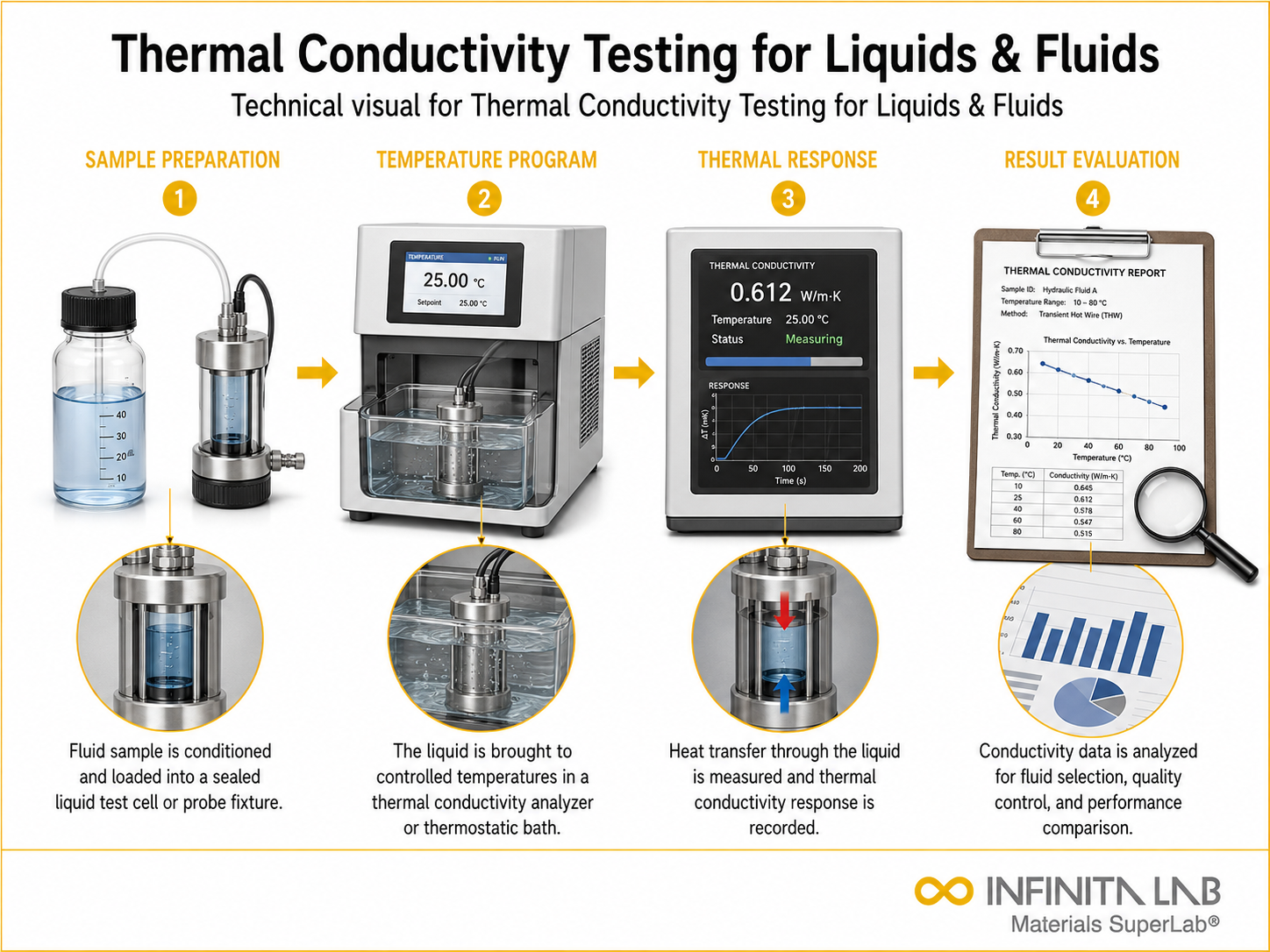
Sample Preparation
Liquid sample is prepared and conditioned to remove impurities and ensure uniform thermal properties. Temperature stabilization is performed before testing begins.
1Instrument Calibration
Measurement device is calibrated using reference fluids with known thermal conductivity to ensure accuracy and repeatability.
2Thermal Measurement
A heat pulse or continuous heat source is applied, and temperature response of the liquid is recorded over time.
3Data Analysis
Thermal conductivity is calculated from temperature-time response curves using established mathematical heat transfer models.
4Thermal Conductivity of Liquids – Technical Specifications
| Parameter | Details |
|---|---|
| Measurement Principle | Heat flow response analysis using transient thermal excitation |
| Thermal Conductivity Range | 0.1 to 1.5 W/m·K depending on liquid type |
| Temperature Range | -20°C to 200°C under controlled environment |
| Sample Volume | Typically 1–10 mL depending on probe design |
| Response Time | 5–60 seconds depending on method used |
| Sensor Type | Thermal probe or hot-wire filament system |
| Data Output | Thermal conductivity vs temperature profile |


Instrumentation Used for Testing
- Transient hot wire thermal conductivity analyzer
- Thermal probe measurement system
- Precision temperature-controlled bath
- Data acquisition and control unit
- Calibration reference fluid standards
- Digital temperature sensors
Results and Deliverables
- Thermal conductivity values at specified temperatures
- Temperature vs conductivity behavior curve
- Data accuracy and repeatability report
- Calibration verification record
- Test methodology documentation
- Comparative fluid performance analysis
Frequently Asked Questions
Thermal conductivity in liquids defines the ability of a fluid to transfer heat energy through molecular motion. It is important because it directly influences heat exchanger performance, cooling efficiency, and thermal system design accuracy in engineering and industrial applications.
The measurement is based on heat transfer response principles, where a controlled heat input is applied and the resulting temperature change in the liquid is analyzed. Mathematical heat diffusion models are used to calculate conductivity accurately.
Response time indicates how quickly the system records thermal changes. Faster response improves efficiency and reduces testing time without compromising accuracy.
Yes, mixtures can show significantly different behavior due to interactions between components, concentration variations, and changes in molecular structure affecting heat transfer properties.
It determines how efficiently heat is transferred between fluids. Higher thermal conductivity improves heat exchange efficiency, reduces energy consumption, and enhances system performance.
Why Choose Infinita Lab for Advanced Materials Testing and Characterization?
At the core of this breadth is our network of 2,000+ accredited laboratories across the USA, offering access to over 10,000 testing methods and analytical services. From advanced materials characterization (SEM, TEM, RBS, XPS) to mechanical, chemical, environmental, biological, and standardized ASTM/ISO-compliant testing, we deliver unmatched flexibility, specialization, and scale. You are never limited by geography, facility, or methodology — Infinita Lab connects you to the right expertise and testing solution, every time.

Looking for a Trusted Partner for Accurate and Reliable Testing Services?
Send query us at hello@infinitlab.com or call us at (888) 878-3090 to learn more about our services and how we can support you.



Request a Quote
Submit your material details and receive testing procedures, pricing, and turnaround time within 24 hours.
 Quick Turnaround and Hasslefree process
 Confidentiality Guarantee
 Free, No-obligation Consultation
 100% Customer Satisfaction
