


Thermal Adhesive Testing Services
Performance testing of thermal adhesives is essential for a variety of applications. Thermal adhesives are designed to improve thermal management and reduce air gaps. Factors like thermal conductivity and contact resistance must be evaluated to ensure the optimal adhesive is selected. Thermal conductivity is determined by the adhesive material and contact resistance is measured by deformation due to contact pressure.
TRUSTED BY


Get compliant results — request your thermal adhesive testing quote
- Overview
- Scope, Applications, and Benefits
- Test Process
- Specifications
- Instrumentation
- Results and Deliverables
What Is Thermal Adhesive?
Thermal adhesive testing evaluates adhesive bonds subjected to elevated temperature conditions, either as a static soak at high temperature or as cyclic thermal exposure that cycles the joint repeatedly between high and low temperature extremes. The purpose is to determine whether the adhesive maintains sufficient strength, stiffness, and dimensional stability when the bonded assembly operates in a thermally demanding environment. Most adhesives that perform well at room temperature experience significant strength reduction at elevated temperatures because the polymer matrix softens as it approaches its glass transition temperature.
Two distinct failure modes are evaluated in thermal adhesive testing. The first is thermal degradation – a permanent reduction in adhesive strength caused by chemical breakdown of the polymer network at sustained high temperatures. The second is thermal fatigue – a cumulative damage mechanism driven by repeated mismatch in thermal expansion between the adhesive and the adherends during temperature cycling. Both mechanisms can cause bond failure at temperatures and stresses well within the design envelope if the adhesive system is not properly selected and qualified.
Thermal adhesive testing is critical for bonded assemblies in automotive underhood and exhaust systems, aerospace structures with wide thermal excursion ranges, electronics assemblies exposed to solder reflow and operational heat, and industrial equipment operating near heat sources. The test program typically includes baseline bond strength at room temperature, elevated temperature shear or tensile testing at the maximum service temperature, and thermal cycling followed by room-temperature retesting to assess cycling-induced strength loss.

Applications and Benefits of Thermal Adhesive Testing
Scope
Thermal adhesive testing applies to structural and functional adhesive bonds in assemblies that experience service temperatures above ambient or that undergo repeated thermal cycles. Testing addresses both static high-temperature strength and thermal fatigue behavior. Evaluation areas include:
- Shear or tensile strength at elevated service temperatures
- Strength retention after thermal aging at maximum service temperature
- Bond integrity after defined numbers of thermal cycles
- Glass transition temperature of the cured adhesive relative to service temperature
- Creep and deformation of adhesive joints under sustained load at elevated temperature
- Failure mode changes between room temperature and elevated temperature conditions
Applications
- Automotive underhood and powertrain component bonded assembly qualification
- Aerospace structure thermal performance verification
- Electronics assembly adhesive qualification for solder reflow and operational temperatures
- Industrial furnace, kiln, and high-temperature process equipment bonding evaluation
- Bonded thermal management assemblies for battery and power electronics
- Adhesive selection programs for thermally demanding service environments
Benefits
- Identifies strength reduction at service temperature before assembly deployment
- Quantifies thermal cycling-induced degradation over the design service life
- Supports adhesive selection with data at actual service conditions rather than room temperature only
- Detects mismatch between adhesive thermal performance and application requirements
- Provides thermal aging data to predict long-term bond reliability
- Generates qualification data for customer or specification submission
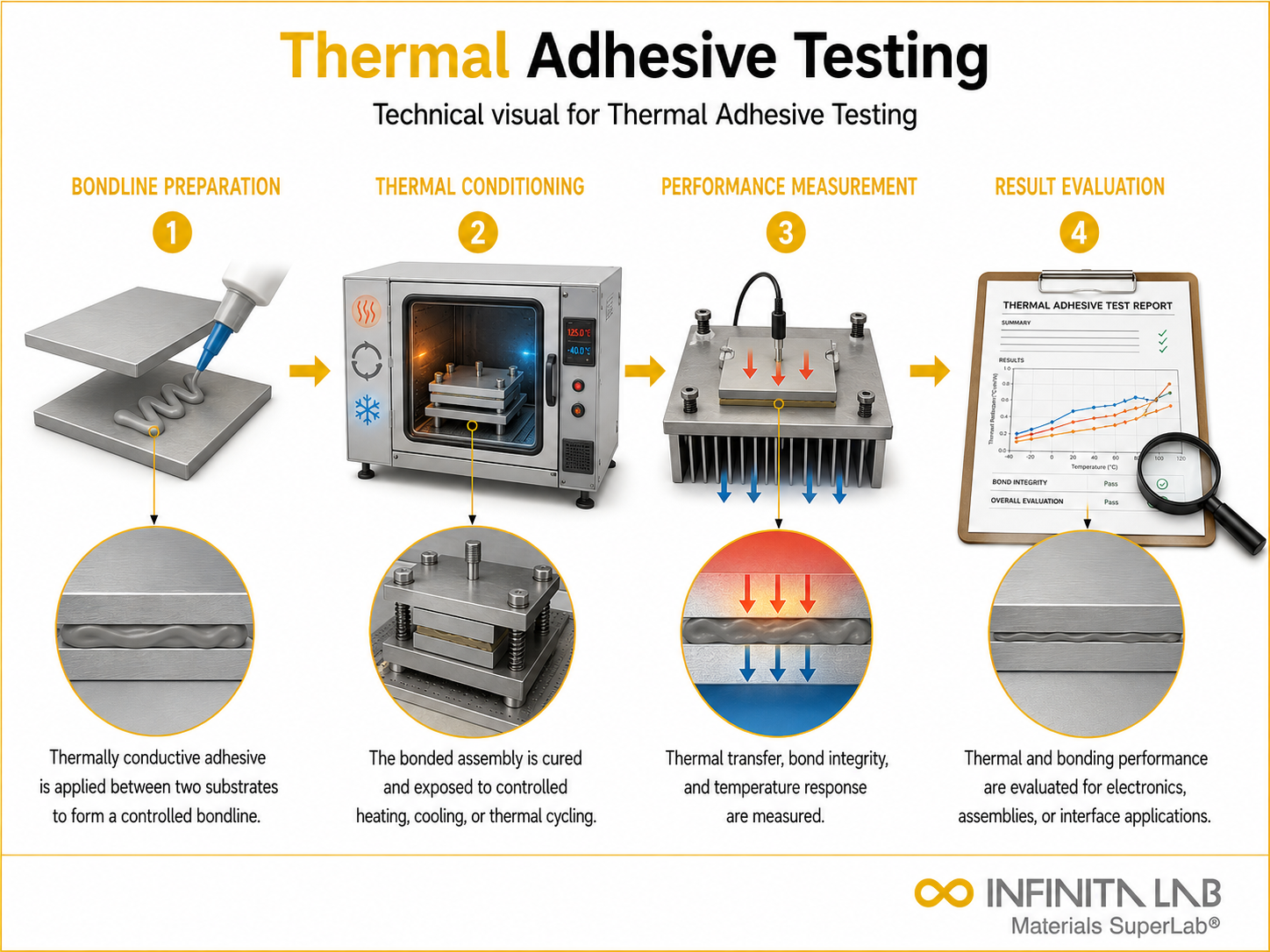
Our Testing Procedure
Baseline Testing
Bond specimens are tested at room temperature to establish baseline strength before any thermal exposure.
1Elevated Temperature Testing
Specimens are brought to the specified elevated temperature and tested while hot, or after a defined soak time
2Thermal Aging
Separate specimens are held at the maximum service temperature for the defined aging duration
3Thermal Cycling
Specimens are cycled between the high and low temperature extremes for the specified number of cycles
4Test parameters and requirements
| Parameter | Details |
|---|---|
| Test Temperatures | Defined by service requirements; typically from -55 degrees Celsius to +250 degrees Celsius depending on application |
| Thermal Cycling Profile | Temperature extremes, ramp rates, and dwell times defined per application or specification |
| Strength Test Methods | ASTM D1002 (lap shear), ASTM D897 (tensile), or other methods per specimen configuration |
| Thermal Aging Duration | Application-dependent; typically 100 to 1000 hours |
| Applicable Adhesive Types | Epoxy, acrylic, silicone, polyurethane, and other structural adhesive systems |
| Output | Strength vs. temperature curves, % strength retention after aging and cycling |


- Universal tensile or shear testing machine
- Environmental chamber with heating and cooling capability integrated with test machine
- Thermal cycling chamber for unloaded thermal fatigue specimens
- Thermocouple array for specimen temperature verification
- Dynamic mechanical analysis (DMA) instrument for glass transition temperature measurement
- Data acquisition software with temperature and force logging
Equipment and Instrumentation Used for Testing
What You Receive: Test Report, Data, and Certification
- Bond strength at room temperature, elevated temperature, and post-aging conditions
- Strength retention percentage relative to room temperature baseline
- Bond strength after defined thermal cycling durations
- Failure mode at each test condition (adhesive, cohesive, or substrate failure)
- Glass transition temperature of the cured adhesive where measured
- Quality assurance documentation
Thermal Adhesive FAQs
Thermal adhesive testing evaluates how an adhesive performs when exposed to elevated or cyclic temperatures. It helps determine whether the bond retains its strength and integrity under expected service conditions.
Thermal adhesive testing is widely used in the automotive, aerospace, electronics, construction, and medical industries, where bonded components are routinely exposed to temperature variations.
Depending on the test method, properties such as bond strength, thermal stability, heat resistance, shear strength, peel strength, and failure mode can be assessed before and after thermal exposure.
Yes. Repeated heating and cooling can induce thermal stresses, leading to bond degradation, cracking, delamination, or reduced adhesion, particularly between materials with different thermal expansion rates.
Why Choose Infinita Lab for Thermal Adhesive Testing
At the core of this breadth is our network of 2,000+ accredited laboratories across the USA, offering access to over 10,000 testing methods and analytical services. From advanced materials characterization (SEM, TEM, RBS, XPS) to mechanical, chemical, environmental, biological, and standardized ASTM/ISO-compliant testing, we deliver unmatched flexibility, specialization, and scale. You are never limited by geography, facility, or methodology — Infinita Lab connects you to the right expertise and testing solution, every time.

Looking for an Accredited Partner for Thermal Adhesive Testing?
Send query us at hello@infinitalab.com or call us at (888) 878-3090 to learn more about our services and how we can support you.



Request a Quote
Submit your material details and receive testing procedures, pricing, and turnaround time within 24 hours.
 Quick Turnaround and Hasslefree process
 Confidentiality Guarantee
 Free, No-obligation Consultation
 100% Customer Satisfaction
