


Stain Resistance Guide Testing Services
Stains can be a frustrating and unsightly problem, particularly when they occur on materials or surfaces that are difficult to clean or replace. Whether it's a spilled glass of red wine on a white carpet or a coffee stain on a favorite shirt, stains can be tough to remove and can leave lasting marks. This is where the concept of stain resistance comes into play, offering a solution to this problem.
TRUSTED BY


Get compliant results — request your stain resistance guide testing quote
- Overview
- Scope, Applications, and Benefits
- Test Process
- Specifications
- Instrumentation
- Results and Deliverables
What Is Stain Resistance Guide?
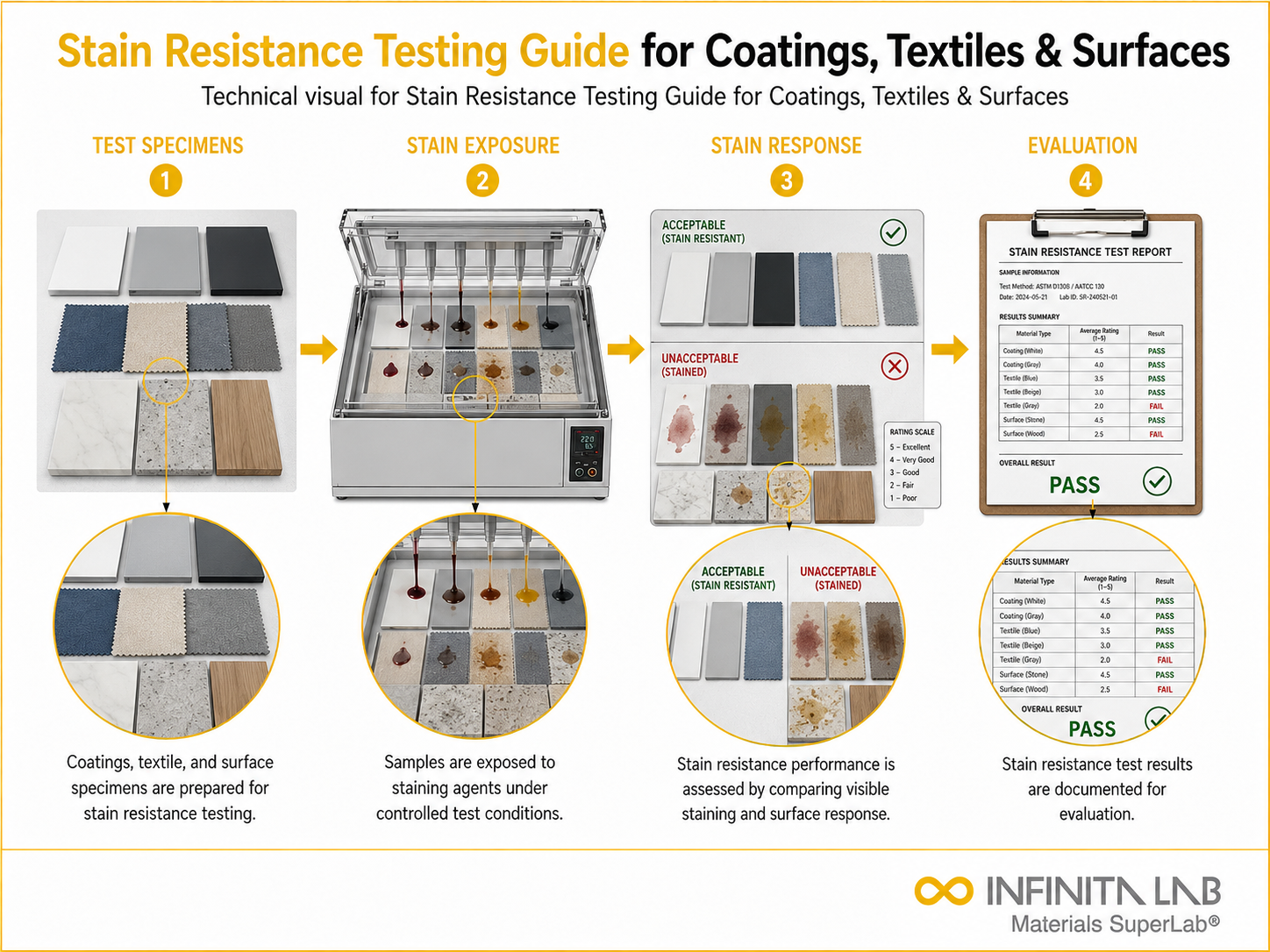
Stain resistance testing evaluates a material’s ability to resist discoloration or contamination when exposed to staining substances such as liquids, oils, dyes, and chemicals. It is an important property for textiles, coatings, plastics, and consumer products where appearance and cleanliness must be maintained.
The testing involves applying standardized staining agents to the material and assessing penetration, adhesion, and ease of removal. Results help determine how well a material repels stains or releases them during cleaning, supporting product performance evaluation and material development.

Applications and Benefits of Stain Resistance Guide Testing
Scope
Stain resistance testing evaluates:
- Resistance to liquid and oil-based stains
- Surface absorption and penetration behavior
- Stain removal and cleanability
- Discoloration and surface damage
- Effectiveness of coatings or treatments
Applications
- Textile and apparel fabrics
- Upholstery and furniture materials
- Coatings, paints, and finishes
- Automotive interiors
- Consumer products and packaging
Benefits
- Textile and apparel fabrics
- Upholstery and furniture materials
- Coatings, paints, and finishes
- Automotive interiors
- Consumer products and packaging
Stain Resistance Test Process
Sample Preparation
Specimen is conditioned and prepared according to standard size and environment.
1Stain Application
Standard staining agents (oil, dye, food, chemicals) are applied to the surface.
2Exposure Time
Stains are allowed to penetrate for a specified duration under controlled conditions.
3Cleaning & Evaluation
Stains are cleaned and residual discoloration is visually or instrumentally rated.
4Stain Resistance Technical Specifications
| Parameter | Details |
|---|---|
| Standards | AATCC 175, AATCC 118, ASTM D1308 |
| Staining Agents | Food dyes, oils, ink, chemicals |
| Evaluation Method | Visual rating scale or instrumental analysis |
| Rating Scale | Typically 1 (severe staining) to 10 (no staining) |
| Sample Type | Textiles, coatings, plastics |
| Measured Outputs | Stain resistance rating, cleanability |


- Stain application tools (pipettes, droppers)
- Controlled environment chamber
- Cleaning and washing setup
- Optical evaluation system
- Spectrophotometer (for color measurement)
- Rating scales and reference standards
Equipment and Instrumentation Used for Testing
What You Receive: Test Report, Data, and Certification
- Stain resistance rating (visual scale)
- Degree of discoloration and penetration
- Cleanability and stain removal performance
- Comparative material analysis
- Performance evaluation report
Stain Resistance Guide FAQs
Stain resistance testing evaluates how well a material resists staining from liquids, oils, or chemicals and how easily stains can be removed, helping assess durability and cleanliness performance in real-world conditions.
Common standards include AATCC 175 for textile staining, AATCC 118 for oil repellency, and ASTM D1308 for chemical resistance, ensuring consistent and comparable evaluation across materials.
Typical stains include food dyes, oils, ink, beverages, and chemicals, selected based on the intended application of the material to simulate real-life exposure conditions.
Results are evaluated using visual rating scales or instrumental color measurement, comparing the stained sample with original reference to determine the level of discoloration and stain removal effectiveness.
It ensures materials maintain appearance and performance over time, reduces maintenance effort, and helps manufacturers develop products with improved durability and resistance to everyday staining conditions.
Why Choose Infinita Lab for Stain Resistance Guide Testing
At the core of this breadth is our network of 2,000+ accredited laboratories across the USA, offering access to over 10,000 testing methods and analytical services. From advanced materials characterization (SEM, TEM, RBS, XPS) to mechanical, chemical, environmental, biological, and standardized ASTM/ISO-compliant testing, we deliver unmatched flexibility, specialization, and scale. You are never limited by geography, facility, or methodology — Infinita Lab connects you to the right expertise and testing solution, every time.

Looking for an Accredited Partner for Stain Resistance Guide Testing?
Send query us at hello@infinitalab.com or call us at (888) 878-3090 to learn more about our services and how we can support you.



Request a Quote
Submit your material details and receive testing procedures, pricing, and turnaround time within 24 hours.
 Quick Turnaround and Hasslefree process
 Confidentiality Guarantee
 Free, No-obligation Consultation
 100% Customer Satisfaction
