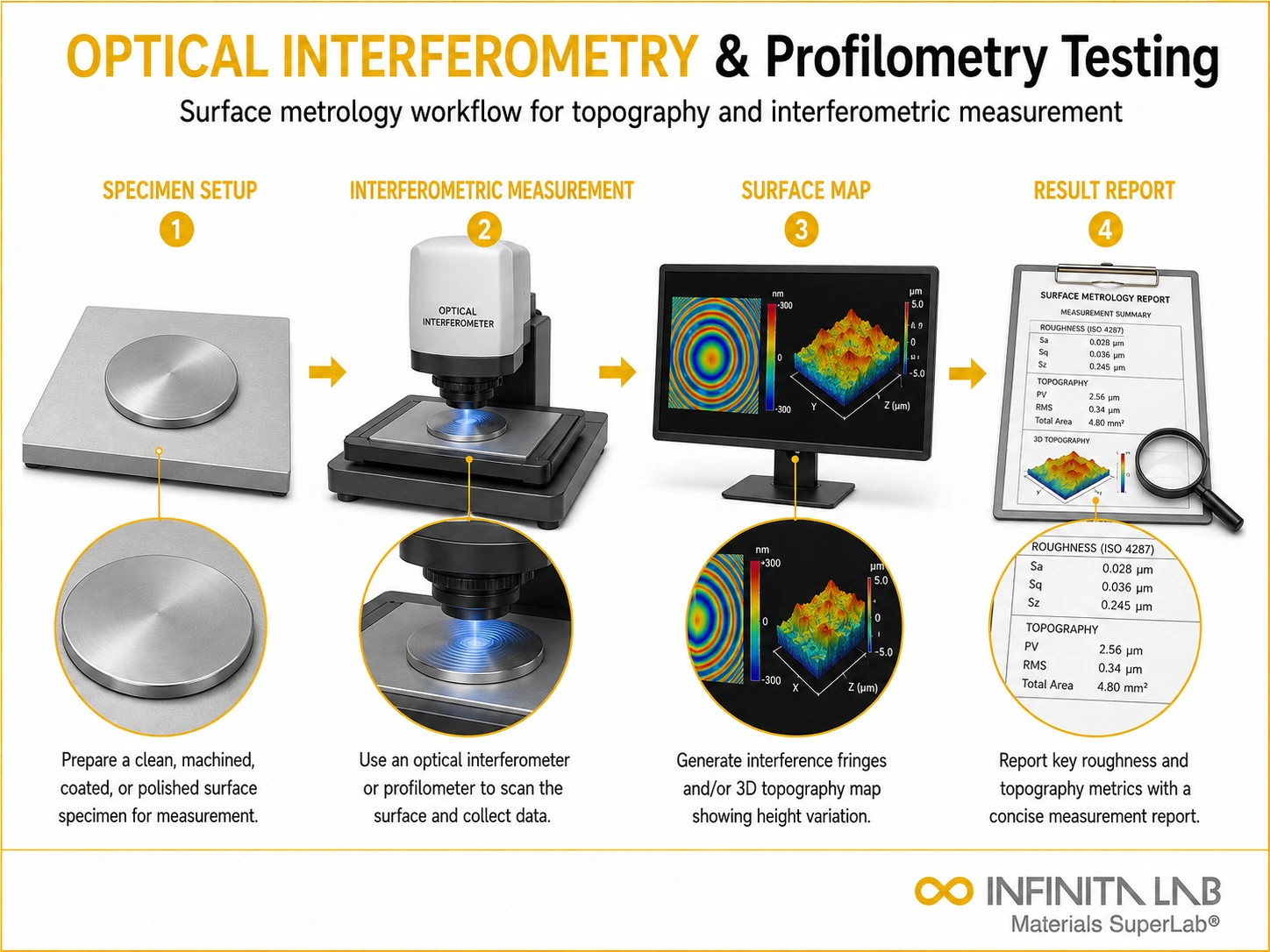


What Is Optical Interferometry Profilometry?
Optical interferometry and profilometry are advanced non-contact techniques used to measure surface topography, roughness, and dimensional features with extremely high precision. These methods utilize the interference of light waves to generate detailed surface maps, enabling nanometer-scale resolution for evaluating fine surface characteristics.
By analyzing phase differences in reflected light, interferometric systems create accurate 3D surface profiles without physically contacting the sample. This makes the technique ideal for delicate, polished, or micro-scale components. It is widely used to assess surface finish, detect defects, and ensure dimensional accuracy in high-precision manufacturing and research applications.

Applications and Benefits of Optical Interferometry Profilometry Testing
Scope
Optical interferometry and profilometry focus on high-resolution surface characterization and dimensional analysis of materials, enabling precise evaluation of surface features under controlled optical measurement conditions.
It includes measurement of surface roughness, step height, waviness, and micro-geometry using non-contact optical methods, ensuring minimal sample disturbance and high repeatability across a wide range of materials and finishes.
- Measurement of surface roughness and texture parameters
- Evaluation of step height and thin film thickness variations
- Analysis of surface waviness and micro-topography
- Detection of surface defects such as scratches and pits
- Characterization of precision-engineered and polished surfaces
- Comparative analysis of surface treatments and coatings
- Assessment of micro-scale dimensional accuracy
- Monitoring of manufacturing process consistency
Applications
- Semiconductor and microelectronics surface analysis
- Optical component quality inspection
- Precision machining and finishing evaluation
- Thin film and coating thickness measurement
- Biomedical device surface characterization
- Research and nanotechnology development
Benefits
- Non-contact measurement prevents surface damage
- Extremely high resolution at nanometer scale
- Accurate 3D surface mapping and visualization
- Suitable for delicate and soft materials
- High repeatability and measurement precision
- Enables detection of micro-level defects
Our Testing Procedure
Sample Preparation & Positioning
The sample is cleaned and precisely positioned on the measurement stage to ensure stable optical alignment.
1Optical Scanning & Interference Generation
Light is directed onto the surface to generate interference patterns based on surface variations.
2Data Acquisition & Surface Mapping
Interference data is captured and processed to generate high-resolution 3D surface profiles.
3Analysis & Parameter Extraction
Surface parameters such as roughness, step height, and waviness are calculated from the generated data.
4Test parameters and requirements
| Parameter | Details |
|---|---|
| Measurement Method | Optical interferometry using white light or laser-based systems |
| Measurement Type | Surface topography, roughness, and step height analysis |
| Resolution | Nanometer to sub-nanometer vertical resolution |
| Lateral Resolution | Micrometer range depending on optical system |
| Measurement Area | Adjustable field of view based on magnification |
| Sample Type | Polished surfaces, coatings, thin films, and micro-components |
| Measurement Units | nm (roughness), µm (step height), 3D surface maps |


- Optical interferometer
- White light profilometer
- Laser profilometer
- Vibration isolation table
- Precision sample stage
- Data analysis software
Equipment and Instrumentation Used for Testing
What You Receive: Test Report, Data, and Certification
- 3D surface topography maps
- Surface roughness parameters (Ra, Rq, Rz)
- Step height and thickness measurements
- Surface defect identification
- High-resolution images and analysis report
- Interpretation of surface quality and performance
Optical Interferometry Profilometry FAQs
It relies on interference between reference and reflected light beams. Phase differences are precisely calculated to determine surface height variations, enabling measurement resolution at nanometer or sub-nanometer levels without physical contact.
Interferometry uses light and is non-contact, offering higher vertical resolution and no surface damage. Stylus profilometry uses a physical probe, which may affect soft surfaces and typically provides lower resolution.
Interference patterns are highly sensitive to movement. Even minor vibrations can distort phase data, causing measurement errors, so vibration isolation is essential for maintaining accuracy and repeatability.
White light interferometry uses broadband light for high vertical resolution and reduced ambiguity, while laser interferometry provides higher coherence but may struggle with discontinuous or rough surfaces.
It measures roughness (Ra, Rq), waviness, step height, and texture, providing a comprehensive understanding of surface characteristics and functional performance.
Why Choose Infinita Lab for Optical Interferometry Profilometry Testing?
At the core of this breadth is our network of 2,000+ accredited laboratories across the USA, offering access to over 10,000 testing methods and analytical services. From advanced materials characterization (SEM, TEM, RBS, XPS) to mechanical, chemical, environmental, biological, and standardized ASTM/ISO-compliant testing, we deliver unmatched flexibility, specialization, and scale. You are never limited by geography, facility, or methodology — Infinita Lab connects you to the right expertise and testing solution, every time.

Looking for an Accredited Partner for Optical Interferometry Profilometry Testing?
Send query us at hello@infinitalab.com or call us at (888) 878-3090 to learn more about our services and how we can support you.





