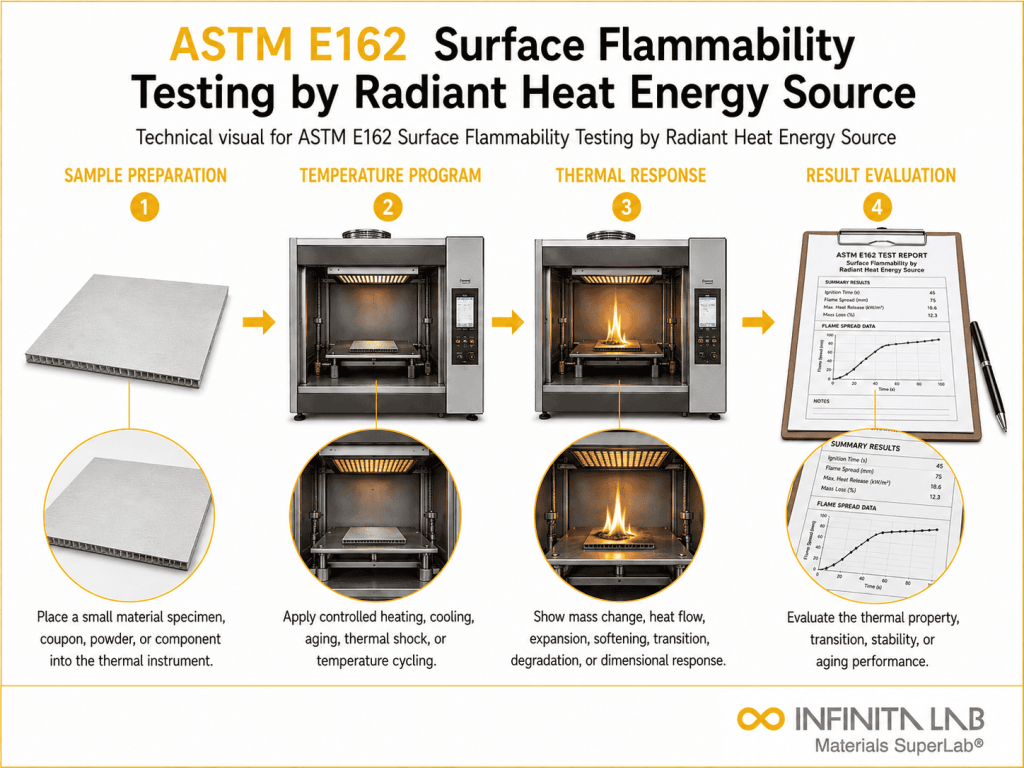


What Is ASTM E162 Radiant Heat Surface Flammability?
ASTM E162 provides a test method for evaluating the surface flammability of materials when exposed to a radiant heat energy source. The test measures how easily a material ignites and how flame spreads across its surface under controlled conditions.
This standard is widely used in building, transportation, and materials industries to assess fire performance and ensure safety compliance.
Applications and Benefits of ASTM E162 Radiant Heat Surface Flammability Testing
Scope
ASTM E162 focuses on determining the flammability characteristics of materials by measuring flame spread and heat release when exposed to radiant heat. It provides a comparative evaluation of fire performance.
The test evaluates:
- Flame spread behavior
- Ignition characteristics
- Heat release rate
- Surface burning properties
- Fire performance index
Applications
- Building and construction materials
- Interior finishes and panels
- Transportation materials (rail, aircraft)
- Insulation and composites
- Fire safety testing laboratories
Benefits
- Improves fire safety evaluation
- Supports regulatory compliance
- Helps in material selection
- Provides comparative flammability data
- Enhances product reliability
Our ASTM E162 Testing Procedure
Sample Preparation
Material specimen is prepared and mounted.
1Radiant Heat Exposure
Sample is exposed to a controlled radiant heat source.
2Ignition and Flame Spread
Ignition and flame propagation are observed.
3Data Recording & Evaluation
Flame spread index is calculated and analyzed.
4ASTM E162 Test Parameters and Requirements
| Parameter | Details |
|---|---|
| Applicable Materials | Solid materials and composites |
| Heat Flux Range | Typically up to ~50 kW/m² |
| Orientation | Inclined specimen setup |
| Ignition Source | Pilot flame |
| Test Temperature | Controlled radiant heat exposure |
| Flame spread index, ignition time | Flame spread index, ignition time |


- Radiant panel furnace
- Specimen holder (inclined)
- Pilot flame source
- Heat flux measurement system
- Temperature sensors
- Data acquisition system
Equipment and Instrumentation Used for ASTM E162 Testing
What You Receive: Test Report, Data, and Certification
- Flame spread index
- Ignition behavior analysis
- Fire performance classification
- Test condition summary
- ASTM compliance report
ASTM E162 Radiant Heat Surface Flammability FAQs
ASTM E162 is a standard test method used to evaluate surface flammability of materials using a radiant heat energy source, measuring flame spread and heat release characteristics.
ASTM E162 is important because it helps determine how materials behave under fire exposure, supporting safety compliance in building, transportation, and industrial applications where fire risk is critical.
ASTM E162 exposes a material to radiant heat and ignition source, then measures flame spread rate and heat release to evaluate flammability characteristics.
ASTM E162 requires a radiant panel apparatus, ignition source, specimen holder, and measurement instruments to record flame spread and heat release parameters.
Results are reported as flame spread index and heat release parameters, indicating material flammability and helping determine compliance with fire safety standards.
ASTM E162-13 evaluates the surface flammability of materials when exposed to controlled radiant heat energy. A prepared specimen is mounted at an inclined angle in front of a gas-fired radiant heat panel. A pilot flame ignites the specimen near its upper edge, allowing the flame front to travel downward across the material. During testing, the flame spread rate and heat evolution are measured and combined to calculate the Radiant Panel Index. This test helps compare the surface-burning characteristics of materials used in transportation, construction, and industrial applications.
The ASTM E162 radiant panel flame spread test measures how quickly flames travel across a material's surface under controlled radiant heat exposure. A conditioned specimen is positioned at an angle in front of a radiant panel and exposed to a pilot flame. The movement of the flame front is monitored, while the heat released during combustion is evaluated. These measurements are used to determine the flame spread factor and heat evolution factor, which are multiplied to calculate the Radiant Panel Index. A lower index generally indicates lower surface flammability under the specified test conditions.
Radiant panel testing evaluates how materials respond to external radiant heat and flame exposure. A representative specimen is mounted in a specialized test apparatus at a specified angle and exposed to controlled radiant energy. An ignition source initiates combustion, and laboratory instruments monitor flame propagation and heat release. Depending on the applicable test standard, the results are used to calculate flame spread characteristics or other fire-response measurements. These results help manufacturers compare material performance and assess suitability for applications requiring fire-performance evaluation.
Why Choose Infinita Lab for Radiant Heat Surface Flammability Testing
When your Radiant Heat Surface Flammability results have to hold up - for compliance, a customer audit, or an engineering decision - ASTM E162 accuracy and an unbiased third-party report matter more than price. Infinita Lab routes your ASTM E162 radiant heat surface flammability testing to ISO/IEC 17025-accredited U.S. partner labs with hands-on method experience, so you get defensible data, transparent reporting, and turnaround times built around your project deadline - not ours.

Need ASTM E162 Radiant Heat Surface Flammability Testing You Can Rely On?
Send query us at hello@infinitalab.com or call us at (888) 878-3090 to learn more about our services and how we can support you.