


Spectrophotometry Testing Services
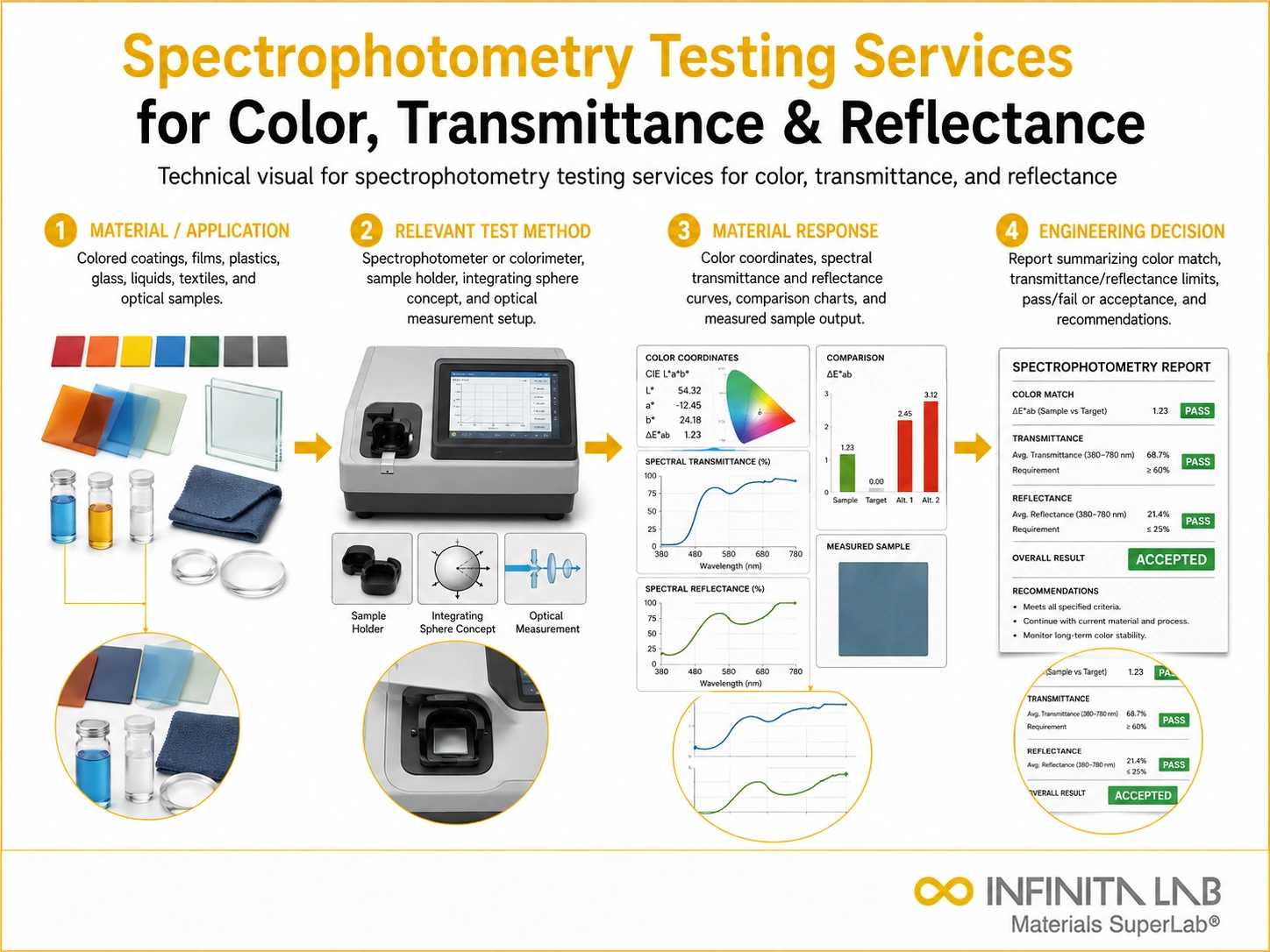
Spectrophotometry measures how a material absorbs, transmits, or reflects light across UV, visible, and infrared wavelengths — giving you quantitative data on concentration, composition, color, and optical properties. Infinita Lab provides UV-Vis and UV-Vis-NIR spectrophotometry testing for chemicals, pharmaceuticals, coatings, polymers, food products, and environmental samples per ASTM E275 and application-specific protocols. Results are delivered as absorbance/transmittance spectra with concentration or optical property analysis.
TRUSTED BY


Get compliant results — request your spectrophotometry testing quote
- Overview
- Scope, Applications, and Benefits
- Test Process
- Specifications
- Instrumentation
- Results and Deliverables
What Is Spectrophotometry?
Spectrophotometry testing is an analytical technique used to measure how materials absorb, transmit, or reflect light across different wavelengths. It is widely used for quantitative analysis of chemical substances, enabling accurate determination of concentration, composition, and optical properties.
The technique operates on the interaction of light with matter, in which specific wavelengths are absorbed depending on molecular structure. By measuring light intensity before and after passing through a sample, spectrophotometry provides precise data for applications in chemistry, pharmaceuticals, environmental analysis, and materials science.

Applications and Benefits of Spectrophotometry Testing
Scope
Spectrophotometry testing evaluates:
- Absorbance and transmittance of light
- Concentration of chemical substances
- Optical properties of materials
- Color and reflectance characteristics
- Chemical composition and purity
Applications
- Chemical and pharmaceutical analysis
- Environmental testing (water, air pollutants)
- Food and beverage quality control
- Polymer and material characterization
- Clinical and biochemical analysis
Benefits
- Accurate quantitative analysis of substances
- Non-destructive and rapid testing
- High sensitivity and precision
- Suitable for a wide range of materials
- Supports quality control and research applications
Our Testing Procedure
Sample Preparation
Sample is prepared in liquid, solid, or gas form and placed in a cuvette or holder.
1Light Exposure
A beam of light of selected wavelength is passed through or reflected from the sample.
2Measurement
Detector measures transmitted, absorbed, or reflected light intensity.
3Data Analysis
Absorbance or transmittance values are used to calculate concentration and properties.
4Test parameters and requirements
| Parameter | Details |
|---|---|
| Standards | ASTM E275, ISO 17025 (analytical methods) |
| Spectral Range | ~190 nm to 2500 nm (UV–Vis–IR) |
| Measurement Modes | Absorbance, transmittance, reflectance |
| Sample Type | Liquids, solids, gases |
| Detection Method | Photodiode / CCD detector |
| Measured Outputs | Concentration, optical properties, color |


- UV-Visible spectrophotometer
- Infrared (IR) spectrophotometer
- Light source (deuterium, tungsten, xenon)
- Monochromator (prism or diffraction grating)
- Sample cuvettes or holders
- Data acquisition and analysis software
Equipment and Instrumentation Used for Testing
What You Receive: Test Report, Data, and Certification
- Absorbance or transmittance spectra
- Concentration of analytes
- Optical property analysis
- Color and reflectance data
- Comparative material evaluation
- Test report
Spectrophotometry FAQs
Spectrophotometry testing measures how much light a substance absorbs, transmits, or reflects at different wavelengths, helping determine concentration, composition, and optical properties for various scientific and industrial applications.
It is based on the interaction of light with matter, where specific wavelengths are absorbed depending on molecular structure, and the measured absorbance is proportional to concentration according to Beer-Lambert law.
Liquids, gases, transparent solids, and even opaque materials (via reflectance) can be tested to determine chemical composition, color properties, and concentration of substances across different industries.
Industries such as pharmaceuticals, environmental monitoring, food processing, chemicals, biotechnology, and materials science use spectrophotometry for analysis, quality control, and research applications.
It provides accurate, fast, and non-destructive analysis of materials, enabling precise measurement of concentration and composition, which is essential for quality control, research, and product development.
Why Choose Infinita Lab for Spectrophotometry Testing
At the core of this breadth is our network of 2,000+ accredited laboratories across the USA, offering access to over 10,000 testing methods and analytical services. From advanced materials characterization (SEM, TEM, RBS, XPS) to mechanical, chemical, environmental, biological, and standardized ASTM/ISO-compliant testing, we deliver unmatched flexibility, specialization, and scale. You are never limited by geography, facility, or methodology — Infinita Lab connects you to the right expertise and testing solution, every time.

Looking for an Accredited Partner for Spectrophotometry Testing?
Send query us at hello@infinitalab.com or call us at (888) 878-3090 to learn more about our services and how we can support you.



Request a Quote
Submit your material details and receive testing procedures, pricing, and turnaround time within 24 hours.
 Quick Turnaround and Hasslefree process
 Confidentiality Guarantee
 Free, No-obligation Consultation
 100% Customer Satisfaction
