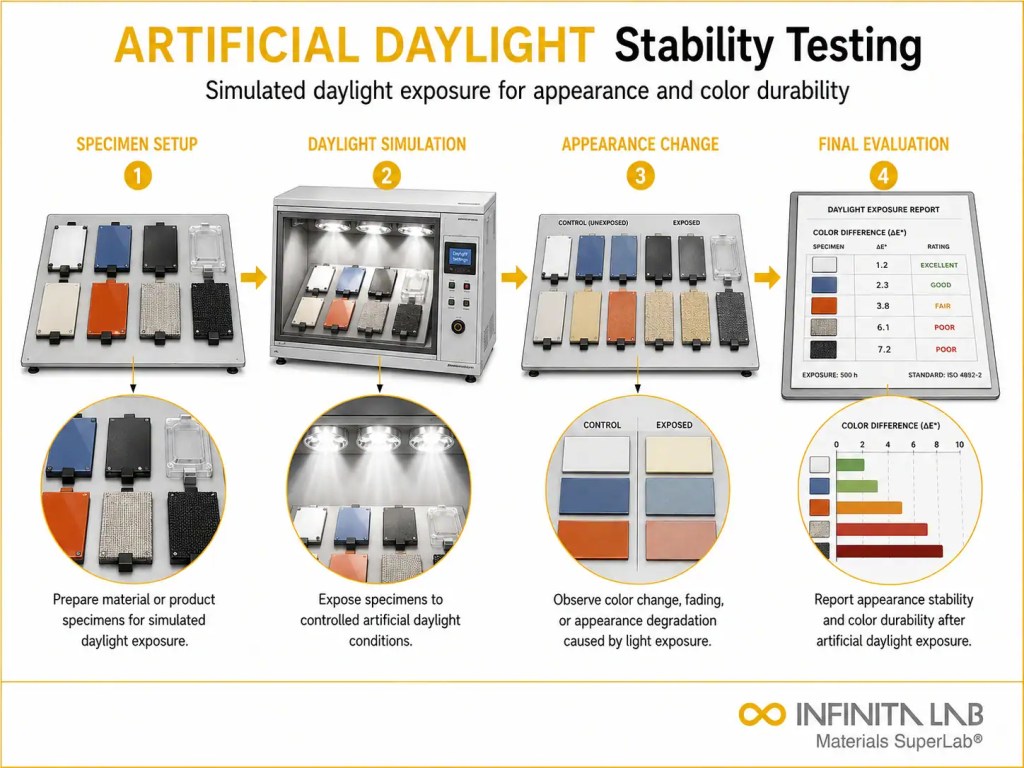


What Is Artificial Daylight Stability?
Artificial Daylight Stability Testing evaluates how materials, products, or coatings respond to simulated daylight exposure over time. It helps determine resistance to fading, discoloration, and degradation when exposed to controlled light sources that replicate natural sunlight conditions.
This testing is widely used in textiles, plastics, paints, and coatings industries to assess colorfastness and durability. By simulating long-term light exposure in a controlled environment, it enables manufacturers to predict product lifespan and ensure compliance with quality and performance standards.
Applications and Benefits of Artificial Daylight Stability Testing
Scope
Artificial daylight stability testing assesses the resistance of materials to color change and degradation under simulated daylight conditions using controlled light sources.
- Applicable to textiles, plastics, coatings, and pigments
- Evaluates colorfastness and light stability
- Simulates natural daylight exposure
- Supports product durability assessment
- Ensures compliance with ASTM, ISO, and AATCC standards
Applications
- Textile colorfastness to light testing
- Paint and coating durability evaluation
- Plastic material stability assessment
- Automotive interior material testing
- Packaging material performance analysis
Benefits
- Predicts long-term light exposure effects
- Improves product durability and quality
- Reduces risk of fading and discoloration
- Supports compliance with international standards
- Enhances customer satisfaction and reliability
Our Testing Procedure
Sample Preparation
Samples are conditioned and mounted for uniform exposure to artificial daylight.
1Exposure Setup
Samples are placed in a light exposure chamber with controlled intensity and conditions.
2Light Exposure
Materials are exposed to simulated daylight for a specified duration.
3Evaluation
Changes in color or properties are assessed and compared with standards.
4Test parameters and requirements
| Parameter | Details |
|---|---|
| Light source | Xenon arc lamp or equivalent daylight simulator |
| Wavelength range | UV, visible, and near-infrared spectrum |
| Exposure time | Hours to weeks depending on requirement |
| Measurement | Color change, fading, degradation |
| Environment | Controlled temperature and humidity |
| Sample type | Textiles, plastics, coatings, pigments |
| Output | Colorfastness ratings and degradation data |


- Xenon arc weathering tester
- Light exposure chamber
- Spectrophotometer for color measurement
- Environmental control system (temperature/humidity)
- Sample mounting frames
Equipment and Instrumentation Used for Testing
What You Receive: Test Report, Data, and Certification
- Colorfastness ratings
- Degree of fading or discoloration
- Comparative analysis with standards
- Performance evaluation report
- Compliance and certification documentation
Artificial Daylight Stability FAQs
Artificial daylight stability testing evaluates how materials respond to simulated sunlight exposure. It measures fading, discoloration, and degradation under controlled light conditions to predict long-term performance and durability of products.
This testing is important because exposure to sunlight can degrade materials over time. It helps manufacturers ensure products maintain color, strength, and appearance throughout their intended lifespan.
Factors include light intensity, exposure duration, temperature, humidity, and sample properties. Proper control of these parameters ensures accurate and repeatable results.
Color change is measured using grey scale ratings or spectrophotometers. These methods provide visual and quantitative assessment of fading and discoloration after exposure.
Materials such as textiles, plastics, paints, coatings, and pigments can be tested. These materials are often exposed to light and require evaluation for color stability and durability.
Why Choose Infinita Lab for Artificial Daylight Stability Testing?
When your Artificial Daylight Stability results have to hold up - for compliance, a customer audit, or an engineering decision - accuracy and an unbiased third-party report matter more than price. Infinita Lab routes your artificial daylight stability testing to ISO/IEC 17025-accredited U.S. partner labs with hands-on method experience, so you get defensible data, transparent reporting, and turnaround times built around your project deadline - not ours.

Looking for an Accredited Partner for Artificial Daylight Stability Testing?
Send query us at hello@infinitalab.com or call us at (888) 878-3090 to learn more about our services and how we can support you.



