


Solar Radiation Testing Services
Solar radiation testing involves understanding the thermal and photochemical degradation effects of sunlight on materials and components.
TRUSTED BY


Get compliant results — request your solar radiation testing quote
- Overview
- Scope, Applications, and Benefits
- Test Process
- Specifications
- Instrumentation
- Results and Deliverables
What Is Solar Radiation?
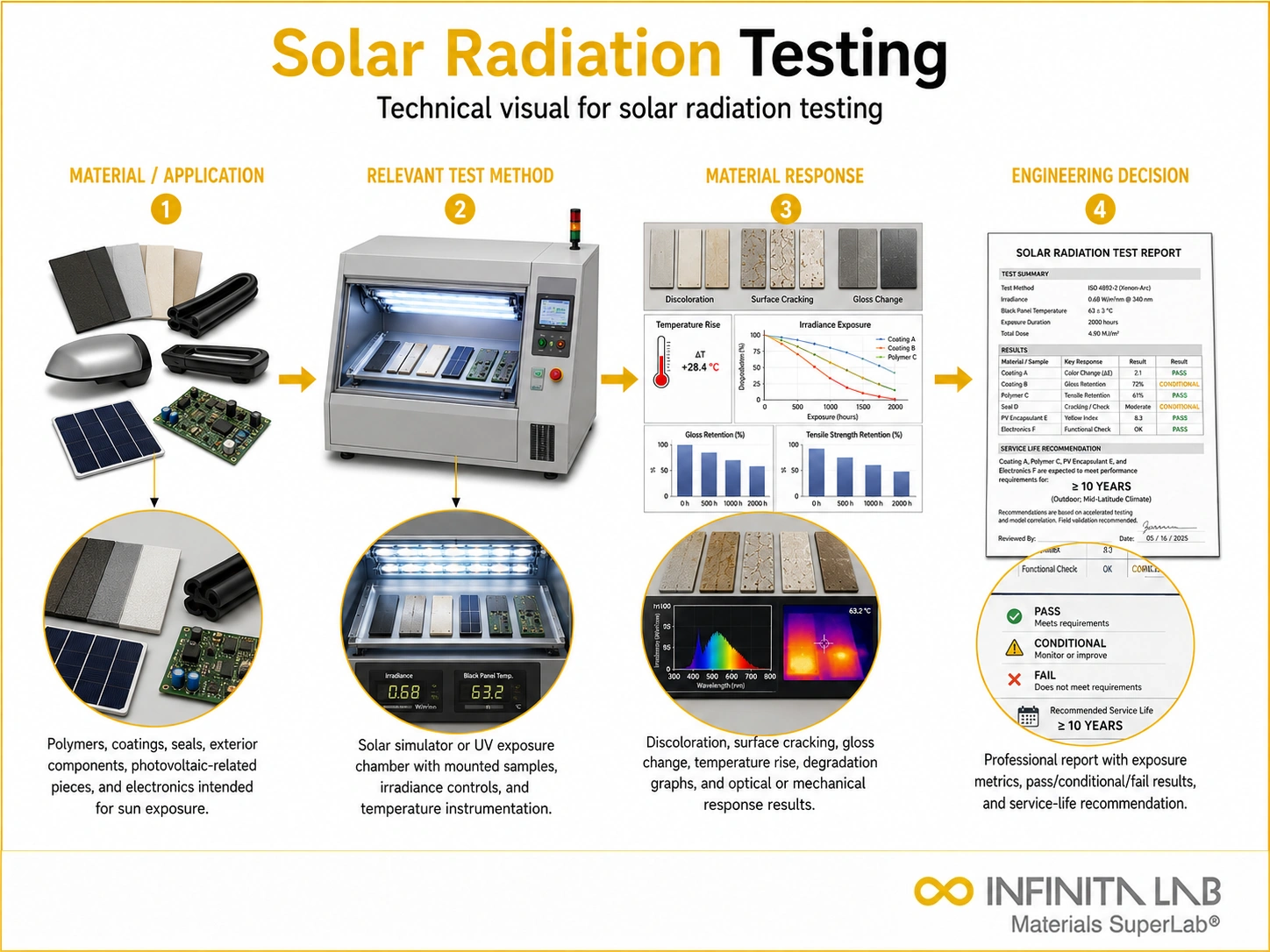
Solar radiation testing evaluates how products and materials respond to the intense sunlight they will encounter in outdoor service – both the heating it causes and the photochemical degradation it drives over time. Sunlight delivers energy across the ultraviolet, visible, and infrared regions, and each part of the spectrum has different effects: the infrared and visible portions heat the product (the “solar load”), raising internal temperatures well above ambient, while the ultraviolet portion drives actinic (photochemical) degradation that fades colors, embrittles plastics, chalks coatings, and degrades elastomers. Solar radiation testing reproduces these effects in a controlled chamber so they can be assessed before a product is deployed.
The principal standard is MIL-STD-810 Method 505, which defines two distinct purposes. The first is the heating (solar load) effect – using a realistic spectrum and a steady or cyclic intensity to determine the elevated temperatures sunlight produces inside and on a product, which can exceed what air temperature alone would cause and affect function and safety. The second is the actinic (photodegradation) effect – longer exposure to assess the cumulative chemical and physical deterioration of materials caused chiefly by the UV content of sunlight.
Solar radiation testing is distinct from, but related to, accelerated weathering tests (such as xenon-arc per ASTM D4459/G155). Method 505 uses a spectrum closely matching natural sunlight and is oriented toward equipment qualification – particularly military, aerospace, and outdoor products – for both the thermal solar load and the degradation effects, whereas accelerated weathering tests focus on long-term material durability and often use intensified or filtered sources.

Applications and Benefits of Solar Radiation Testing
Scope
Solar radiation testing covers the controlled exposure of products and materials to a simulated solar spectrum in an environmental chamber, to evaluate both the heating (solar load) effect and the actinic (photodegradation) effect, principally per MIL-STD-810 Method 505.
Key aspects of the test scope include:
- Heating (solar load) procedure – applying a realistic solar spectrum at controlled intensity, typically in a diurnal (day/night) cycle, to determine the elevated temperatures produced in and on the product
- Actinic (steady-state) procedure – longer exposure emphasizing the UV-driven photochemical degradation of materials over time
- Solar spectrum – a source and filtering arranged to approximate the spectral distribution of natural sunlight across UV, visible, and infrared
- Intensity and cycling – controlled irradiance (commonly around 1120 W/m² peak for the standard cycle) applied steadily or in 24-hour cycles, with chamber temperature control
- Measured effects – internal/surface temperature rise (heating) and material changes such as fading, color change, embrittlement, cracking, chalking, and loss of properties (actinic)
- Related standards – MIL-STD-810 Method 505 (primary); related accelerated weathering standards (e.g., ASTM G155/D4459 xenon-arc) where long-term durability is the focus
Applications
- Military and defense equipment – qualifying equipment per MIL-STD-810 Method 505 for the solar environments it will face in deployment, both heating and degradation
- Aerospace – evaluating solar loading and UV degradation of aircraft and aerospace components and materials exposed to sunlight
- Outdoor electronics and enclosures – determining the internal temperature rise from solar heating in outdoor electronic enclosures, and the UV durability of their housings
- Automotive – assessing solar heating of interiors and components and the UV degradation of exterior and interior materials
- Polymers, coatings, and elastomers – evaluating fading, chalking, embrittlement, and property loss in materials exposed to the UV content of sunlight
- Textiles and consumer products – assessing color fastness and material durability of products used outdoors
- Product temperature/safety assessment – determining whether solar heating pushes a product beyond safe or functional temperature limits
Benefits
- Captures both heating and degradation – Method 505 addresses the two distinct solar effects (elevated temperature and photochemical degradation), so a single testing capability evaluates both how hot a product gets and how its materials deteriorate
- Realistic solar spectrum – using a spectrum matched to natural sunlight makes the results representative of true outdoor exposure rather than an arbitrary light source
- Reveals solar-load temperatures air-temperature testing misses – solar heating can drive product temperatures well above ambient; the test quantifies this, which plain temperature testing does not
- Identifies UV-vulnerable materials before deployment – actinic testing reveals fading, embrittlement, and property loss before products reach the field, guiding material selection and protection
- Supports equipment qualification – Method 505 results provide the evidence needed to qualify equipment for solar environments, particularly in military and aerospace programs
- Complements weathering and temperature programs – fits alongside accelerated weathering and temperature testing to build a complete picture of outdoor environmental durability
Our Testing Procedure
Define the Test
Select the solar exposure objective, irradiance, cycle, duration, and monitoring requirements.
1Establish the Baseline
Document the product’s appearance, material condition, and functional performance.
2Apply Solar Exposure
Expose the product to the specified solar spectrum while monitoring irradiance and temperature.
3Evaluate and Report
Inspect for fading, cracking, embrittlement, or functional changes and report the pass/fail outcome.
4Test parameters and requirements
| Parameter | Details |
|---|---|
| Procedures | Heating (solar load) and actinic (photodegradation) |
| Solar Spectrum | Simulated natural sunlight across UV, visible, infrared |
| Irradiance | Controlled (commonly ~1120 W/m² peak for the standard cycle) |
| Cycling | Steady-state or 24-hour diurnal cycle |
| Measured Effects | Solar-load temperature rise; material degradation (fading, embrittlement, chalking, cracking) |
| Chamber Control | Irradiance and temperature controlled and monitored |
| Product Types | Military, aerospace, automotive, outdoor electronics, polymers, coatings, textiles |


- Solar simulation environmental chamber with controlled-spectrum lamps
- Solar lamps/filters arranged to approximate the natural solar spectrum
- Irradiance (pyranometer/radiometer) measurement and control
- Temperature sensors (thermocouples) for surface/internal solar-load measurement
- Chamber temperature control system
- Functional monitoring equipment (for powered tests)
- Data acquisition and recording system
Equipment and Instrumentation Used for Testing
What You Receive: Test Report, Data, and Certification
- Solar radiation test report – the procedure, spectrum, irradiance, cycle, and duration applied, with the measured results documented
- Solar-load temperature data – surface and internal temperatures recorded through the cycle for the heating procedure, against any limits
- Material degradation findings – documented fading, color change, embrittlement, cracking, chalking, or property loss from the actinic exposure
- Functional results (where applicable) – product performance during and after exposure for operating tests
- Pass/fail determination – outcome against the applicable Method 505 requirement or specification
- Photographic documentation – before/after images of the product and materials showing any visible changes
- Test conditions record – irradiance, spectrum, cycle, chamber temperature, and instrumentation locations
Solar Radiation FAQs
Continuous sunlight exposure can damage materials and increase product temperatures during service. Testing helps verify durability, functionality and suitability for outdoor or high-solar-load environments.
Testing is commonly performed on aerospace equipment, automotive components, electronics, coatings, plastics, textiles and outdoor products. Military and transportation equipment may also require solar exposure qualification.
The specimen is placed inside a controlled chamber and exposed to a calibrated solar-simulation system. Radiation intensity, spectrum, chamber temperature and exposure duration are controlled according to the test procedure.
Testing may reveal fading, embrittlement, coating deterioration, seal degradation, deformation and overheating. Functional products are also monitored for electrical or mechanical performance changes.
Solar radiation testing reproduces a broader sunlight spectrum and evaluates both photochemical and heating effects. UV testing concentrates mainly on degradation caused by ultraviolet wavelengths.
Why Choose Infinita Lab for Solar Radiation Testing?
At the core of this breadth is our network of 2,000+ accredited laboratories across the USA, offering access to over 10,000 testing methods and analytical services. From advanced materials characterization (SEM, TEM, RBS, XPS) to mechanical, chemical, environmental, biological, and standardized ASTM/ISO-compliant testing, we deliver unmatched flexibility, specialization, and scale. You are never limited by geography, facility, or methodology — Infinita Lab connects you to the right expertise and testing solution, every time.

Looking for an Accredited Partner for Solar Radiation Testing?
Send query us at hello@infinitalab.com or call us at (888) 878-3090 to learn more about our services and how we can support you.



Request a Quote
Submit your material details and receive testing procedures, pricing, and turnaround time within 24 hours.
 Quick Turnaround and Hasslefree process
 Confidentiality Guarantee
 Free, No-obligation Consultation
 100% Customer Satisfaction
