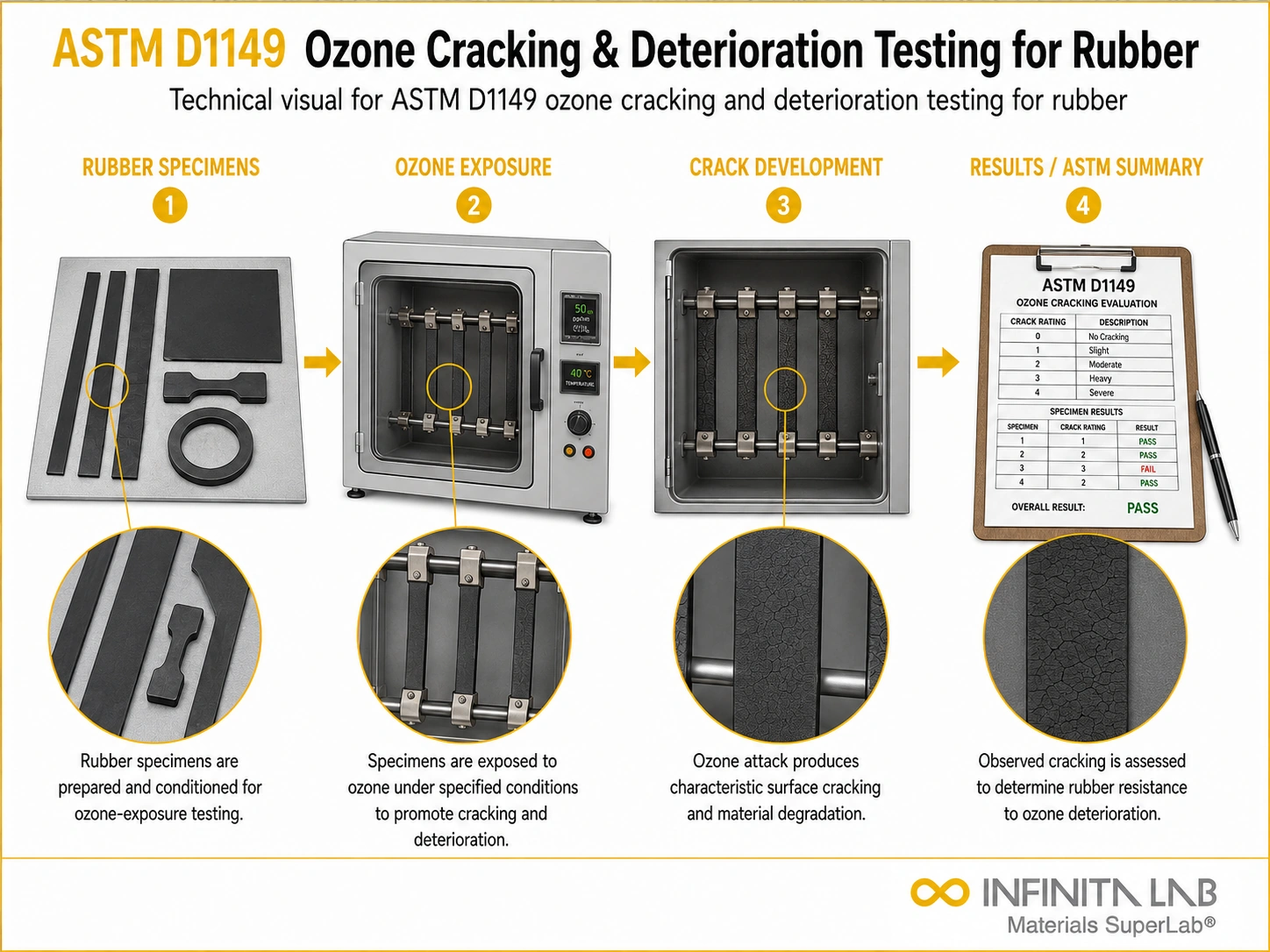


What Is ASTM D1149 Rubber Ozone Cracking Deterioration?
ASTM D 1149 Ozone Cracking Tests are the standardized test procedures for determining the ozone cracking resistance of rubber materials. ASTM D1149 specifies test procedures for determining the rubber’s ozone cracking resistance. The test procedures for determining the rubber ozone cracking resistance of materials involve specimen preparation, test conditions for exposing specimens to ozone, and methods for measuring this resistance.

Applications and Benefits of ASTM D1149 Rubber Ozone Cracking Deterioration Testing
Scope
ASTM D 1149 is a test that measures the resistance of rubber or other elastomeric material to ozone cracking by exposing strained test pieces of specified rubber or other elastomeric material to a specified environment of controlled ozone concentration at specified temperature and humidity conditions.
ASTM D 1149 ozone cracking testing evaluates:
- Ozone cracking resistance of vulcanized rubber and elastomeric materials under defined strain
- Surface crack initiation and propagation in rubber specimens under controlled ozone exposure
- Comparative ozone resistance of rubber compounds and elastomeric material formulations
- Effect of antiozonant level, compound formulation, and strain on ozone cracking performance
- Compliance with defined ozone cracking resistance requirements for rubber materials
Applications
- Automotive rubber seals, gaskets, and weatherstrip materials requiring ozone resistance data
- Industrial rubber hose, belt, and flexible component ozone resistance assessment
- Electrical cable insulation and rubber jacketing materials are subject to outdoor ozone exposure
- Aerospace and defense rubber sealing systems requiring ozone cracking resistance data
- Rubber compounders and material suppliers requiring ASTM D 1149 ozone resistance test data
Benefits
- Provides reliable ozone cracking resistance data for rubber material selection and design
- Supports rubber material specification compliance and supplier verification programs
- Identifies ozone cracking deficiencies in rubber compounds before production deployment
- Delivers traceable ozone resistance test records for engineering and research submissions
- Reduces design risk by verifying rubber ozone cracking resistance early in the approval cycle
Our ASTM D1149 Testing Procedure
Sample Preparation
Rubber specimens prepared, strained to defined elongation, and mounted per ASTM D 1149 requirements.
1Ozone Exposure
Strained specimens exposed to defined ozone concentration, temperature, and humidity conditions.
2Surface Crack Evaluation
Specimens visually inspected for crack initiation, density, and severity following ozone exposure.
3Data Analysis & Reporting
Cracking observations rated against ASTM D 1149 criteria to determine test compliance result.
4ASTM D1149 Test Parameters and Requirements
| Parameter | Details |
|---|---|
| Applicable Materials | Vulcanized rubber, elastomers, and flexible polymeric materials requiring ozone resistance assessment |
| Specimen Geometry | Defined rubber specimen dimensions and strain level per ASTM D 1149 requirements |
| Ozone Exposure Conditions | Defined ozone concentration, temperature, and humidity per ASTM D 1149 |
| Measured Parameters | Crack initiation, crack density, crack severity, and surface deterioration observations |
| Measured Outputs | Crack observations, cracking severity rating, and test compliance result |


- Controlled ozone exposure chamber with defined ozone concentration regulation
- Ozone concentration monitoring and verification system
- Specimen straining fixtures for defined elongation maintenance during exposure
- Temperature and humidity monitoring and control system
- Visual inspection and magnification equipment for crack assessment
- Data acquisition and test reporting system
Equipment and Instrumentation Used for ASTM D1149 Testing
What You Receive: Test Report, Data, and Certification
- Ozone exposure records including concentration, temperature, humidity, and exposure duration
- Visual crack initiation and severity observations for all tested rubber specimens
- Ozone cracking rating per ASTM D 1149 evaluation criteria
- Test compliance result assessed against defined rubber ozone resistance requirements
- ASTM D 1149 test report
ASTM D1149 Rubber Ozone Cracking Deterioration FAQs
ASTM D1149 measures how rubber materials resist cracking from ozone exposure. It looks at how elastomers perform when they are exposed to controlled ozone levels while under strain in a lab setting.
Ozone exposure can cause surface cracking in rubber parts, which leads to early failure. ASTM D1149 testing helps manufacturers make sure rubber products stay durable when exposed to atmospheric ozone.
ASTM D1149 is often used for rubber seals, gaskets, hoses, tires, and elastomer parts found in automotive, aerospace, and industrial equipment that are exposed to ozone in outdoor settings.
ASTM D1149 testing involves putting stressed rubber samples in a chamber where the ozone level, temperature, and humidity are controlled. After specific exposure times, the surfaces are checked for cracks or damage.
ASTM D1149 tests how ozone causes cracking in a lab setting. It may not reflect the complicated conditions of the real world. Factors like sunlight, mechanical stress, pollutants, and changes in temperature all affect how rubber breaks down.
Why Choose Infinita Lab for Rubber Ozone Cracking Deterioration Testing
At the core of this breadth is our network of 2,000+ accredited laboratories across the USA, offering access to over 10,000 testing methods and analytical services. From advanced materials characterization (SEM, TEM, RBS, XPS) to mechanical, chemical, environmental, biological, and standardized ASTM/ISO-compliant testing, we deliver unmatched flexibility, specialization, and scale. You are never limited by geography, facility, or methodology — Infinita Lab connects you to the right expertise and testing solution, every time.

Need ASTM D1149 Rubber Ozone Cracking Deterioration Testing You Can Rely On?
Send query us at hello@infinitalab.com or call us at (888) 878-3090 to learn more about our services and how we can support you.





