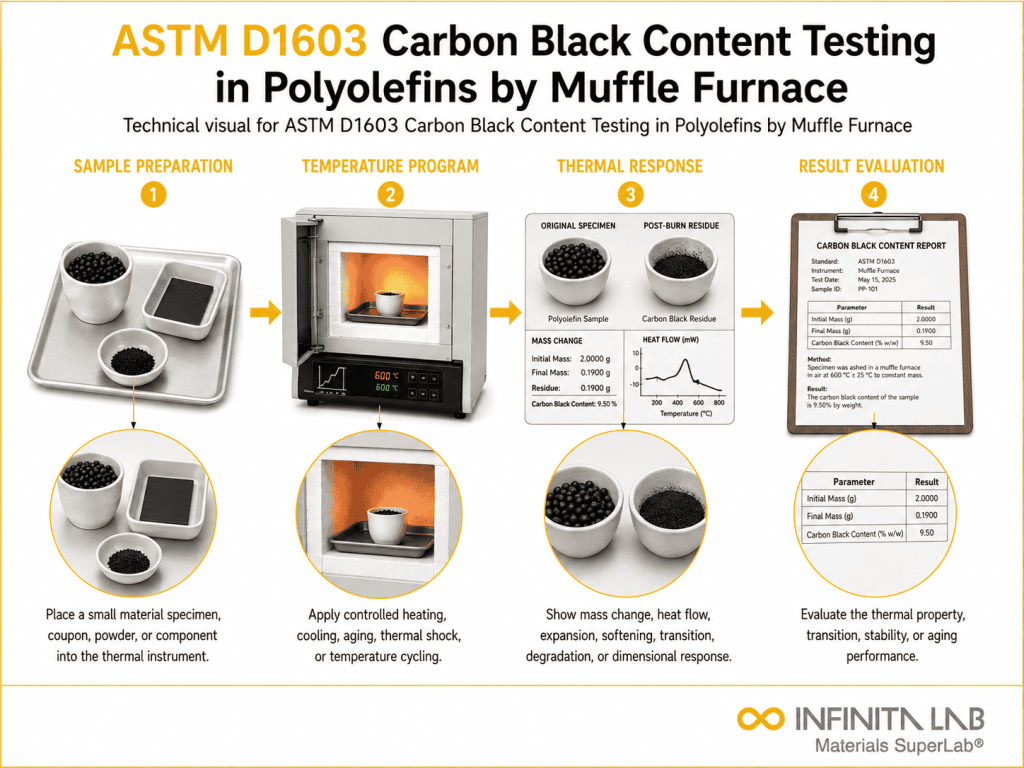


What Is ASTM D1603 Carbon Black Content Polyolefin?
ASTM D1603 determines the carbon black content in olefin plastics such as polyethylene and polypropylene. The test involves thermal decomposition of the polymer matrix in an inert atmosphere, leaving carbon black residue, which is then quantified to determine its percentage in the material.
This method is essential for evaluating UV resistance and long-term durability of plastic materials. Carbon black acts as a stabilizer against ultraviolet degradation, and its proper concentration ensures improved weathering performance, mechanical strength retention, and extended service life of plastic products.
Applications and Benefits of ASTM D1603 Carbon Black Content Polyolefin Testing
Scope
ASTM D1603 defines a procedure for measuring carbon black content in polyolefin materials through controlled thermal decomposition and residue analysis. It is widely used for quality control and material verification.
- Applicable to polyethylene and polypropylene materials
- Determines percentage of carbon black content
- Uses high-temperature furnace in inert atmosphere
- Suitable for quality control and product validation
- Helps ensure uniform dispersion and proper formulation
- Supports evaluation of UV stabilization properties
- Provides data for material specification compliance
Applications
- Evaluation of UV-resistant plastic materials
- Quality control in polymer manufacturing
- Verification of compound formulations
- Outdoor piping and cable insulation materials
- Plastic products exposed to sunlight
Benefits
- Accurate measurement of carbon black content
- Ensures proper UV protection in plastics
- Supports consistency in material production
- Helps prevent premature material degradation
- Enhances durability and service life
Our ASTM D1603 Testing Procedure
Sample Preparation
Plastic specimen is weighed and prepared in suitable form for testing.
1Thermal Decomposition
Sample is heated in an inert atmosphere to remove polymer content.
2Residue Formation
Carbon black remains as residue after polymer decomposition.
3Result Calculation
Residue is weighed and percentage of carbon black is calculated.
4ASTM D1603 Test Parameters and Requirements
| Parameter | Details |
|---|---|
| Material Type | Polyolefins such as PE and PP |
| Atmosphere | Inert gas (nitrogen) environment |
| Temperature Range | Typically up to 600–800°C |
| Output | Carbon black percentage (%) |
| Furnace Type | Controlled high-temperature furnace |
| Sample Size | Small, accurately weighed specimen |
| Residue Measurement | Gravimetric method |


- Muffle furnace or tube furnace
- Nitrogen gas supply system
- Analytical balance
- Crucibles or sample holders
- Temperature control system
Equipment and Instrumentation Used for ASTM D1603 Testing
What You Receive: Test Report, Data, and Certification
- Carbon black content (%)
- Test conditions and temperature details
- Sample identification and description
- Observations on residue quality
- Compliance statement with ASTM D1603
ASTM D1603 Carbon Black Content Polyolefin FAQs
Carbon black is essential for improving UV resistance and preventing degradation caused by sunlight exposure. Proper content ensures durability, maintains mechanical properties, and extends the service life of plastic products used in outdoor applications.
An inert atmosphere prevents oxidation of carbon black during heating. This ensures that only the polymer decomposes while the carbon black remains intact for accurate measurement.
While it measures total content, it does not directly assess dispersion quality. Additional tests are required to evaluate uniform distribution of carbon black within the material.
Proper temperature control ensures complete decomposition of the polymer without affecting carbon black. Incorrect temperatures can lead to incomplete removal or oxidation, resulting in inaccurate measurements.
Low carbon black content can lead to poor UV resistance, causing premature degradation, cracking, and reduced lifespan of plastic products exposed to sunlight.
ASTM D1603 determines the carbon black content in olefin plastics, including polyethylene, polypropylene, and polybutylene. A weighed sample is heated under a nitrogen atmosphere to decompose the polymer, leaving a residue containing carbon black. The residue is weighed and then oxidized to determine the carbon black content by mass difference. This test supports material quality control and formulation verification.
A carbon black test measures the amount of carbon black present in a material. For plastics, the sample may be heated under nitrogen to remove the polymer, and the remaining residue is weighed before and after oxidation to calculate the carbon black percentage. The results help verify pigment concentration, material consistency, and compliance with product specifications. The appropriate test method depends on the material being analyzed.
Why Choose Infinita Lab for Carbon Black Content Polyolefin Testing
When your Carbon Black Content Polyolefin results have to hold up - for compliance, a customer audit, or an engineering decision - ASTM D1603 accuracy and an unbiased third-party report matter more than price. Infinita Lab routes your ASTM D1603 carbon black content polyolefin testing to ISO/IEC 17025-accredited U.S. partner labs with hands-on method experience, so you get defensible data, transparent reporting, and turnaround times built around your project deadline - not ours.

Need ASTM D1603 Carbon Black Content Polyolefin Testing You Can Rely On?
Send query us at hello@infinitalab.com or call us at (888) 878-3090 to learn more about our services and how we can support you.



