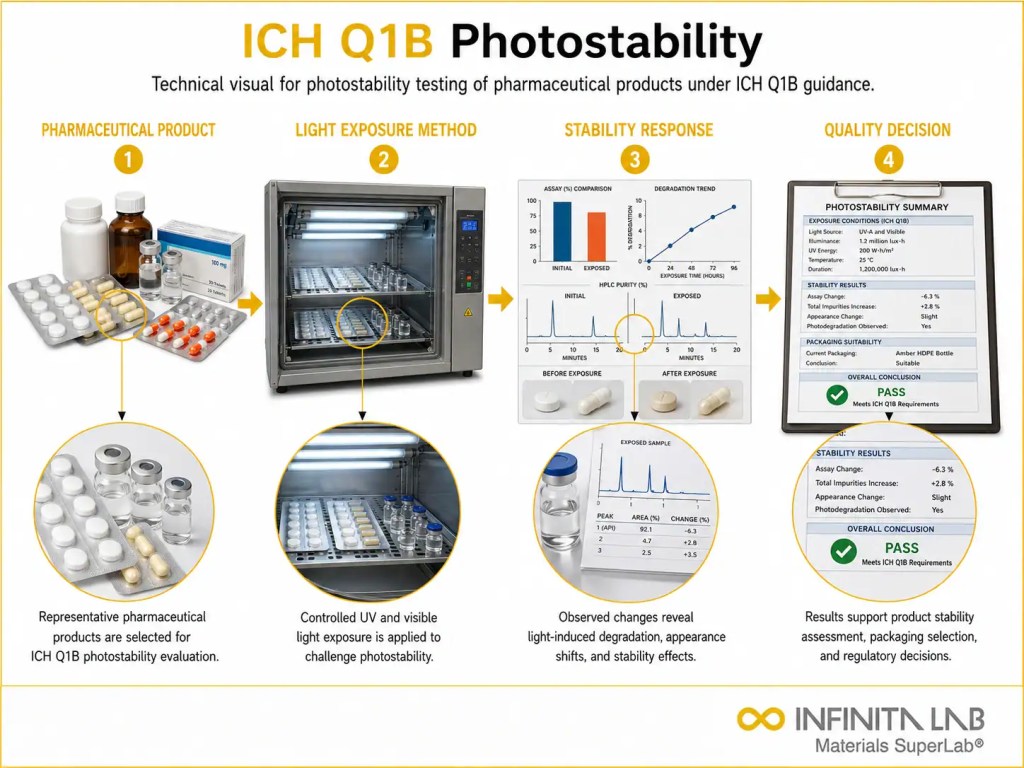


What Is ICH Q1b Photostability?
ICH Photostability Testing evaluates the effect of light exposure on pharmaceutical products to ensure their stability, safety, and efficacy throughout shelf life. It is conducted as per ICH Q1B guidelines, which define standardized conditions for light exposure.
This testing is essential for determining whether a drug substance or product undergoes degradation when exposed to UV and visible light, helping manufacturers design proper packaging, labeling, and storage conditions to maintain product quality.
Applications and Benefits of ICH Q1b Photostability Testing
Scope
Photostability testing involves exposing samples to controlled light sources simulating daylight and UV radiation to assess potential degradation. It supports stability studies, regulatory compliance, and product development.
The scope includes:
Testing of drug substances and finished products
Exposure to UV and visible light sources
Evaluation of photodegradation behavior
Assessment of packaging effectiveness
Compliance with ICH Q1B guidelines
Applications
- Stability testing of formulations
Packaging material evaluation
Regulatory submission studies
Quality control laboratories
Benefits
Ensures product safety and efficacy
Identifies light-sensitive compounds
Supports proper packaging selection
Meets regulatory requirements
Extends product shelf life
Our Testing Procedure
Sample Preparation
Drug substances or products are placed in suitable containers and prepared according to testing requirements.
1Light Exposure
Samples are exposed to controlled UV and visible light sources under defined intensity and duration conditions.
2Monitoring Changes
Physical and chemical changes such as color, potency, or degradation are monitored during exposure.
3Analysis and Evaluation
Results are analyzed to determine photostability and compliance with ICH guidelines.
4Test parameters and requirements
| Parameter | Details |
|---|---|
| Light Sources | UV (near 320–400 nm) and visible light |
| Exposure Conditions | Defined lux hours and UV energy levels |
| Sample Types | Drug substances and finished products |
| Parameters Measured | Degradation, color change, potency loss |
| Environment | Controlled temperature and humidity |
| Output | Stability data and degradation profile |


Photostability Chamber
UV and Visible Light Sources
Lux Meter
UV Radiometer
Analytical Instruments (HPLC, UV-Vis Spectrophotometer)
Equipment and Instrumentation Used for Testing
What You Receive: Test Report, Data, and Certification
Photostability study report
Degradation and stability data
Compliance with ICH Q1B
Packaging suitability assessment
Recommendations for storage conditions
ICH Q1b Photostability FAQs
ICH photostability testing evaluates how pharmaceutical products respond to exposure from UV and visible light, helping determine whether they degrade and ensuring product stability, safety, and efficacy throughout their intended shelf life.
It identifies light-sensitive products, ensures drug safety and effectiveness, and helps manufacturers select appropriate packaging and labeling to protect products from light-induced degradation during storage and distribution.
Parameters include chemical degradation, potency loss, color changes, and physical appearance to determine whether the product remains stable under specified light exposure conditions.
Yes, packaging materials can protect products from light exposure, so testing is often performed with and without packaging to evaluate its effectiveness.
Both drug substances and finished pharmaceutical products, including tablets, capsules, and injectables, are tested to evaluate their stability under light exposure and determine potential degradation risks.
ICH Q1B photostability testing evaluates the sensitivity of pharmaceutical substances and finished drug products to light exposure. Samples are exposed to controlled visible and ultraviolet light using a photostability chamber. The confirmatory study requires a minimum exposure of 1.2 million lux-hours of visible light and 200 Wh/m² of integrated near-ultraviolet energy. Exposed samples are compared with protected controls and analyzed for changes in appearance, potency, and degradation products. The results help determine suitable storage conditions, packaging requirements, and labeling precautions.
Food photostability testing evaluates how exposure to sunlight or artificial light affects food quality, appearance, flavor, and nutritional properties. Food samples are placed in a controlled light-exposure chamber and subjected to specified lighting conditions for a selected period. After exposure, laboratories evaluate changes such as discoloration, lipid oxidation, nutrient loss, and off-flavor development. The results help manufacturers determine appropriate packaging materials, storage conditions, and shelf-life requirements.
Why Choose Infinita Lab for ICH Q1b Photostability Testing
When your ICH Q1b Photostability results have to hold up - for compliance, a customer audit, or an engineering decision - accuracy and an unbiased third-party report matter more than price. Infinita Lab routes your ICH q1b photostability testing to ISO/IEC 17025-accredited U.S. partner labs with hands-on method experience, so you get defensible data, transparent reporting, and turnaround times built around your project deadline - not ours.

Looking for an Accredited Partner for ICH Q1b Photostability Testing?
Send query us at hello@infinitalab.com or call us at (888) 878-3090 to learn more about our services and how we can support you.