


Seal Strength Testing Services
Seal Strength Integrity Testing is a method used to assess the strength and reliability of seals between flexible and rigid materials. It is necessary for medical device packaging, as it guarantees sterility and protection against environmental conditions. Three techniques are used in the testing process, which is done according to ASTM F88. Tensile testing machines measure the tensile load and grip separation, and a test report is written including the material, tools, and conditions. Seal Strength Integrity Testing ensures the quality of a product and its package integrity.
TRUSTED BY


Get compliant results — request your seal strength testing quote
- Overview
- Scope, Applications, and Benefits
- Test Process
- Specifications
- Instrumentation
- Results and Deliverables
What Is Seal Strength?
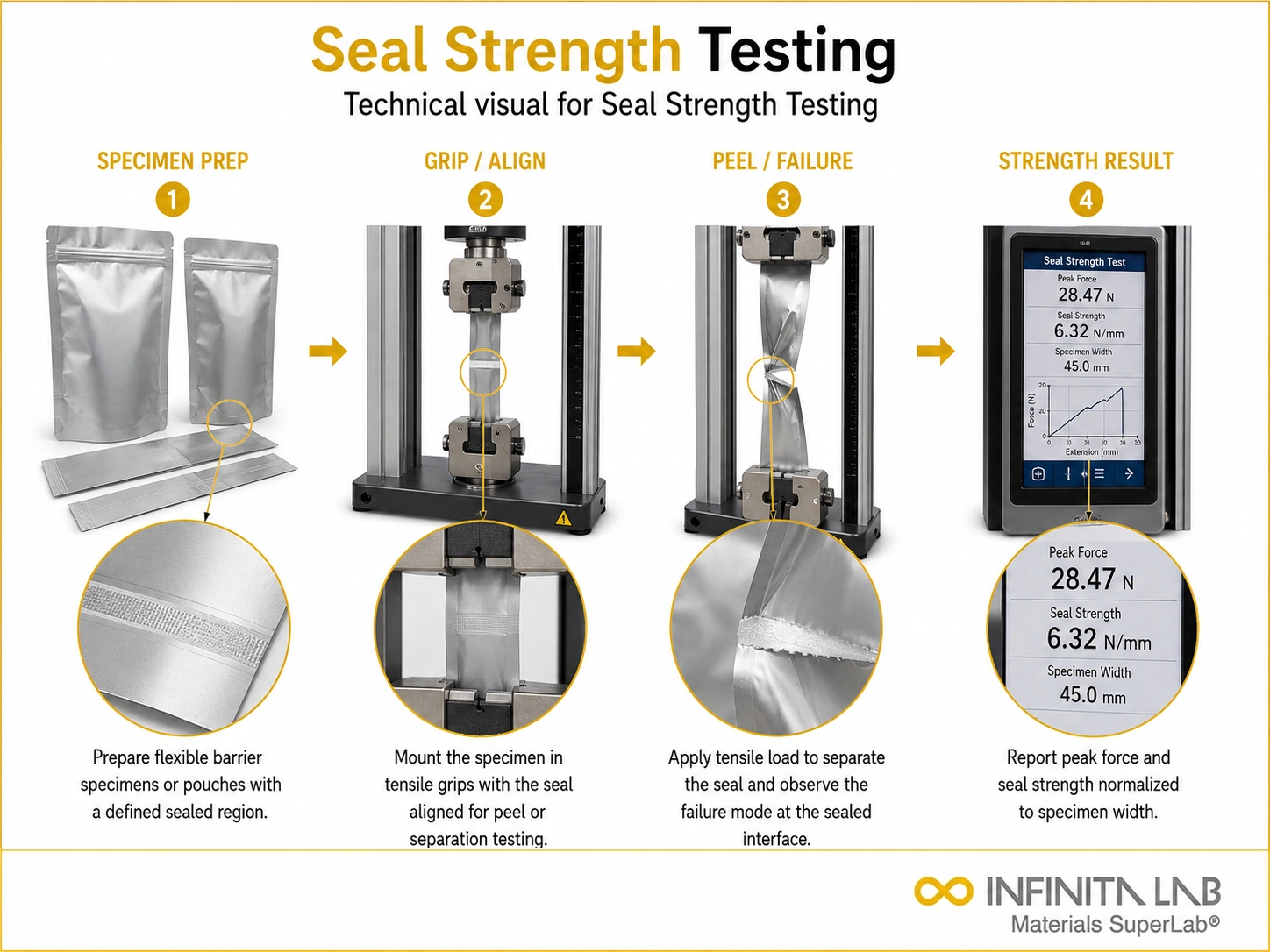
Seal strength testing measures the force required to peel apart a seal between two materials, characterizing the strength and reliability of seals in flexible packaging. The most widely used method is ASTM F88, which determines the seal (peel) strength of flexible barrier materials by pulling the two sealed sides apart in a tensile testing machine and recording the force needed to separate the seal. This is one of the most important tests for package integrity, particularly for medical device and pharmaceutical packaging where a reliable seal is what maintains sterility and protects the product.
A seal that is too weak may open prematurely during handling, shipping, or storage, breaching the package and compromising the contents. A seal that is too strong can make the package difficult to open or can damage the packaging material on opening (an important concern for peelable medical pouches that must open cleanly without tearing or shedding fibers). Seal strength testing quantifies the seal force so it can be confirmed to fall within the acceptable window for the application.
ASTM F88 defines how the seal specimen is gripped and pulled, including different techniques for supporting the unsealed “tails” of the specimen during the test, because the way the specimen is held affects the measured value. The test is run on a tensile testing machine that records the peak and average force, and the results – together with the observed mode of failure – characterize the seal.

Applications and Benefits of Seal Strength Testing
Scope
ASTM F88 covers the measurement of seal strength of flexible barrier materials by determining the force required to separate a seal, using a tensile testing machine. The specimen support technique and test conditions are selected per the standard and the package type.
Key aspects of the test scope include:
- Seal (peel) strength measurement – the seal is pulled apart in tension and the force to separate it is recorded, typically as peak force and average force per unit width
- Specimen support techniques – ASTM F88 defines three approaches for holding the unsupported tails of the specimen: unsupported (Technique A), supported at 90° (Technique B), and supported in alignment/180° (Technique C); the technique affects the measured result and must be reported
- Failure mode – the way the seal fails is recorded (e.g., peel/adhesive separation, material elongation, or material break), which is as important as the force value
- Applicable materials – flexible barrier materials and packaging, including pouches, films, laminates, and lidding sealed to trays or other substrates (flexible-to-flexible and flexible-to-rigid)
- Tensile machine measurement – grip separation rate, load, and the force-versus-extension behavior are recorded
- Related context – frequently run alongside package integrity tests such as burst/creep (ASTM F1140/F2054), dye penetration (ASTM F1929), and as part of distribution and sterilization validation programs
Applications
- Medical device packaging – verifying seal strength of sterile barrier pouches and tray lidding, where the seal maintains sterility until the point of use and must also peel open cleanly
- Food packaging – measuring seal strength of flexible food packaging to confirm it protects the contents and performs as intended
- Package development – optimizing heat-seal parameters (temperature, pressure, dwell time) during package development by measuring how they affect seal strength
- Seal process validation – establishing and validating the sealing process window for a package, and confirming seals stay within it
- Quality control – routine verification that production seals meet the seal-strength specification
- Stability and aging studies – checking whether seal strength changes after sterilization, aging, or environmental conditioning
Benefits
- Directly verifies package integrity – seal strength is a primary indicator of whether a package will stay sealed through handling, shipping, and storage, protecting the contents and (for medical packaging) sterility
- Identifies seals that are too weak or too strong – the test catches both weak seals that may breach and overly strong seals that prevent clean peel opening, both of which are problems for medical pouches
- Supports sealing process optimization – measuring how seal parameters affect strength lets manufacturers establish the correct sealing window for a reliable, peelable seal
- Failure mode adds diagnostic value – recording how the seal fails (peel, material stretch, or break) reveals not just the strength but the nature of the seal, supporting troubleshooting
- Standardized and comparable – as a defined ASTM method, F88 results provide a consistent basis for specification, validation, and quality control, recognized across the packaging industry
Our Testing Procedure
Prepare the Specimens
Cut seal samples to the required width and condition them before testing.
1Set Up the Test
Mount the sample in the tensile tester and select the appropriate support technique and test speed.
2Test Seal Strength
Peel the seal apart while recording peak and average force.
3Evaluate and Report
Document seal strength, failure mode, test conditions, and compliance with acceptance criteria.
4Test parameters and requirements
| Parameter | Details |
|---|---|
| Measured Property | Seal (peel) strength - peak and average force per unit width |
| Specimen Support | Technique A (unsupported), B (90° supported), C (aligned/180°) |
| Equipment | Tensile testing machine with appropriate grips |
| Failure Modes Recorded | Peel/adhesive, material elongation, material break |
| Applicable Materials | Flexible barrier films, laminates, pouches, lidding (flexible and flexible-to-rigid) |
| Specimen | Defined-width strip cut across the seal |
| Conditioning | Standard atmosphere per the method |


- Tensile testing machine with calibrated load cell
- Appropriate grips/fixtures for seal specimens (and supports for Techniques B and C)
- Specimen cutting equipment for consistent-width strips
- Conditioning chamber for specimen preconditioning
- Data acquisition system for force-versus-extension recording
Equipment and Instrumentation Used for Testing
What You Receive: Test Report, Data, and Certification
- Seal strength report – peak and/or average seal strength per unit width, with the specimen support technique used clearly stated
- Per-specimen data – individual and average seal strength results with the relevant statistics across the specimens tested
- Failure mode – the observed mode of seal failure (peel, elongation, or break) for each specimen
- Test conditions – support technique, grip separation rate, specimen width, and conditioning atmosphere
- Comparison against specification (where provided) – measured seal strength against the acceptable range for the package
- Sample records – material/package identification, seal location, and specimen preparation details
Seal Strength FAQs
Testing is commonly performed on medical-device pouches, food packaging, pharmaceutical packs, sachets, bags and flexible laminates. It may also be used for plastic films, foil structures and adhesive-bonded materials.
A strip containing the sealed area is clamped in a universal testing machine. The grips pull the two layers apart at a controlled speed while the equipment records the force required to open the seal.
Peak seal strength is the highest force recorded while the seal is being separated. It may indicate the maximum resistance of the seal but does not always represent its overall consistency.
Sealing temperature, pressure, dwell time, material thickness and surface contamination can influence seal strength. Film composition, adhesive properties and specimen-conditioning conditions may also affect results.
Failure may occur through adhesive separation, cohesive tearing, film breakage, delamination or peeling at the seal interface. Recording the failure mode helps determine whether the seal or packaging material caused the failure.
Why Choose Infinita Lab for Seal Strength Testing?
At the core of this breadth is our network of 2,000+ accredited laboratories across the USA, offering access to over 10,000 testing methods and analytical services. From advanced materials characterization (SEM, TEM, RBS, XPS) to mechanical, chemical, environmental, biological, and standardized ASTM/ISO-compliant testing, we deliver unmatched flexibility, specialization, and scale. You are never limited by geography, facility, or methodology — Infinita Lab connects you to the right expertise and testing solution, every time.

Looking for an Accredited Partner for Seal Strength Testing?
Send query us at hello@infinitalab.com or call us at (888) 878-3090 to learn more about our services and how we can support you.



Request a Quote
Submit your material details and receive testing procedures, pricing, and turnaround time within 24 hours.
 Quick Turnaround and Hasslefree process
 Confidentiality Guarantee
 Free, No-obligation Consultation
 100% Customer Satisfaction
