


Salt Spray Testing Services
A salt spray or salt fog test is corrosion resistance testing performed in high-saline environments to measure the resistance of products, paints, and coatings toward corrosion over a prolonged time. Salt fog corrosion testing is done in a closed chamber under a variety of corrosive environments.
TRUSTED BY


Get compliant results — request your salt spray testing quote
- Overview
- Scope, Applications, and Benefits
- Test Process
- Specifications
- Instrumentation
- Results and Deliverables
What Is Salt Spray?
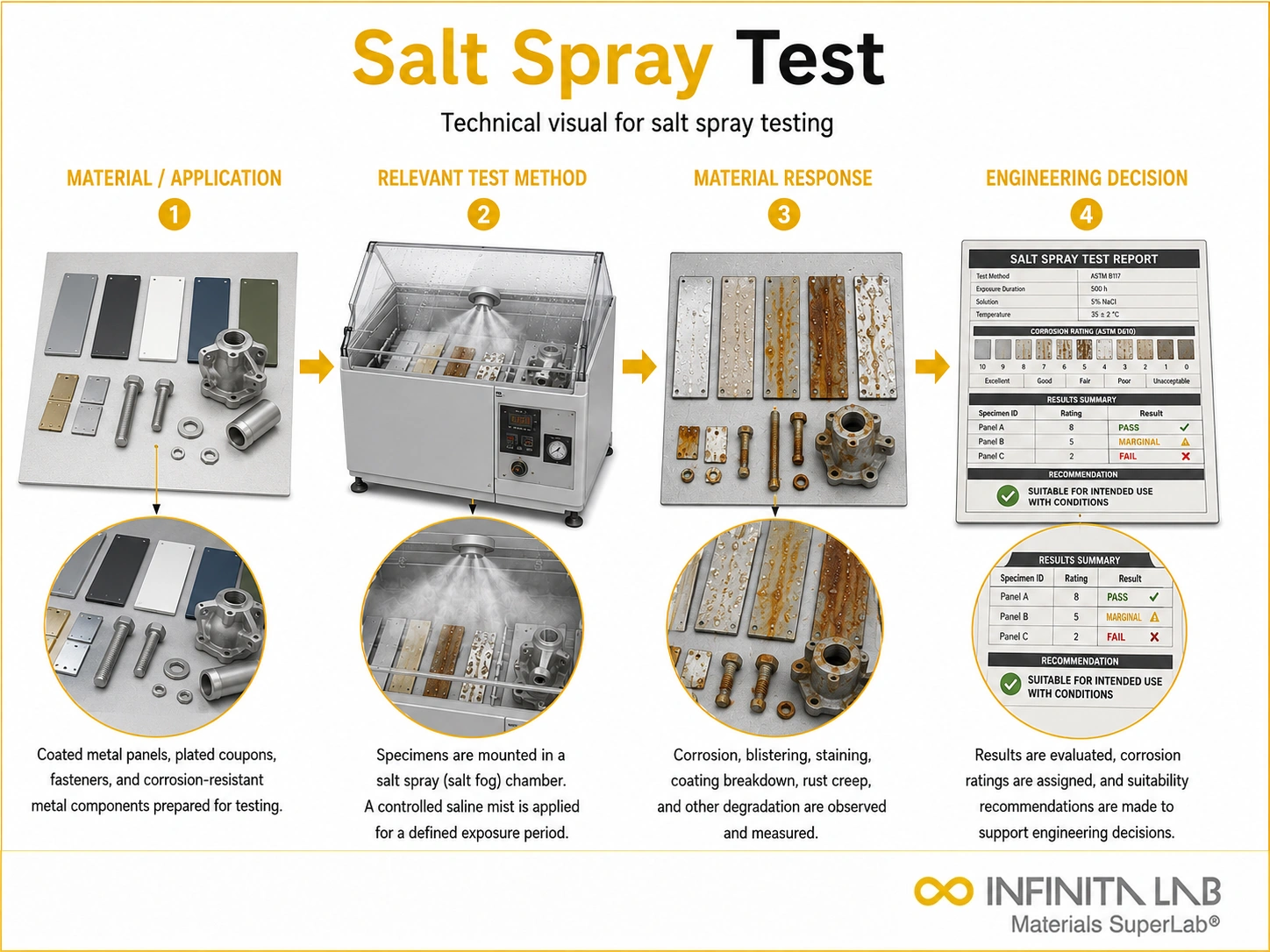
The salt spray test, also referred to as salt fog testing, is an accelerated corrosion test that exposes material specimens or coated components to a continuous mist of saline solution under controlled temperature and humidity conditions. The test is designed to replicate and accelerate the corrosion mechanisms that occur in marine or coastal service environments, compressing years of field exposure into a controlled laboratory timeframe.
The most widely referenced procedure is ASTM B117, which specifies a 5 percent sodium chloride solution at 35 degrees Celsius, a pH between 6.5 and 7.2, and a collection rate of 1.0 to 2.0 mL per 80 cm2 per hour. Specimens are placed in the chamber at a defined angle and exposed for a specified duration – ranging from a few hours for preliminary screening to thousands of hours for qualification of long-life coatings and surface treatments.
Salt spray testing is used to evaluate the protective performance of metallic coatings, organic coatings, anodized surfaces, conversion coatings, and plated finishes. Results are assessed by the time to first corrosion, the percentage of surface area corroded at defined intervals, or the presence of underfilm corrosion creeping from a scribed line. These results drive coating selection, specification development, and production quality control decisions.

Applications and Benefits of Salt Spray Testing
Scope
Salt spray testing applies to metals, metallic coatings, organic coatings, and surface-treated components where corrosion resistance is a performance requirement. Testing follows ASTM B117 or alternative procedures such as ASTM G85 (modified salt spray) or ISO 9227 depending on the specification. The test evaluates:
- Corrosion resistance of metallic and organic coatings
- Performance of plated and anodized surfaces
- Undercutting and delamination from scribed defects in coated panels
- Galvanic compatibility at dissimilar metal interfaces
- Effect of edge and fastener geometry on corrosion initiation
- Batch-to-batch consistency of coating application quality
Applications
- Automotive exterior and underbody component qualification
- Aerospace fastener and structural coating evaluation
- Consumer electronics enclosure and hardware testing
- Industrial equipment protective coating qualification
- Marine hardware and fixture corrosion resistance evaluation
- Production quality control for plating and coating operations
Benefits
- Accelerates corrosion detection relative to natural weathering exposure
- Standardized conditions allow cross-laboratory and cross-specification comparison
- Identifies coating defects and weak points before field deployment
- Quantifies relative performance of different coating systems
- Supports coating specification development with reproducible data
- Scalable to any exposure duration required by the applicable specification
Our Testing Procedure
Specimen Preparation
Specimens are cleaned, scribed where required by the specification, measured, and photographed before exposure begins.
1Chamber Setup and Verification
The salt spray chamber is loaded with 5 percent NaCl solution.
2Continuous Exposure
Specimens are exposed continuously to the salt fog at 35 degrees Celsius for the specified duration.
3Post-Exposure Evaluation
After exposure, specimens are rinsed, dried, and evaluated for corrosion initiation time, affected area, and coating adhesion loss
4Test parameters and requirements
| Parameter | Details |
|---|---|
| Primary Standard | ASTM B117 |
| Salt Solution | 5 percent sodium chloride by weight |
| Test Temperature | 35 degrees Celsius (+/-1 degree) |
| Solution pH | 6.5 to 7.2 |
| Collection Rate | 1.0 to 2.0 mL/80 cm2/hr |
| Applicable Standards | ASTM B117, ASTM G85, ISO 9227 |


- Salt spray test chamber with programmable temperature control
- pH meter and titration equipment for solution verification
- Collection funnel and graduated cylinder for spray rate measurement
- Scribing tool for intentional coating defect introduction
- Digital imaging system for pre- and post-exposure documentation
- Data logging system for continuous chamber condition recording
Equipment and Instrumentation Used for Testing
What You Receive: Test Report, Data, and Certification
- Time to first visible corrosion initiation
- Percentage of corroded surface area at defined exposure intervals
- Undercutting distance from scribe line where applicable
- Photographic documentation of specimen condition at all evaluation intervals
- Chamber condition logs including temperature, pH, and collection rate
- Quality assurance documentation
Salt Spray FAQs
An accelerated corrosion test called salt spray testing causes a corrosive attack on coated items for evaluation (mostly comparison). Protective coatings postpone corrosion. The coating type, thickness, and application quality all affect performance.
Maintaining a pH of 6.5 to 7.2 provides uniform conditions of corrosiveness and is essential to obtaining accurate results. A salt spray test can actively combat corrosion issues, increase the longevity of products, and satisfy customers.
Industries frequently use the salt spray test to evaluate metallic surfaces for corrosion resistance, while they often choose the salt fog test to assess painted surfaces and organic coatings. Both tests evaluate metals, alloys, and protective coatings.
Test durations vary depending on standards and material requirements, ranging from 24 hours to several weeks.
Protective coatings delay corrosion onset, with performance depending on coating type, thickness, and application quality.
Why Choose Infinita Lab for Salt Spray Testing
At the core of this breadth is our network of 2,000+ accredited laboratories across the USA, offering access to over 10,000 testing methods and analytical services. From advanced materials characterization (SEM, TEM, RBS, XPS) to mechanical, chemical, environmental, biological, and standardized ASTM/ISO-compliant testing, we deliver unmatched flexibility, specialization, and scale. You are never limited by geography, facility, or methodology — Infinita Lab connects you to the right expertise and testing solution, every time.

Looking for an Accredited Partner for Salt Spray Testing?
Send query us at hello@infinitalab.com or call us at (888) 878-3090 to learn more about our services and how we can support you.



Request a Quote
Submit your material details and receive testing procedures, pricing, and turnaround time within 24 hours.
 Quick Turnaround and Hasslefree process
 Confidentiality Guarantee
 Free, No-obligation Consultation
 100% Customer Satisfaction
