


Intergranular Corrosion Testing Services
Accredited intergranular corrosion testing from Infinita Lab, performed to the exact standard requirements - accurate, reproducible results with full documentation for compliance, R&D, and quality control programs.
TRUSTED BY


Get compliant results - request your intergranular corrosion testing quote
- Overview
- Scope, Applications, and Benefits
- Test Process
- Specifications
- Instrumentation
- Results and Deliverables
What Is Intergranular Corrosion?
Intergranular corrosion (IGC), also called intercrystallite corrosion, is a localised attack that occurs preferentially along a metal’s grain boundaries while the grain interiors remain largely unaffected. In austenitic stainless steels and certain nickel-based alloys, IGC most commonly results from sensitisation: exposure to temperatures roughly between 425°C and 815°C, such as during welding, stress relief, or improper heat treatment, causes chromium to combine with carbon and precipitate as chromium carbides at the grain boundaries. This precipitation depletes the chromium in the metal immediately adjacent to the boundary, leaving a narrow zone with reduced corrosion resistance that is preferentially attacked in service. Because the damage develops beneath the surface and along boundaries rather than as general surface loss, sensitised components can appear sound visually while harbouring a network of weakened grain boundaries that can lead to unexpected loss of mechanical strength, leaking joints, or sudden cracking under stress.
Susceptibility to IGC is evaluated using the ASTM A262 family of standard practices, which were developed specifically to detect sensitisation in austenitic stainless steels. Practice A uses a rapid oxalic acid electrolytic etch to screen microstructure for the ditched grain boundary structures associated with sensitisation, while Practices B, C, and E immerse specimens in boiling acid solutions, such as ferric sulphate-sulfuric acid, nitric acid, or copper-copper sulphate-sulfuric acid, for extended periods to quantify corrosion rate through weight loss or to reveal cracking through a bend test. Each practice suits particular alloy grades, product forms, or expected service conditions, and multiple practices are often used together to confirm results.
Intergranular corrosion testing is essential for qualifying welding procedures, verifying heat treatment, and confirming that fabricated stainless steel equipment will maintain its corrosion resistance throughout its intended service life in demanding chemical, food, pharmaceutical, energy, and industrial environments.

Applications and Benefits of Intergranular Corrosion Testing
Scope
- Testing evaluates the susceptibility of austenitic stainless steels and related alloys to intergranular corrosion caused by sensitisation at grain boundaries.
- Practice A (oxalic acid etch test) is a rapid electrolytic etch screening method used to classify grain-boundary microstructure as step, dual, or ditch structure and determine whether further acid immersion testing is warranted.
- Practice B (ferric sulphate-sulfuric acid test, also known as the Streicher test) exposes specimens to a boiling ferric sulphate and sulfuric acid solution for an extended period and evaluates corrosion severity by weight loss.
- Practice C (nitric acid test, also known as the Huey test) exposes specimens to repeated boiling nitric acid cycles and measures weight loss after each cycle, and is particularly effective for detecting chromium depletion and certain intermetallic phase attack.
- Practice E (copper-copper sulphate-sulfuric acid test, also known as the Strauss test) exposes specimens to a boiling copper sulphate and sulfuric acid solution followed by a bend test to reveal fissures or cracking indicative of sensitisation.
- Commonly covered materials include austenitic stainless steel grades such as the 300 series, as well as related welded and heat-affected alloy products.
- Testing evaluates base metal, weldments, and heat-affected zones to confirm that fabrication and welding procedures have not induced sensitisation.
- Industries served include chemical and petrochemical processing, food and beverage, pharmaceutical and biotechnology, power generation, nuclear, and oil and gas.
- Results support material selection, weld procedure qualification, mill certification, and compliance verification for corrosive service applications.
- Testing can be performed on production components, test coupons, and procedure qualification specimens to support both incoming material acceptance and ongoing quality assurance programs.
Applications
- Qualification of welding procedures and welder performance for stainless steel piping, vessels, and structural components intended for corrosive service.
- Verification of heat treatment effectiveness following solution annealing, stress relieving, or other thermal processing steps.
- Acceptance testing of stainless steel piping, tubing, and vessels used in chemical processing and petrochemical plants.
- Quality assurance for food, dairy, and pharmaceutical processing equipment where hygienic stainless steel surfaces must remain corrosion-resistant.
- Material qualification for nuclear power plant components and systems exposed to high-purity water and elevated temperatures.
- Evaluation of oil and gas production, refining, and pipeline equipment exposed to corrosive process streams.
- Root cause investigation of in-service corrosion failures, cracking, or leaks suspected to originate from sensitised grain boundaries.
Benefits
- Identifies sensitisation and susceptibility to intergranular attack before components enter corrosive service.
- Supports weld procedure and heat treatment qualification, reducing the risk of premature failure in fabricated assemblies.
- Provides an objective, standardized basis for material acceptance, mill certification, and specification compliance.
- Helps prevent unplanned downtime, leaks, and costly field failures in critical process and structural equipment.
- Allows selection of the most appropriate A262 practice for the specific alloy grade and application, avoiding unnecessary testing time and cost.
- Delivers documented, traceable test data that supports regulatory, insurance, and customer quality requirements.
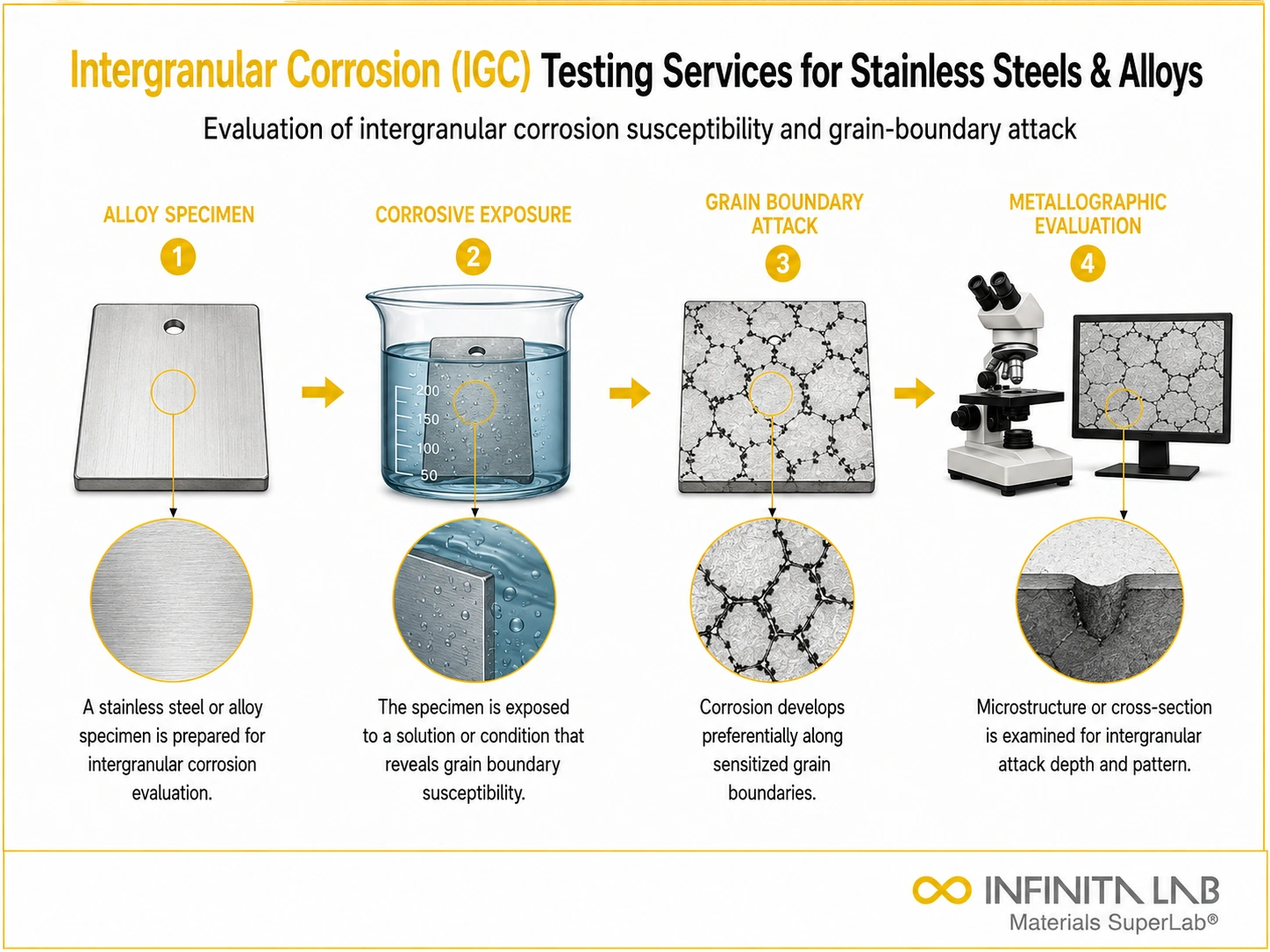
Our Testing Procedure
Specimen Preparation & Exposure
Machine, polish, clean, and immerse specimens per ASTM under controlled conditions.
1Mechanical or Weight Loss Evaluation
Perform bend tests (where applicable) to detect grain boundary cracking or measure mass loss to determine corrosion rate.
2Metallographic Examination
Prepare cross-sections and examine under an optical microscope to assess intergranular attack depth and morphology.
3Interpretation & Reporting
Classify the material as acceptable or susceptible based on the relevant standard acceptance criteria and issue a detailed report.
4Test parameters and requirements
| Parameter | Details |
|---|---|
| Material Types | Austenitic SS, Duplex SS, Nickel Alloys |
| Applicable Materials | Stainless steels, nickel alloys, aluminum alloys |
| Test Environment | Specific acid solutions per standard requirement |
| Temperature Range | Typically boiling solutions (~100°C) |
| Exposure Duration | 15 minutes to 120 hours (depending on practice) |
| Evaluation Method | Microscopic examination, bend test, or weight loss measurement |


- Metallurgical microscope – used to examine and classify the etched grain boundary microstructure produced by the Practice A oxalic acid test.
- Electrolytic etching apparatus – provides the controlled current and oxalic acid solution used to etch specimen surfaces for microstructural screening.
- Acid immersion test apparatus with reflux condenser – maintains sustained boiling of the acid reagent for Practice B, C, and E immersion tests while preventing solution loss through evaporation.
- Analytical balance – measures specimen weight before and after immersion testing to determine weight loss and calculate corrosion rate.
- Bend test fixture – applies the controlled bend used in Practice E to reveal surface fissures or cracking associated with sensitisation.
- Specimen preparation equipment – grinding and polishing equipment used to prepare specimen surfaces to the required finish before etching or immersion.
- Digital imaging system – captures photomicrographs of etched microstructures and post-test surfaces for inclusion in the test report.
Equipment and Instrumentation Used for Testing
What You Receive: Test Report, Data, and Certification
- Etch structure classification (step, dual, or ditch) with representative photomicrographs from Practice A screening.
- Calculated corrosion rate based on measured weight loss for Practice B and Practice C immersion testing.
- Pass/fail determination and photographic documentation of bend test surfaces for Practice E evaluation.
- Clear statement of the practice(s) used, specimen condition, and applicable acceptance criteria.
- Comprehensive test report suitable for submission to customers, regulatory bodies, or quality assurance records.
- Guidance on appropriate follow-up testing when initial screening results are inconclusive or warrant further evaluation.
Intergranular Corrosion FAQs
Intergranular corrosion is a localized attack along grain boundaries in metals, often caused by chromium depletion. It weakens the material internally and can lead to sudden failure without visible surface damage.
Common standards include ASTM A262 for stainless steels, ASTM G28 for nickel alloys, ASTM G67 for aluminum alloys, and ISO 3651 for corrosion resistance evaluation.
ASTM A262 defines multiple test practices (A, B, C, E, F) to detect susceptibility to intergranular corrosion in austenitic stainless steels using chemical exposure and evaluation methods.
Corrosion is measured using weight loss, visual inspection, bend tests, or metallographic analysis. Some methods quantify corrosion rates, while others assess cracking or grain boundary attack.
IGC testing ensures materials are not susceptible to grain boundary corrosion, which can cause unexpected failure. It is critical for safety and reliability in high-temperature and corrosive environments.
IGC stands for Intergranular Corrosion. IGC testing evaluates a material’s susceptibility to corrosion along grain boundaries by exposing a prepared specimen to a specified corrosive environment and assessing corrosion through weight loss, microscopic examination, or other prescribed criteria. ASTM A262 and ASTM G28 provide methods for different alloy systems.
The prepared specimen is exposed to a specified chemical solution under controlled time and temperature conditions. After exposure, corrosion behavior is evaluated using methods such as weight-loss measurement, visual examination, bend testing, or metallographic examination, depending on the applicable standard.
IGC testing is required to identify materials that may be susceptible to grain-boundary corrosion, particularly due to sensitization or grain-boundary precipitation. It helps assess material quality and the effects of processing or heat treatment before use in corrosive service.
Why Choose Infinita Lab for Intergranular Corrosion Testing
When your Intergranular Corrosion results have to hold up - for compliance, a customer audit, or an engineering decision - accuracy and an unbiased third-party report matter more than price. Infinita Lab routes your intergranular corrosion testing to ISO/IEC 17025-accredited U.S. partner labs with hands-on method experience, so you get defensible data, transparent reporting, and turnaround times built around your project deadline - not ours.

Looking for an Accredited Partner for Intergranular Corrosion Testing?
Send query us at hello@infinitalab.com or call us at (888) 878-3090 to learn more about our services and how we can support you.



Request a Quote
Submit your material details and receive testing procedures, pricing, and turnaround time within 24 hours.
 Quick Turnaround and Hasslefree process
 Confidentiality Guarantee
 Free, No-obligation Consultation
 100% Customer Satisfaction
