


Electrochemical Analysis Testing Services
Electrochemical analysis encompasses a variety of analytical methods based on Oxidation-Reduction (REDOX) reactions in electrolytic solutions. It is used for various applications including mineral analysis, corrosion, pollution monitoring, electrolysis, fuel-cell, and battery research. The laboratory network of Infinita Lab, USA, offers this test to clients in the USA and other places.
TRUSTED BY


Get compliant results — request your electrochemical analysis testing quote
- Overview
- Scope, Applications, and Benefits
- Test Process
- Specifications
- Instrumentation
- Results and Deliverables
What Is Electrochemical Analysis?
Electrochemical analysis is a family of analytical techniques based on the oxidation-reduction (redox) reactions that occur when electrodes are placed in an electrolytic solution and a potential or current is applied. By measuring the relationship between applied potential, current, charge, and time, these methods reveal how a material behaves electrochemically – how readily it oxidizes or reduces, how fast charge transfers at its surface, and how it corrodes, stores charge, or participates in a reaction. The signal is a direct measure of the electrochemical processes happening at the electrode-electrolyte interface.
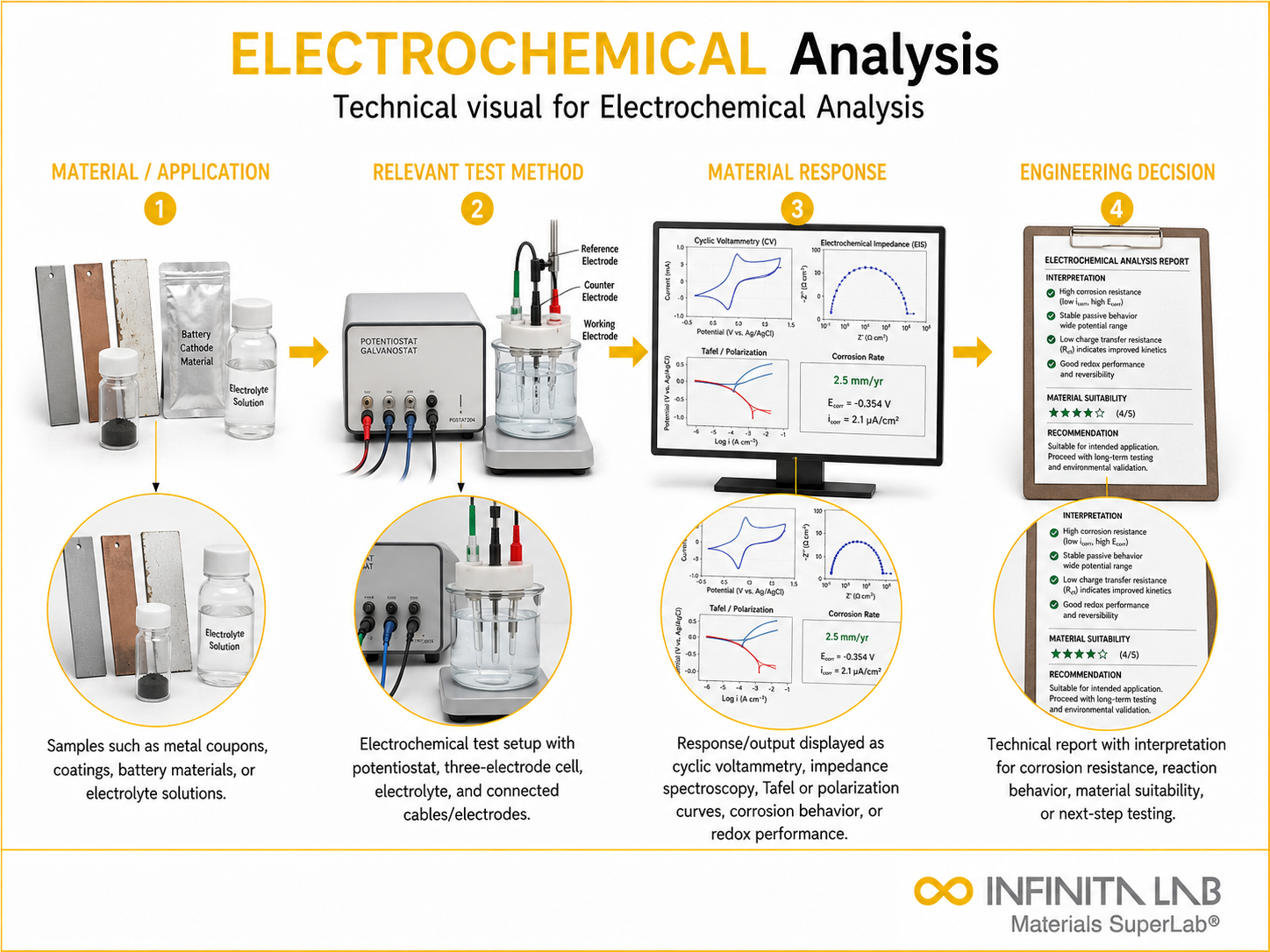
The field encompasses a range of complementary techniques. Potentiodynamic polarization characterizes corrosion behavior by sweeping potential and measuring the resulting current, yielding corrosion rate and passivation behavior. Electrochemical impedance spectroscopy (EIS) probes interfacial and transport processes across a range of frequencies. Cyclic voltammetry sweeps potential back and forth to study redox reactions and reaction mechanisms. Other methods include galvanostatic and potentiostatic techniques, chronoamperometry, and charge-discharge cycling for energy storage materials.
Electrochemical analysis is widely used in corrosion science, battery and fuel-cell research, coatings evaluation, sensor development, and electroplating, as well as in mineral analysis and environmental/pollution monitoring. Because the techniques are sensitive, quantitative, and often non-destructive, they are central tools wherever the electrochemical behavior of a material or system needs to be understood.

Applications and Benefits of Electrochemical Analysis Testing
Scope
Electrochemical analysis covers the characterization of materials and systems through redox-based measurements in an electrolyte, using a range of techniques selected to match the property and system under study. Measurements relate applied potential and/or current to the resulting electrochemical response.
Key techniques within the scope include:
- Potentiodynamic polarization – sweeping the potential and measuring current to determine corrosion rate, corrosion potential, passivation behavior, and pitting susceptibility (linear polarization, Tafel, cyclic polarization)
- Electrochemical impedance spectroscopy (EIS) – measuring impedance across a frequency range to resolve charge-transfer, double-layer, coating, and diffusion processes
- Cyclic voltammetry (CV) – sweeping potential cyclically to study redox reactions, reaction reversibility, and reaction mechanisms
- Galvanostatic / potentiostatic techniques – controlling current or potential to study electrochemical response, including charge-discharge cycling of energy storage materials
- Chronoamperometry / chronopotentiometry – measuring current or potential over time under a controlled step, for kinetics and diffusion studies
- Cell configurations – typically two- or three-electrode cells with reference and counter electrodes, in the appropriate electrolyte
- Applications spanning – corrosion, batteries and fuel cells, coatings, sensors, electroplating, mineral and environmental analysis
Applications
- Corrosion characterization – determining corrosion rates, passivation, and localized corrosion susceptibility of metals and coatings through polarization techniques
- Battery and energy storage research – characterizing electrode materials, electrolytes, and full cells through impedance, cyclic voltammetry, and charge-discharge cycling
- Fuel cells and electrolyzers – studying electrode kinetics, losses, and performance of electrochemical energy conversion systems
- Coatings evaluation – assessing the barrier and protective performance of organic and conversion coatings, often by EIS
- Sensor and biosensor development – characterizing electrode reactions and interfacial behavior in electrochemical sensing
- Electroplating and surface finishing – studying deposition behavior and optimizing plating processes
- Mineral and environmental analysis – applying electroanalytical techniques to mineral characterization and pollution/contaminant monitoring
- Materials development – comparing electrode materials, surface treatments, and electrolytes by their electrochemical behavior
Benefits
- Directly measures electrochemical behavior – the techniques probe the redox and interfacial processes themselves, giving information about corrosion, charge transfer, and reaction behavior that other methods infer only indirectly
- Quantitative results – polarization gives corrosion rates, CV gives reaction parameters, and impedance gives resolved process parameters, supporting objective comparison and analysis
- Spans corrosion, energy, and analytical needs – one family of techniques addresses corrosion, batteries, fuel cells, coatings, sensors, and analytical chemistry, making it broadly applicable
- Sensitive and often non-destructive – many electrochemical measurements are highly sensitive to surface and interfacial processes and can be made without destroying the sample
- Complementary techniques give a full picture – combining polarization, EIS, and voltammetry characterizes a system from multiple angles, building a more complete understanding than any single measurement
Our Testing Procedure
Prepare the Cell
Prepare the electrode, electrolyte, and reference and counter electrodes, then allow the system to stabilise.
1Select the Technique
Choose polarization, EIS, CV, or charge-discharge testing and set the required parameters.
2Perform the Measurement
Apply the controlled potential or current and record the electrochemical response.
3Analyse and Report
Extract corrosion, impedance, redox, or cycling parameters and report the results with test conditions.
4Test parameters and requirements
| Parameter | Details |
|---|---|
| Basis | Oxidation-reduction (redox) reactions in an electrolyte |
| Corrosion Outputs | Corrosion rate, corrosion potential, passivation, pitting susceptibility |
| EIS Outputs | Charge-transfer resistance, double-layer capacitance, coating R/C, diffusion |
| CV Outputs | Redox potentials, reaction reversibility, reaction mechanism |
| Cell Configuration | Two- or three-electrode (working, reference, counter) |
| Applications | Corrosion, batteries, fuel cells, coatings, sensors, electroplating, environmental |
| Nature | Sensitive, quantitative, often non-destructive |


- Potentiostat/galvanostat with frequency response analyzer (for EIS)
- Electrochemical cells (two- and three-electrode configurations)
- Reference electrodes (e.g., saturated calomel, Ag/AgCl) and counter electrodes
- Battery/cell cycling equipment (for charge-discharge testing)
- Temperature-controlled cell or environment (where required)
- Faraday cage / shielding for low-noise measurement
- Data acquisition and electrochemical analysis software
Equipment and Instrumentation Used for Testing
What You Receive: Test Report, Data, and Certification
- Electrochemical analysis report – the technique(s) applied, test conditions, measured curves, and extracted parameters
- Corrosion data (polarization) – corrosion rate, corrosion potential, and polarization behavior, with Tafel/polarization analysis
- Impedance data (EIS) – Nyquist and Bode plots with equivalent circuit model and extracted parameters
- Voltammetry data (CV) – voltammograms with identified redox peaks and reaction analysis
- Cycling data (energy storage) – capacity, efficiency, and behavior over charge-discharge cycles where applicable
- Test conditions – cell configuration, electrolyte, electrode area, scan rate/frequency range, and temperature
- Sample records – material/electrode description, surface condition, and identification
Electrochemical Analysis FAQs
The analysis can measure current, voltage, charge, resistance, capacitance and impedance. These values provide information about reaction rates, conductivity, corrosion resistance and electrochemical stability.
Electrochemical methods are commonly applied to metals, coatings, batteries, fuel cells, sensors, electrolytes and semiconductor materials. Both solid specimens and liquid solutions can be evaluated.
Cyclic voltammetry applies a changing voltage to the sample while recording the resulting current. It helps identify oxidation and reduction reactions, reaction reversibility and electrochemical stability.
Electrochemical impedance spectroscopy applies a small alternating signal over a range of frequencies. It evaluates processes such as charge transfer, diffusion, coating degradation and battery resistance.
Electrochemical techniques can estimate corrosion rate and evaluate passivation, pitting and coating performance. They provide faster results than many long-term exposure tests under controlled laboratory conditions.
Why Choose Infinita Lab for Electrochemical Analysis Testing?
At the core of this breadth is our network of 2,000+ accredited laboratories across the USA, offering access to over 10,000 testing methods and analytical services. From advanced materials characterization (SEM, TEM, RBS, XPS) to mechanical, chemical, environmental, biological, and standardized ASTM/ISO-compliant testing, we deliver unmatched flexibility, specialization, and scale. You are never limited by geography, facility, or methodology — Infinita Lab connects you to the right expertise and testing solution, every time.

Looking for an Accredited Partner for Electrochemical Analysis Testing?
Send query us at hello@infinitalab.com or call us at (888) 878-3090 to learn more about our services and how we can support you.



Request a Quote
Submit your material details and receive testing procedures, pricing, and turnaround time within 24 hours.
 Quick Turnaround and Hasslefree process
 Confidentiality Guarantee
 Free, No-obligation Consultation
 100% Customer Satisfaction
