


Microhardness Testing Services
When test materials are unsuitable for macro-hardness, microhardness testing is a way of assessing a material's hardness or resistance to deformation. Microhardness testing is the best method for determining the hardness of very small or thin samples, complicated forms, discrete phases of material, and surface coatings or platings.
TRUSTED BY


Get compliant results — request your microhardness testing quote
- Overview
- Scope, Applications, and Benefits
- Test Process
- Specifications
- Instrumentation
- Results and Deliverables
What Is Microhardness?
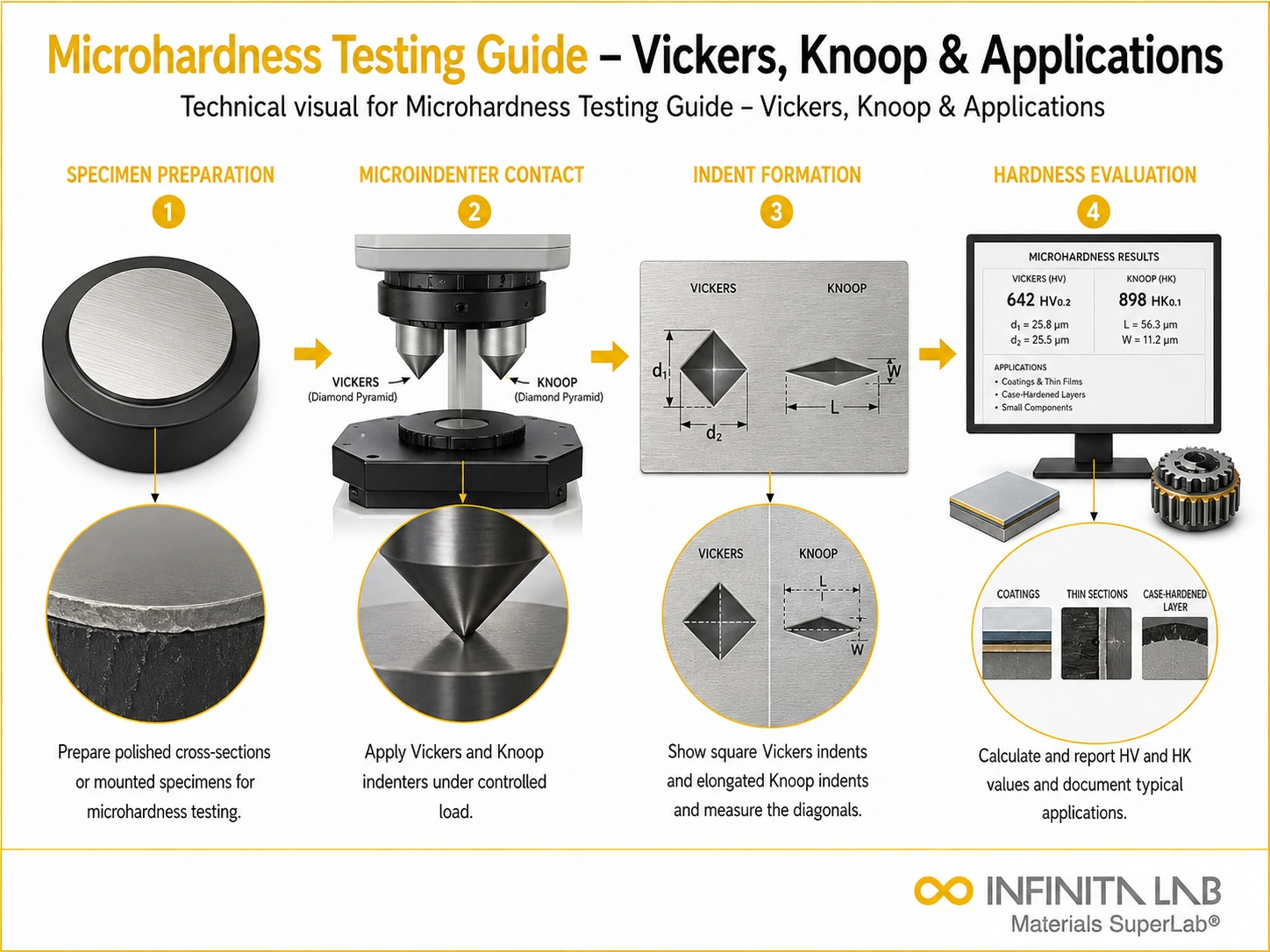
Microhardness testing is used to measure the hardness of materials at a microscopic scale by applying very small loads through a diamond indenter. It is particularly useful for evaluating thin coatings, surface treatments, microstructures, and small components where conventional hardness tests are not suitable.
The test determines resistance to localized plastic deformation by measuring the size of the indentation under controlled loads. Common methods such as Vickers and Knoop provide precise hardness values, enabling detailed analysis of material properties, phase distribution, and gradients across microstructural features.

Applications and Benefits of Microhardness Testing
Scope
Microhardness testing focuses on determining localized hardness in small or thin material sections, enabling evaluation of microstructural variations and surface properties under controlled indentation conditions.
- Measurement of hardness in thin coatings and layers
- Evaluation of microstructural phases and grain boundaries
- Assessment of surface treatments and case depth
- Testing of small or delicate components
- Comparative analysis of material hardness at micro-scale
Applications
- Coating thickness and hardness evaluation
- Case hardening depth measurement
- Microstructural phase analysis
- Quality control of heat-treated materials
- Failure analysis of localized defects
- Research and development of advanced materials
Benefits
- High precision measurement at micro-scale
- Suitable for very small or thin samples
- Minimal material damage due to low load
- Enables phase-specific hardness evaluation
- Supports detailed material characterization
- Useful for gradient and layer analysis
Our Testing Procedure
Sample Preparation
The specimen surface is polished to achieve a smooth, defect-free finish.
1Indentation Application
A controlled load is applied using a diamond indenter for a specified time.
2Indent Measurement
The indentation dimensions are accurately measured using a high-resolution optical microscope system.
3Hardness Calculation
Hardness value is calculated using standard formulas based on load and measured indentation geometry.
4Microhardness Testing – Technical Specification
| Parameter | Details |
|---|---|
| Indenter Type | Diamond pyramid (Vickers) or elongated diamond (Knoop) |
| Load Range | Typically 10 gf to 1000 gf depending on material and standard |
| Dwell Time | Usually 10 to 15 seconds for consistent indentation |
| Resolution | Capable of measuring indentations in micrometer range |
| Sample Size | Small sections, thin coatings, or microstructural areas |
| Measurement Units | HV (Vickers Hardness), HK (Knoop Hardness) |


- Microhardness tester (Vickers/Knoop)
- Optical microscope
- Diamond indenter
- Polishing machine
- Sample mounting press
- Calibration standards
Equipment and Instrumentation Used for Testing
What You Receive: Test Report, Data, and Certification
- Microhardness values (HV or HK)
- Indentation images and measurements
- Hardness profile across sample (if required)
- Case depth or coating evaluation
- Test report with method details
- Interpretation and recommendations
Microhardness FAQs
Microhardness testing measures hardness at very small scales using low loads, enabling evaluation of thin layers and microstructures. Unlike macro tests, it provides localized hardness values without significantly affecting the overall structure of the material.
They use diamond indenters that produce precise and measurable impressions under small loads. Vickers is suitable for general purposes, while Knoop is preferred for brittle materials and very thin layers due to its elongated indentation.
Load influences indentation size and measurement accuracy. Excessive load may involve substrate effects, while insufficient load can produce indistinct impressions. Proper load selection ensures representative hardness values and minimizes measurement uncertainty.
Yes, it is highly effective for coating evaluation when appropriate loads are used. The indentation must remain within the coating thickness to avoid substrate influence, ensuring accurate hardness measurement of the coating material itself.
Yes, it can identify differences in hardness across phases, grain boundaries, and treated regions. This makes it highly useful for analyzing material heterogeneity and evaluating the effects of processing or heat treatment.
Why Choose Infinita Lab for Microhardness Testing
At the core of this breadth is our network of 2,000+ accredited laboratories across the USA, offering access to over 10,000 testing methods and analytical services. From advanced materials characterization (SEM, TEM, RBS, XPS) to mechanical, chemical, environmental, biological, and standardized ASTM/ISO-compliant testing, we deliver unmatched flexibility, specialization, and scale. You are never limited by geography, facility, or methodology — Infinita Lab connects you to the right expertise and testing solution, every time.

Looking for an Accredited Partner for Microhardness Testing?
Send query us at hello@infinitalab.com or call us at (888) 878-3090 to learn more about our services and how we can support you.



Request a Quote
Submit your material details and receive testing procedures, pricing, and turnaround time within 24 hours.
 Quick Turnaround and Hasslefree process
 Confidentiality Guarantee
 Free, No-obligation Consultation
 100% Customer Satisfaction
