


ASTM D6539 Permeability Testing for Unsaturated Porous Materials
The permeability coefficient for air passage through unsaturated porous materials is determined using the test method ASTM D6539. The values expressed in SI units should be considered standard. The method helps study the properties of porous materials in detail.
TRUSTED BY


Precision-driven testing for dimensional accuracy and compliance
- Overview
- Scope, Applications, and Benefits
- Test Process
- Specifications
- Instrumentation
- Results and Deliverables
Overview
ASTM D6539 measures the permeability of unsaturated porous materials by evaluating the rate at which a fluid passes through a material that is not fully saturated. It helps determine flow characteristics under partially saturated conditions, which are common in real-world geotechnical and material systems.
The method is widely applied in soil science, construction materials, filtration media, and environmental engineering. It provides critical insight into fluid transport behavior, aiding in the prediction of drainage, seepage, and moisture movement in porous structures.

Scope, Applications, and Benefits
Scope
This method evaluates fluid flow through unsaturated porous materials.
- Measurement of permeability under unsaturated conditions
- Applicable to soils, porous media, and construction materials
- Evaluation of fluid transport characteristics
- Determination of hydraulic conductivity behavior
- Analysis of partially saturated systems
- Supports geotechnical and environmental studies
Applications
- Soil permeability and geotechnical engineering
- Landfill and waste containment systems
- Filtration and separation media
- Road and pavement base materials
- Hydrology and groundwater studies
- Civil engineering and construction materials
Benefits
- Predicts fluid movement in real conditions
- Improves soil and material design
- Supports environmental protection systems
- Helps prevent seepage and leakage issues
- Enhances drainage system design
- Provides critical engineering data
Test Process
Sample Preparation
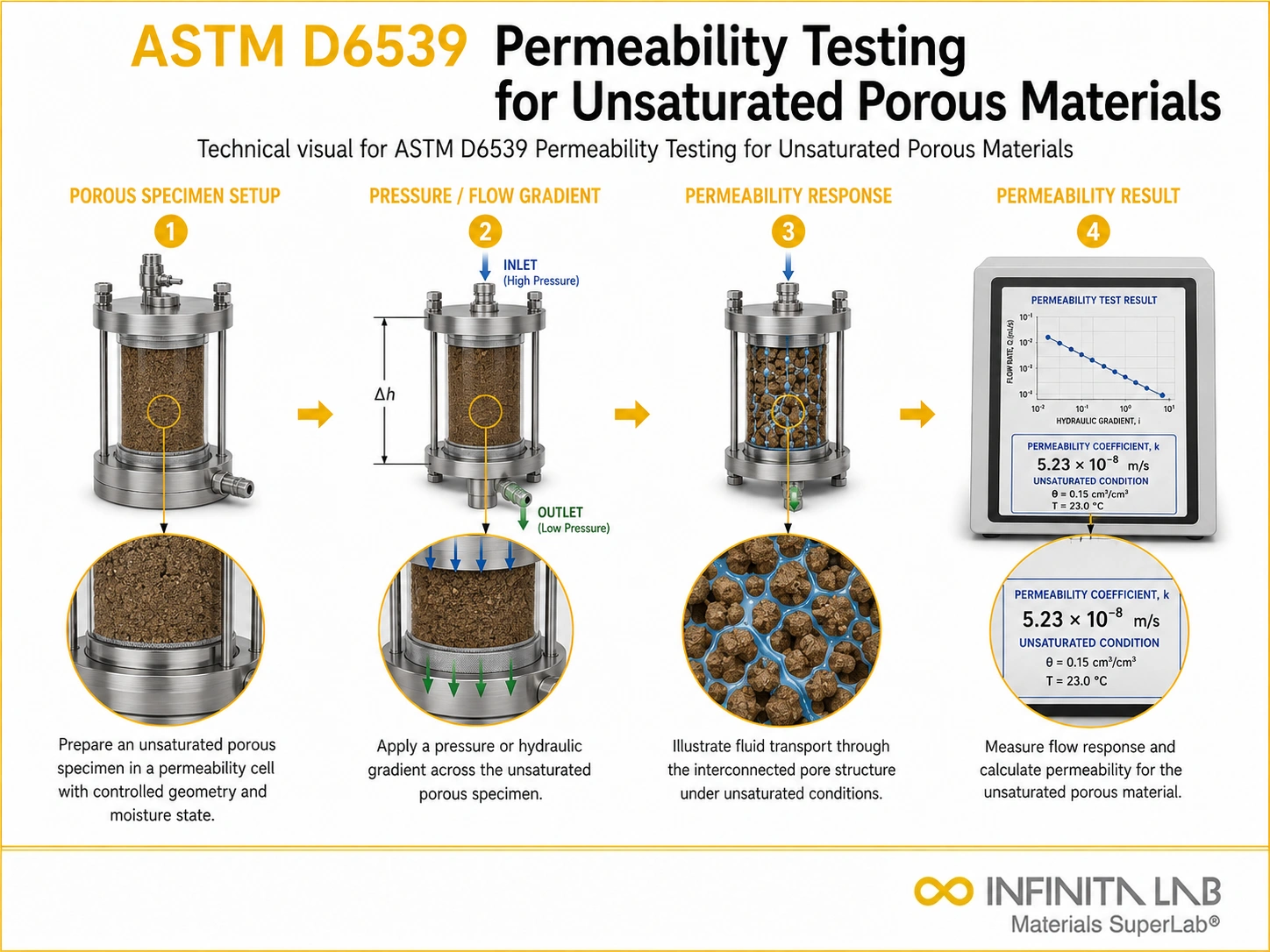
Porous material sample is prepared and conditioned to achieve a defined moisture or saturation level.
1Fluid Introduction
A controlled fluid is introduced to the sample under specified pressure or hydraulic gradient.
2Flow Measurement
The rate of fluid flow through the material is measured over time under unsaturated conditions.
3Permeability Calculation
Permeability is calculated using measured flow rates and hydraulic parameters of the system.
4Technical Specifications
| Parameter | Details |
|---|---|
| Material type | Unsaturated porous media |
| Fluid type | Water or test liquid |
| Measurement principle | Fluid flow rate under gradient |
| Hydraulic gradient | Controlled and defined |
| Saturation level | Partially saturated conditions |
| Flow measurement | Time-based volume flow |
| Sample geometry | Standardized dimensions |
| Temperature control | Maintained for consistency |
| Permeability range | Low to moderate permeability materials |


- Permeameter setup
- Flow measurement system
- Pressure control system
- Fluid reservoir
- Data acquisition system
- Sample containment chamber
- Hydraulic gradient control apparatus
Instrumentation Used for Testing
Results and Deliverables
- Permeability coefficient (unsaturated conditions)
- Flow rate vs time data
- Hydraulic conductivity values
- Moisture retention characteristics
- Test report with environmental conditions
- Material flow behavior analysis
Frequently Asked Question
Unsaturated permeability measures fluid flow in partially filled pores, where air and fluid coexist. Saturated permeability assumes all pores are filled with fluid. Unsaturated conditions are more complex due to capillary forces and varying moisture content affecting flow behavior significantly.
Most natural and engineered systems are not fully saturated. Understanding unsaturated permeability helps predict moisture movement in soils, prevent waterlogging, design drainage systems, and assess environmental contamination transport in partially saturated conditions.
Permeability is influenced by pore size distribution, material structure, saturation level, fluid viscosity, and temperature. These factors determine how easily fluid can move through interconnected pore spaces.
It is more complex than saturated testing and sensitive to environmental conditions, making it difficult to achieve consistent results without precise control.
Larger, well-connected pores increase permeability, while small or poorly connected pores restrict fluid flow. Pore geometry plays a critical role in determining flow paths.
Why Choose Infinita Lab for Advanced Materials Testing and Characterization?
At the core of this breadth is our network of 2,000+ accredited laboratories across the USA, offering access to over 10,000 testing methods and analytical services. From advanced materials characterization (SEM, TEM, RBS, XPS) to mechanical, chemical, environmental, biological, and standardized ASTM/ISO-compliant testing, we deliver unmatched flexibility, specialization, and scale. You are never limited by geography, facility, or methodology — Infinita Lab connects you to the right expertise and testing solution, every time.

Looking for a Trusted Partner for Accurate and Reliable Testing Services?
Send query us at hello@infinitalab.com or call us at (888) 878-3090 to learn more about our services and how we can support you.



Request a Quote
Submit your material details and receive testing procedures, pricing, and turnaround time within 24 hours.
 Quick Turnaround and Hasslefree process
 Confidentiality Guarantee
 Free, No-obligation Consultation
 100% Customer Satisfaction
