


ASTM D6561 Hexamethylene Diisocyanate (HDI) Aerosol Monitoring in Air
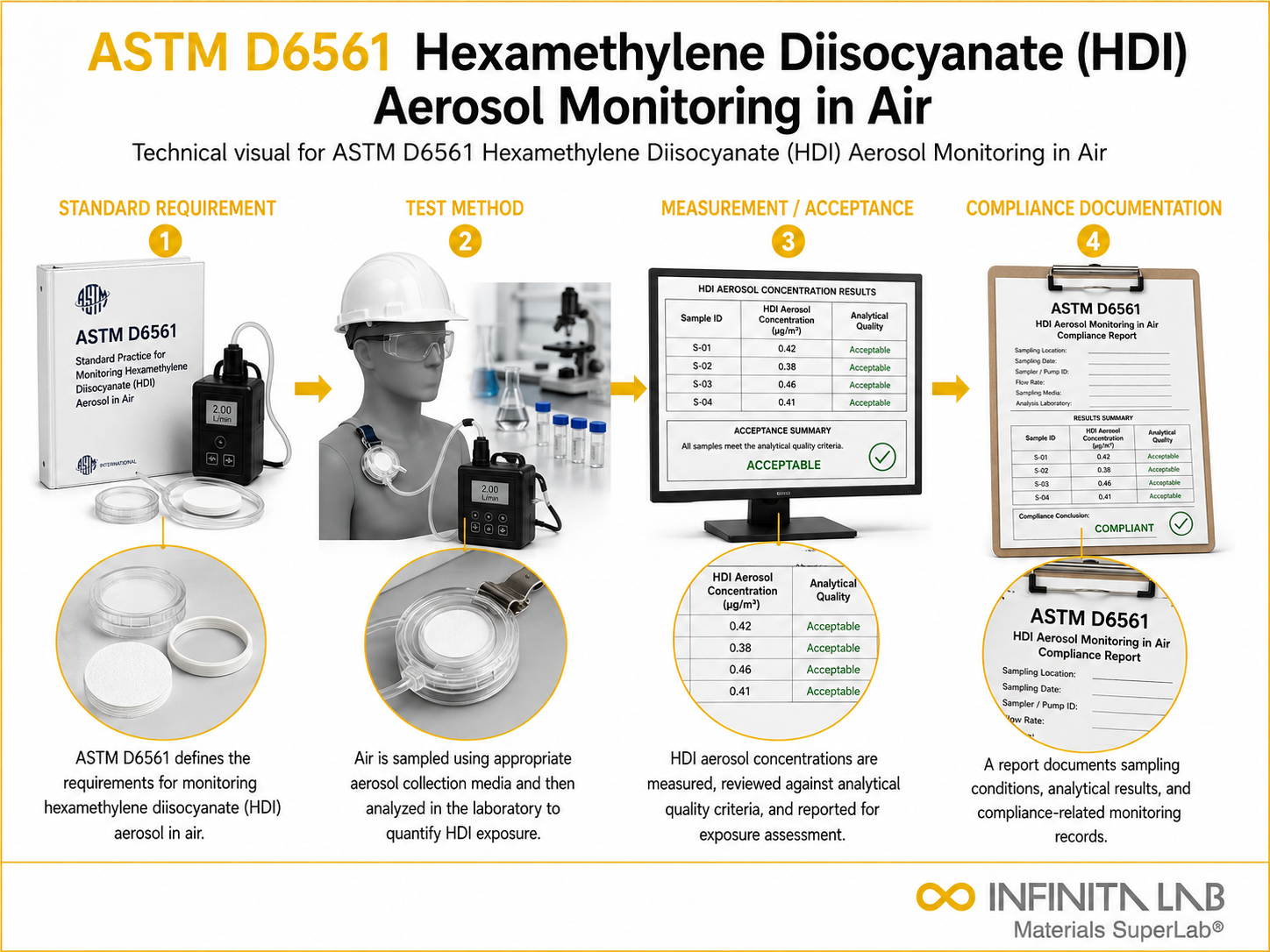
ASTM D6561 involves the detection of aerosol hexamethylene diisocyanate (HDI) in air samples taken from the workplace and ambient atmospheres are covered by this test technique. This method collects separate fractions, one from vapors and the other from the aerosol. The values stated in SI are considered standard.
TRUSTED BY


Precision-driven testing for dimensional accuracy and compliance
- Overview
- Scope, Applications, and Benefits
- Test Process
- Specifications
- Instrumentation
- Results and Deliverables
Overview
ASTM D6561 is a standard test method for the determination of aerosol monomeric and oligomeric hexamethylene diisocyanate (HDI) in workplace air. HDI is a reactive diisocyanate widely used in polyurethane coatings, adhesives, and elastomers, and occupational exposure to HDI aerosols poses significant health risks including respiratory sensitization and occupational asthma.
This method provides a reliable, validated procedure for collecting and analyzing airborne HDI using impinger sampling and high-performance liquid chromatography (HPLC), supporting industrial hygiene programs and regulatory compliance.

Scope, Applications, and Benefits
Scope
ASTM D6561 covers the measurement of:
- Monomeric HDI (1,6-hexamethylene diisocyanate)
- Oligomeric HDI (biuret, isocyanurate, and other polyisocyanate forms)
- Total aerosol HDI concentration in workplace air
- Sampling and analysis using impinger and HPLC-UV detection
The method is applicable to spray painting, coating application, and other operations where HDI aerosols may be generated.
Applications
- Industrial hygiene monitoring in painting and coating operations
- Occupational exposure assessment for HDI-based coatings
- Regulatory compliance with workplace exposure limits
- Automotive and aerospace refinishing facilities
- Evaluation of engineering controls and respiratory protection
Benefits
- Distinguishes between monomeric and oligomeric HDI species
- Provides sensitive and selective detection via HPLC
- Supports compliance with OSHA and ACGIH exposure limits
- Enables assessment of worker protection measures
- Validated method with established precision and accuracy
Test Process
Air Sampling
Airborne HDI aerosols are collected using specialized sampling media designed to capture reactive isocyanates.
1Derivatization
Collected HDI reacts with a derivatizing agent to stabilize reactive isocyanate groups.
2Analytical Measurement
The derivatized sample is analyzed using chromatographic techniques to separate and detect components.
3Quantification
Concentrations of monomeric and oligomeric HDI are calculated based on calibration standards and analytical data.
4Technical Specifications
| Parameter | Details |
|---|---|
| Target analyte | Hexamethylene diisocyanate (HDI) species |
| Sampling type | Aerosol and vapor phase collection |
| Derivatization reagent | Stabilizes isocyanate groups |
| Analytical method | HPLC or equivalent chromatographic technique |
| Detection range | Low ppb to ppm levels |
| Sample stability | Maintained after derivatization |
| Flow rate | Controlled sampling flow |


- Air sampling pump
- Sampling filters or impingers
- Derivatization reagents and kits
- High-Performance Liquid Chromatography (HPLC) system
- Detector (UV or fluorescence)
- Calibration standards
- Laboratory glassware and extraction tools
Instrumentation Used for Testing
Results and Deliverables
- Concentration of monomeric HDI
- Concentration of oligomeric HDI
- Total HDI exposure levels
- Chromatographic analysis data
- Calibration curves and validation
- Detailed exposure assessment report
Frequently Asked Question
Monomeric HDI is highly volatile and toxic, while oligomeric forms are less volatile but still hazardous. Differentiation enables accurate exposure assessment, as both forms contribute differently to respiratory risk and require distinct control strategies in occupational environments.
HDI is highly reactive and unstable in its native form. Derivatization converts it into a stable compound, preventing loss or transformation during analysis, ensuring accurate quantification and reliable identification of both monomeric and oligomeric species.
Aerosolized HDI can vary in particle size and distribution, making efficient capture difficult. Incomplete sampling or losses due to reactivity can lead to underestimation, requiring carefully designed sampling systems and conditions.
It provides quantitative data on airborne HDI levels, allowing comparison with exposure limits and helping implement appropriate control measures to protect worker health.
Accuracy depends on sampling efficiency, derivatization completeness, calibration quality, and instrument performance. Environmental conditions can also affect results.
Why Choose Infinita Lab for Advanced Materials Testing and Characterization?
At the core of this breadth is our network of 2,000+ accredited laboratories across the USA, offering access to over 10,000 testing methods and analytical services. From advanced materials characterization (SEM, TEM, RBS, XPS) to mechanical, chemical, environmental, biological, and standardized ASTM/ISO-compliant testing, we deliver unmatched flexibility, specialization, and scale. You are never limited by geography, facility, or methodology — Infinita Lab connects you to the right expertise and testing solution, every time.

Looking for a Trusted Partner for Accurate and Reliable Testing Services?
Send query us at hello@infinitalab.com or call us at (888) 878-3090 to learn more about our services and how we can support you.



Request a Quote
Submit your material details and receive testing procedures, pricing, and turnaround time within 24 hours.
 Quick Turnaround and Hasslefree process
 Confidentiality Guarantee
 Free, No-obligation Consultation
 100% Customer Satisfaction
