


Medical Glove Condom Testing Services
Gloves and condoms are two of the most common protective items used in our daily lives. Both of them are designed to minimize the risk of transmission of infection or disease. Although they serve different purposes, they are important tools for personal safety and health.
TRUSTED BY


Get compliant results — request your medical glove condom testing quote
- Overview
- Scope, Applications, and Benefits
- Test Process
- Specifications
- Instrumentation
- Results and Deliverables
What Is Medical Glove Condom?
Glove and condom testing evaluate the physical, mechanical, and barrier-integrity properties of protective products designed to prevent contamination, infection, and fluid transfer. These products must maintain consistent performance under mechanical stress and real-use conditions.
Testing focuses on strength, elasticity, leakage resistance, and material uniformity to ensure reliable protection. It plays a critical role in minimizing risks associated with healthcare exposure, industrial hazards, and personal safety applications.

Applications and Benefits of Medical Glove Condom Testing
Scope
Glove and condom testing evaluate:
- Tensile strength (typically 20–30 MPa for latex)
- Elongation at break (≥700–800%)
- Leakage and pinhole detection (water/air methods)
- Thickness uniformity (0.04–0.08 mm typical range)
- Burst pressure and volume performance
Applications
- Medical and surgical gloves
- Examination and disposable gloves
- Male and female condoms
- Personal protective equipment (PPE)
- Pharmaceutical and laboratory use products
Benefits
- Ensures reliable barrier protection against pathogens
- Reduces risk of leakage and contamination
- Supports safe usage in critical environments
- Improves product durability and consistency
- Enables performance comparison across materials
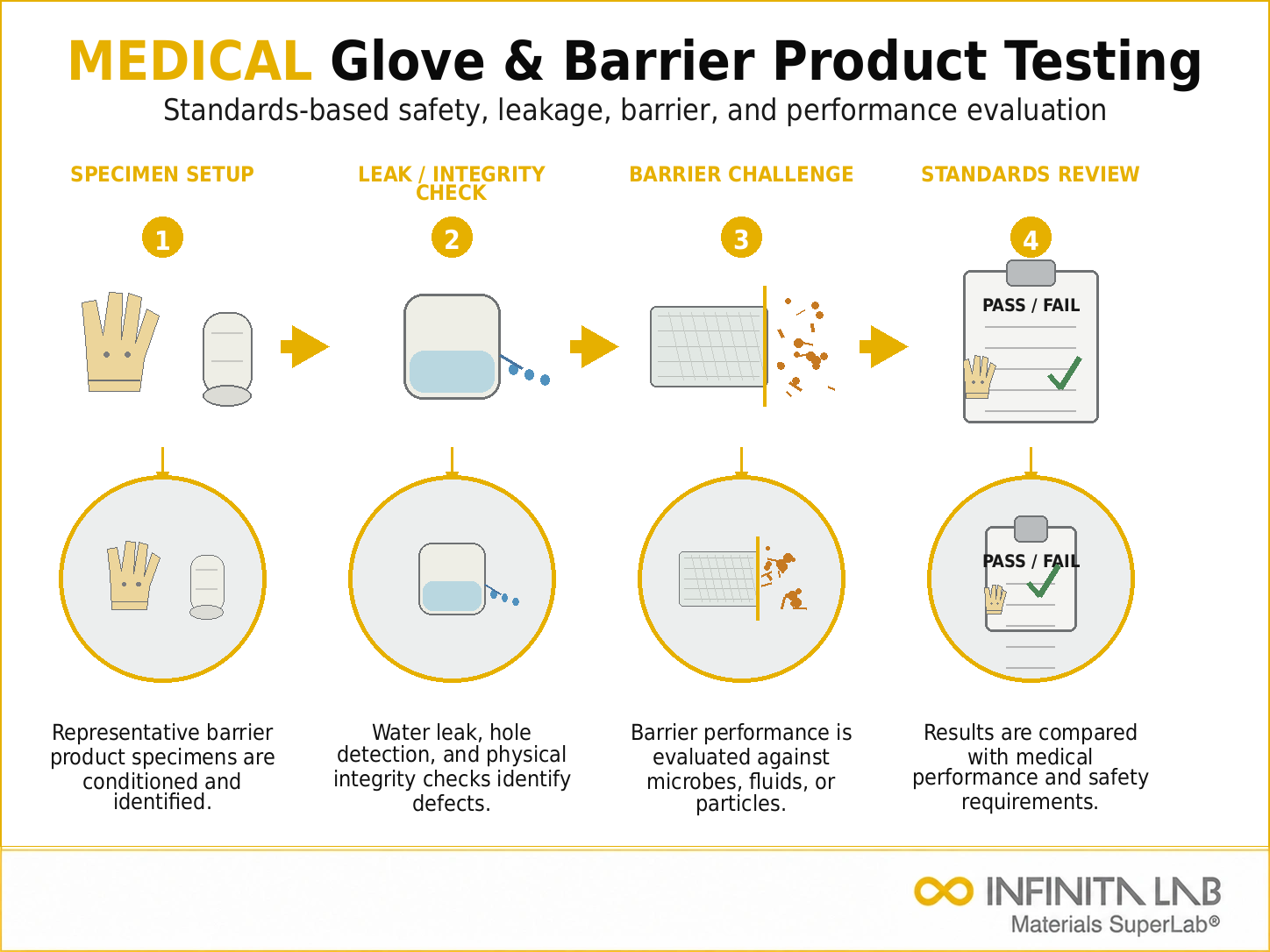
Our Testing Procedure
Sample Conditioning
Samples are conditioned at 23 ± 2°C and 50 ± 5% RH for at least 24 hours to ensure consistent testing conditions.
1Physical Testing
Tensile strength and elongation are measured using universal testing machines as per ASTM D412 or ISO standards.
2Leakage Testing
Products are filled with water (typically ~300 mL for condoms, ~1000 mL for gloves) to detect pinholes and leaks.
3Data Analysis
Results are analyzed for compliance with performance limits and failure criteria.
4Glove & Condom Testing Technical Specifications
| Parameter | Details |
|---|---|
| Standard | ASTM D412, ASTM D5151, ISO 4074, ISO 11193 |
| Test Principle | Mechanical strength and barrier integrity evaluation |
| Applicable Materials | Latex, nitrile, polyurethane, polyisoprene |
| Minimum Sample Size | Batch sampling (typically 13–32 units) |
| Measured Outputs | Strength (MPa), elongation (%), leakage rate |
| Burst Volume | ≥18–30 L (condoms typical range) |


- Universal testing machine (UTM)
- Water leakage test apparatus
- Air burst and inflation tester
- Thickness gauges (±1 µm resolution)
- Microscopes for defect inspection
- Environmental conditioning chamber
What You Receive: Test Report, Data, and Certification
Medical Glove Condom FAQs
- Tensile strength and elongation data
- Leakage and pinhole detection results
- Burst pressure and volume performance
- Thickness and dimensional analysis
- Comparative material performance evaluation
Why Choose Infinita Lab for Medical Glove Condom Testing
Testing ensures these products provide reliable protection against pathogens and contaminants. It verifies strength, elasticity, and leakage resistance, helping reduce risks in medical, industrial, and personal applications where safety is critical.
Leakage testing is commonly performed using water fill methods, where condoms are filled with ~300 mL and gloves with ~1000 mL water. Any leakage indicates defects such as pinholes or weak areas.
Standards such as ASTM D412, ISO 4074 (condoms), and ISO 11193 (gloves) define testing procedures for strength, elongation, and leakage, ensuring consistent evaluation of product performance and safety.
Common materials include natural latex, nitrile rubber, polyurethane, and polyisoprene. Each material offers different properties in terms of elasticity, chemical resistance, and durability, which are evaluated during testing.
Burst volume measures how much air a condom can hold before failure, typically ranging from 18 to 30 liters. It indicates elasticity and strength, ensuring the product can withstand stress during use.
Why Choose Infinita Lab for Medical Glove Condom Testing
At the core of this breadth is our network of 2,000+ accredited laboratories across the USA, offering access to over 10,000 testing methods and analytical services. From advanced materials characterization (SEM, TEM, RBS, XPS) to mechanical, chemical, environmental, biological, and standardized ASTM/ISO-compliant testing, we deliver unmatched flexibility, specialization, and scale. You are never limited by geography, facility, or methodology — Infinita Lab connects you to the right expertise and testing solution, every time.

Looking for an Accredited Partner for Medical Glove Condom Testing?
Send query us at hello@infinitalab.com or call us at (888) 878-3090 to learn more about our services and how we can support you.



Request a Quote
Submit your material details and receive testing procedures, pricing, and turnaround time within 24 hours.
 Quick Turnaround and Hasslefree process
 Confidentiality Guarantee
 Free, No-obligation Consultation
 100% Customer Satisfaction
