


Glass Analysis Testing Services
Unlock the secrets of glass with advanced analysis techniques. Explore composition, properties, and applications for a deeper understanding of this versatile material.
TRUSTED BY


Get compliant results — request your glass analysis testing quote
- Overview
- Scope, Applications, and Benefits
- Test Process
- Specifications
- Instrumentation
- Results and Deliverables
What Is Glass Analysis?
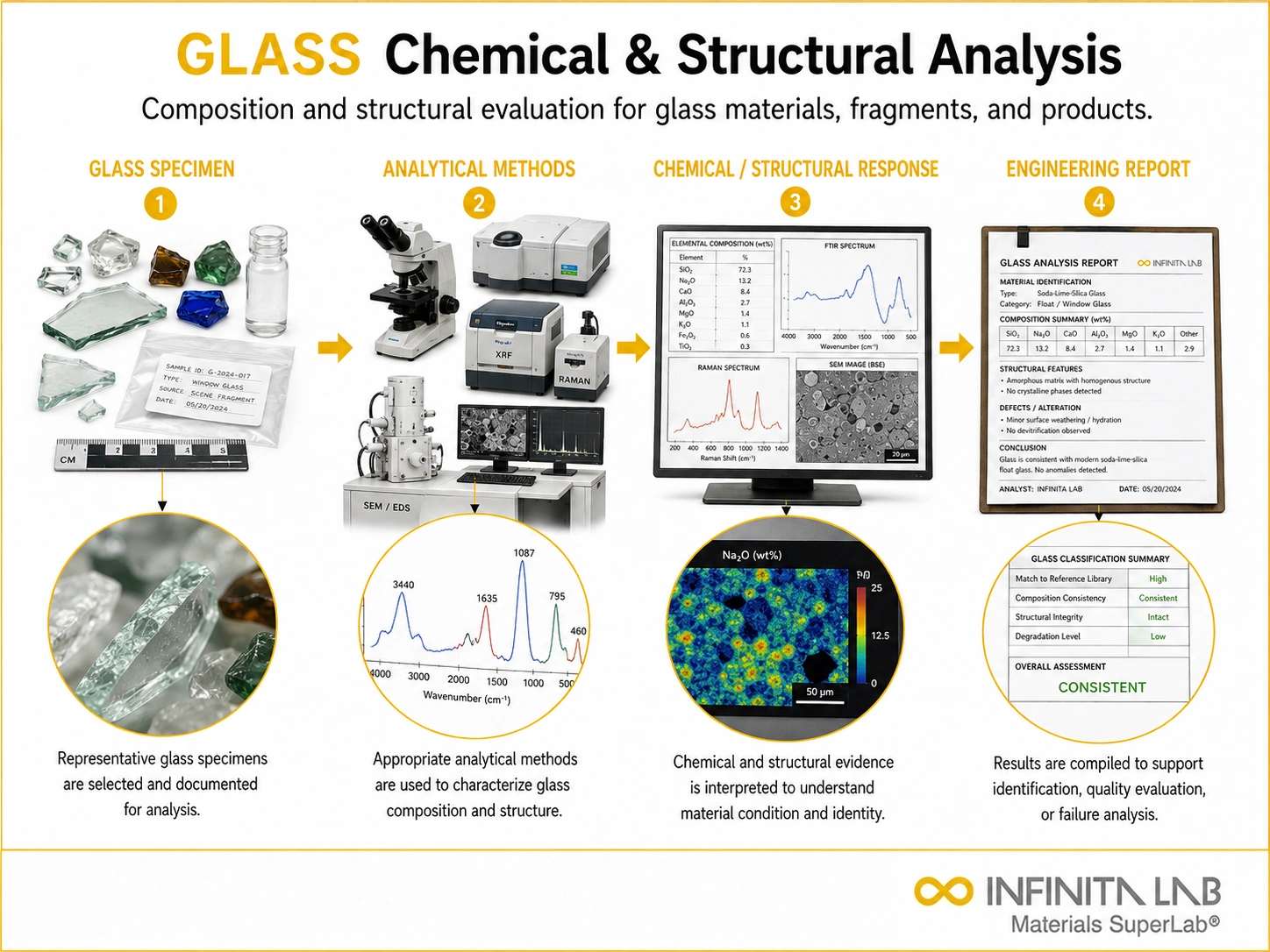
Glass analysis is used to evaluate the composition, structure, and performance characteristics of glass materials. The test helps identify chemical composition, impurities, defects, and physical properties that influence strength, transparency, and durability.
This analysis is widely used in industries such as construction, automotive, electronics, and optics. It supports quality control, failure analysis, and material development by providing insights into glass behavior under various conditions.

Applications and Benefits of Glass Analysis Testing
Scope
Glass analysis evaluates the chemical, physical, and structural properties of glass materials using analytical and microscopic techniques. The test helps determine composition, defects, and performance characteristics.
The analysis evaluates:
- Chemical composition of glass materials
- Presence of impurities and contaminants
- Surface and internal defects, such as cracks or inclusions
- Optical properties and transparency
- Structural integrity and material consistency
Applications
- Architectural glass
- Automotive glass components
- Optical and specialty glass
- Electronic display materials
- Packaging and container glass
- Failure analysis and material research
Benefits
- Provides a detailed understanding of glass composition
- Helps identify defects and quality issues
- Supports material selection and product development
- Assists in failure analysis and root cause investigation
- Enables comparison of different glass materials
Our Testing Procedure
Sample Preparation
Glass samples are cut, cleaned, and prepared for analysis.
1Structural and Chemical Analysis
Techniques such as spectroscopy and microscopy are used to determine composition and structure.
2Property Evaluation
Optical, mechanical, and surface properties are measured.
3Data Recording & Evaluation
Results are analyzed to assess material quality and performance.
4Test parameters and requirements
| Parameter | Details |
|---|---|
| Applicable Materials | Soda-lime, borosilicate, tempered, and specialty glass |
| Composition Analysis | SiO₂, Na₂O, CaO, B₂O₃ (wt%) |
| Optical Measurement | Transmission 80% to 92% (typical clear glass) |
| Defect Size Detection | ~1 µm to 1 mm |
| Surface Roughness | ~0.01 µm to 10 µm |
| Measured Outputs | Composition, defects, optical and structural properties |


- X-ray fluorescence (XRF) analyzer
- Scanning electron microscope (SEM)
- Optical microscope
- UV-Vis spectrophotometer
- Surface profilometer
- Data acquisition and analysis software
Equipment and Instrumentation Used for Testing
What You Receive: Test Report, Data, and Certification
- Material composition data
- Defect and inclusion analysis
- Optical property measurements
- Surface and structural evaluation
- Test condition summary
- ASTM compliance report
Glass Analysis FAQs
Glass analysis includes composition, optical properties, mechanical strength, thermal behavior, and surface defects, evaluating material performance, quality, and suitability for applications such as construction, optics, and electronics.
Glass analysis helps identify composition, defects, and performance characteristics, ensuring materials meet safety, durability, and optical requirements for various industrial and consumer applications.
Glass analysis uses techniques such as spectroscopy, microscopy, X-ray diffraction, thermal analysis, and mechanical testing to evaluate properties and identify defects.
Glass analysis is commonly applied to float glass, tempered glass, laminated glass, optical glass, and specialty glass used in construction, automotive, electronics, and optical applications.
Glass analysis may be influenced by sample preparation, surface condition, and measurement techniques, requiring careful control of testing conditions to ensure accurate and reliable results.
Why Choose Infinita Lab for Glass Analysis Testing
At the core of this breadth is our network of 2,000+ accredited laboratories across the USA, offering access to over 10,000 testing methods and analytical services. From advanced materials characterization (SEM, TEM, RBS, XPS) to mechanical, chemical, environmental, biological, and standardized ASTM/ISO-compliant testing, we deliver unmatched flexibility, specialization, and scale. You are never limited by geography, facility, or methodology — Infinita Lab connects you to the right expertise and testing solution, every time.

Looking for an Accredited Partner for Glass Analysis Testing?
Send query us at hello@infinitalab.com or call us at (888) 878-3090 to learn more about our services and how we can support you.



Request a Quote
Submit your material details and receive testing procedures, pricing, and turnaround time within 24 hours.
 Quick Turnaround and Hasslefree process
 Confidentiality Guarantee
 Free, No-obligation Consultation
 100% Customer Satisfaction
