


ASTM D1056: Flexible Cellular Rubber Sponge Testing Services
This ASTM D 1056 specification applies to the products known as sponge rubber and expanded rubber. A blowing agent, such as sodium bicarbonate, is added to the compound to create sponge rubber, which expands the bulk during the vulcanization process. Incorporate gas-forming chemicals into the rubber compound to create closed-cell rubber, or expose the compound to high-pressure gas, such as nitrogen.
TRUSTED BY


Get ASTM D1056 compliant results — request your flexible cellular rubber sponge testing quote
- Overview
- Scope, Applications, and Benefits
- Test Process
- Specifications
- Instrumentation
- Results and Deliverables
What Is ASTM D1056 Flexible Cellular Rubber Sponge?
ASTM D1056 covers the classification and testing of flexible cellular materials such as sponge rubber and expanded plastics. The test evaluates physical properties that define performance, including density, compression behavior, and recovery characteristics.
This standard is widely used in automotive, construction, and sealing applications. It ensures that flexible cellular materials meet performance requirements for cushioning, sealing, and insulation.

Applications and Benefits of ASTM D1056 Flexible Cellular Rubber Sponge Testing
Scope
ASTM D1056 evaluates flexible cellular materials by classifying them based on physical and mechanical properties. The test ensures materials meet defined performance criteria for specific applications.
The test evaluates:
- Density and structure of cellular materials
- Compression deflection characteristics
- Recovery and resilience behavior
- Water absorption properties
- Material classification and grading
Applications
- Automotive gaskets and seals
- HVAC insulation materials
- Packaging and cushioning products
- Construction sealing materials
- Industrial rubber and foam components
- Vibration-damping materials
Benefits
- Provides standardized material classification
- Ensures consistent product performance
- Supports material selection and design
- Helps maintain quality in production
- Enables comparison of different materials
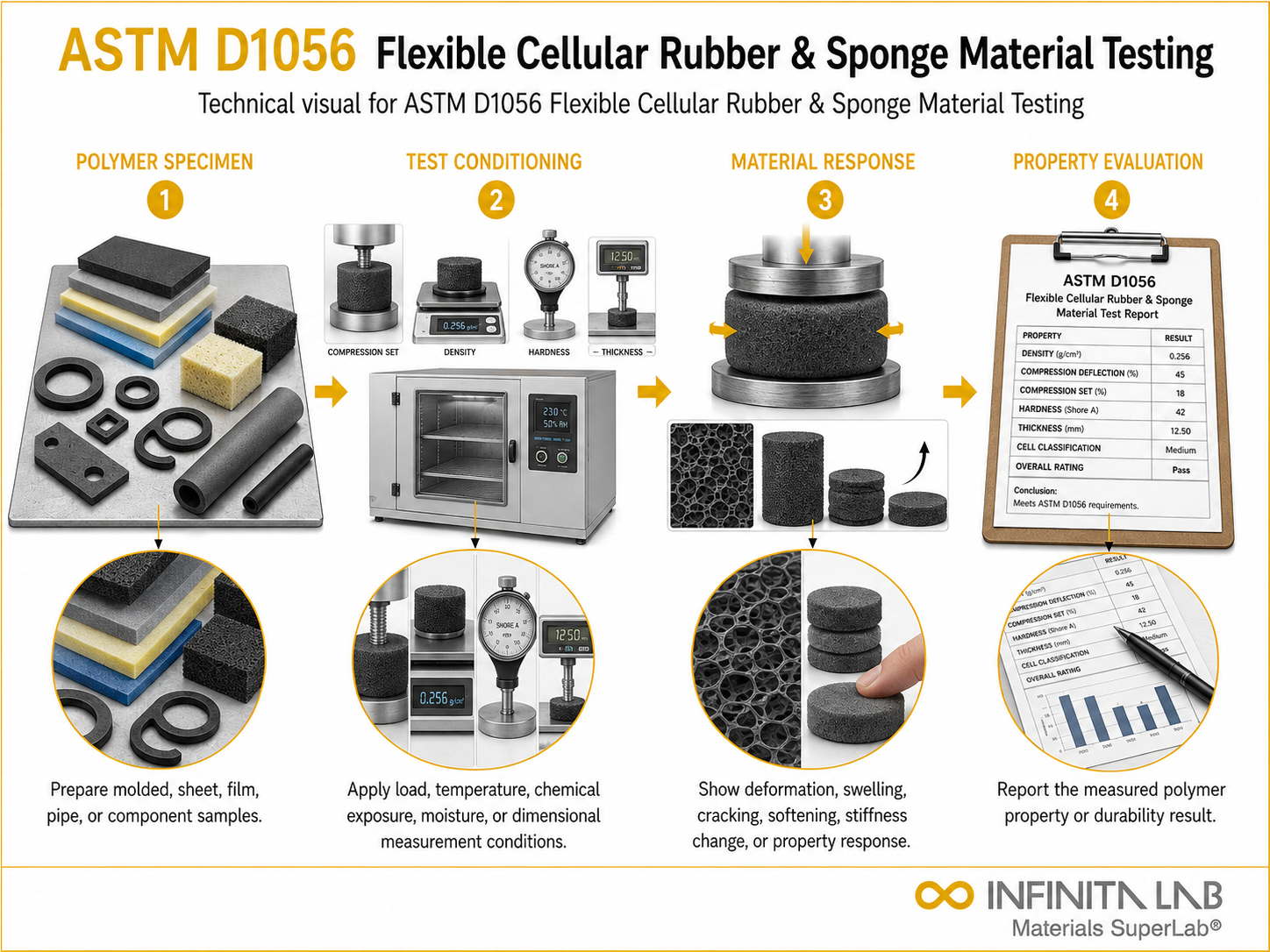
Our ASTM D1056 Testing Procedure
Sample Preparation
Specimens are cut to specified dimensions from cellular material.
1Conditioning
Samples are conditioned under controlled temperature and humidity.
2Property Testing
Compression, density, and other physical tests are conducted.
3Data Recording & Evaluation
Results are recorded and compared with classification requirements.
4ASTM D1056 Test Parameters and Requirements
| Parameter | Details |
|---|---|
| Applicable Materials | Flexible cellular rubber and plastics |
| Density Range | ~0.02 to 0.5 g/cm³ |
| Compression Deflection | ~10% to 50% strain |
| Water Absorption | ~1% to 20% |
| Test Temperature | ~23°C ± 2°C |
| Measured Outputs | Density, compression, recovery, absorption |


- Compression testing machine
- Density measurement setup
- Environmental conditioning chamber
- Thickness gauges
- Sample cutting tools
- Data acquisition system
Equipment and Instrumentation Used for ASTM D1056 Testing
What You Receive: Test Report, Data, and Certification
- Material classification results
- Density and compression values
- Recovery and resilience data
- Water absorption measurements
- Test condition summary
- ASTM compliance report
ASTM D1056 Flexible Cellular Rubber Sponge FAQs
ASTM D1056 classifies flexible cellular materials such as foam rubber and sponge materials. It defines physical requirements like compression, density, and resilience, helping ensure consistent performance in sealing, cushioning, and insulation applications.
Key parameters include density, compression deflection, compression set, tensile strength, and elongation. Environmental resistance properties may also be considered depending on material grade and application requirements.
The test provides classification based on physical properties and performance characteristics. Results indicate material suitability for specific applications like gasketing, vibration damping, and thermal insulation.
ASTM D1056 applies to flexible cellular materials including open-cell and closed-cell foams. These are used in automotive, construction, electronics, and industrial sealing applications.
ASTM D1056 provides standardized classification but may not cover all real-world conditions. Additional testing may be required for specific environments such as extreme temperatures, chemicals, or long-term aging effects.
Why Choose Infinita Lab for Flexible Cellular Rubber Sponge Testing
At the core of this breadth is our network of 2,000+ accredited laboratories across the USA, offering access to over 10,000 testing methods and analytical services. From advanced materials characterization (SEM, TEM, RBS, XPS) to mechanical, chemical, environmental, biological, and standardized ASTM/ISO-compliant testing, we deliver unmatched flexibility, specialization, and scale. You are never limited by geography, facility, or methodology — Infinita Lab connects you to the right expertise and testing solution, every time.

Need ASTM D1056 Flexible Cellular Rubber Sponge Testing You Can Rely On?
Send query us at hello@infinitalab.com or call us at (888) 878-3090 to learn more about our services and how we can support you.



Request a Quote
Submit your material details and receive testing procedures, pricing, and turnaround time within 24 hours.
 Quick Turnaround and Hasslefree process
 Confidentiality Guarantee
 Free, No-obligation Consultation
 100% Customer Satisfaction
