


Fungus Testing Services
A crucial method for determining how much a material will sustain microbial growth and how that growth might impair the material's performance is fungus testing. By being aware of the causes of fungal development and how it affects materials, we may choose the materials we use every day with confidence that they are secure and long-lasting.
TRUSTED BY


Get compliant results — request your fungus testing quote
- Overview
- Scope, Applications, and Benefits
- Test Process
- Specifications
- Instrumentation
- Results and Deliverables
What Is Fungus?
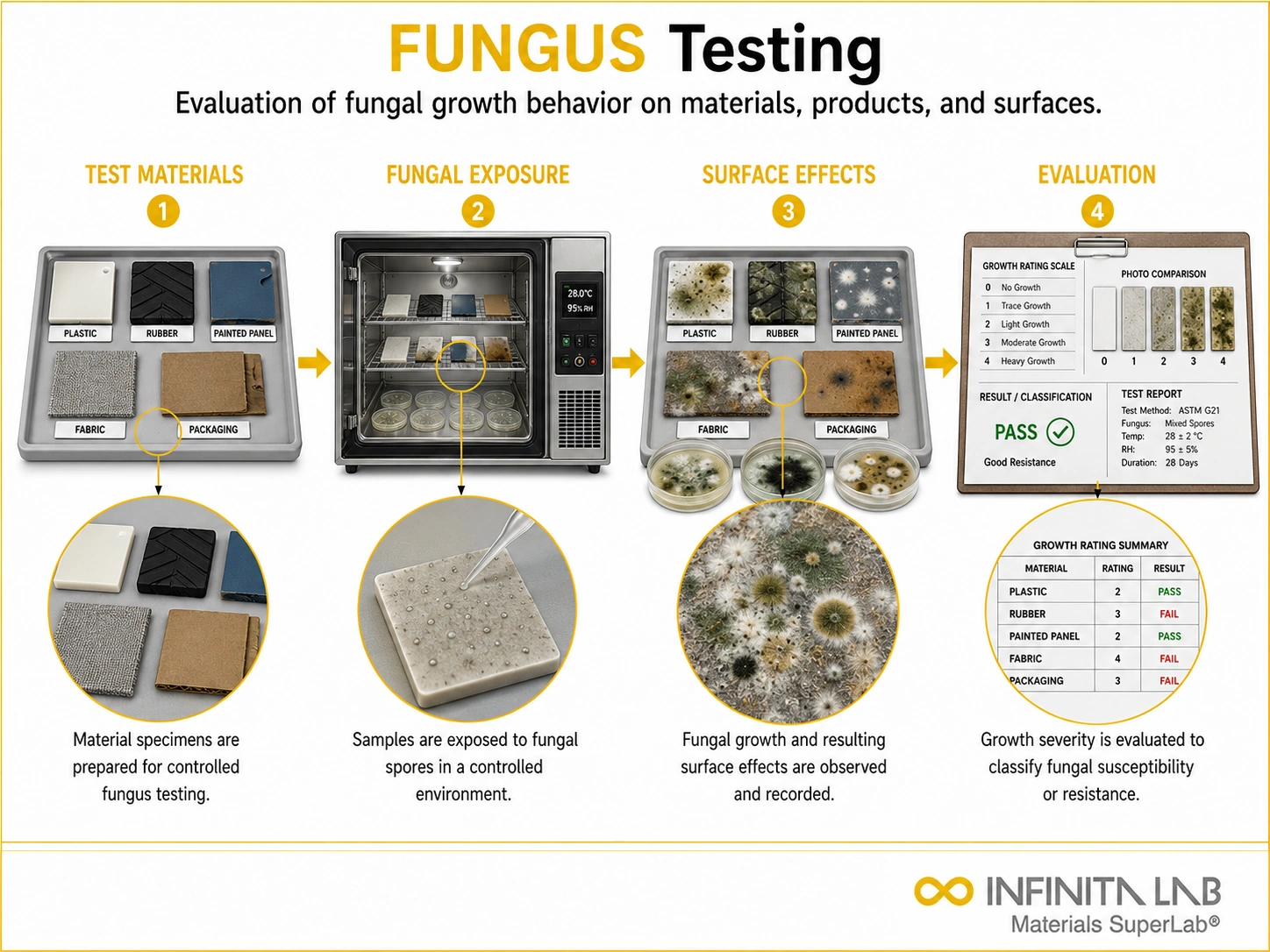
Fungus testing determines how much a material will support fungal growth and how that growth affects the material’s performance, appearance, and durability over time. Unlike a disinfectant efficacy test, which evaluates whether a product kills fungi, fungus testing on materials asks the opposite question: does the material itself resist fungal colonization, or does it provide nutrients and surface conditions that allow molds and other fungi to grow and degrade it?
The test works by inoculating the material with a standardized mixture of fungal spores and incubating it under warm, humid conditions that favor fungal growth – typically around 29°C and high relative humidity for 28 days. At the end of the exposure, the material is examined for visible fungal growth and for any associated effects such as discoloration, staining, surface etching, loss of strength, or impaired function. Growth is scored on a standardized rating scale.
Fungus testing is widely used for materials and products destined for tropical climates, humid storage, or any environment where mold growth is a known risk – including polymers, coatings, textiles, electronics, optical components, and packaging. The results guide material selection, formulation, and the decision of whether a fungicide or biocide treatment is needed.

Applications and Benefits of Fungus Testing
Scope
Fungus testing covers the evaluation of materials and products for their susceptibility to fungal growth under controlled, growth-promoting conditions. A spore suspension of specified fungal species is applied to the material, which is then incubated and examined for growth and degradation. Results are reported as a growth rating on a standardized scale.
Commonly referenced standards include:
- ASTM G21 – resistance of synthetic polymeric materials to fungi; the primary standard for plastics, coatings, rubbers, and related materials, using a defined fungal mix and 28-day incubation
- ISO 846 – evaluation of the action of microorganisms (fungi and bacteria) on plastics, covering both growth support and resulting property changes
- MIL-STD-810 Method 508 – fungus testing for military equipment and materials intended for tropical service
- IEC 60068-2-10 – mold growth testing for electrotechnical products and components
- AATCC 30 – antifungal/mildew resistance assessment for textile materials
The fungal species used typically include Aspergillus niger, Aspergillus flavus, Penicillium funiculosum, Trichoderma virens, and Chaetomium globosum, depending on the standard.
Applications
- Polymers, plastics, and coatings – evaluating whether a polymer formulation, coating, or additive package resists fungal growth, the most common use of ASTM G21 and ISO 846
- Electronics and electrical equipment – testing PCBs, enclosures, insulation, and components per IEC 60068-2-10 to confirm they will not support mold growth in humid operating conditions
- Textiles and technical fabrics – mildew and rot resistance of fabrics, outdoor textiles, and protective clothing per AATCC 30
- Optical and precision components – assessing optics, lenses, and instruments where fungal growth on surfaces can permanently impair function in humid environments
- Packaging materials – evaluating papers, films, boards, and adhesives used in humid or tropical-climate packaging to protect the contents
- Military and aerospace materials – qualifying non-metallic materials and equipment per MIL-STD-810 for deployment in tropical and high-humidity environments
- Building and construction materials – testing insulation, sealants, membranes, and finishes for mold resistance in moisture-exposed applications
Benefits
- Reproduces the conditions that cause mold failures in service – the warm, humid 28-day incubation replicates the tropical-environment conditions that drive fungal degradation in real use
- Identifies vulnerable materials before deployment – catching a material or formulation that supports fungal growth at the testing stage prevents field failures, appearance complaints, and costly product issues
- Covers a wide range of material types – plastics, coatings, textiles, electronics, and optics can all be evaluated using the applicable standard variant
- Guides formulation and treatment decisions – comparative testing of grades, additives, or biocide treatments shows clearly which options provide fungal resistance, supporting material and formulation choices
- Supports requirements in regulated sectors – military, aerospace, and electronics specifications often require fungus testing data before a material or product is accepted
Our Testing Procedure
Prepare and Inoculate
Size the specimens and apply the fungal spore suspension uniformly.
1Incubate
Maintain the samples at the specified temperature and humidity, typically for 28 days.
2Examine and Rate
Inspect for fungal growth, discoloration, or degradation and assign a 0–4 growth rating.
3Report Results
Record ratings, photographs, material effects, and compliance with the acceptance criteria.
4Test parameters and requirements
| Parameter | Details |
|---|---|
| Fungal Species (typical) | Aspergillus niger, A. flavus, Penicillium funiculosum, Trichoderma virens, Chaetomium globosum |
| Incubation Temperature | 29 ± 1°C (ASTM G21 / MIL-STD-810); per method |
| Relative Humidity | ≥95% RH |
| Test Duration | 28 days (standard); other durations per method |
| Inoculation | Spore suspension applied to specimen on nutrient-salts medium |
| Growth Rating Scale | 0 (none) to 4 (heavy, >60% coverage) |
| Specimen Types | Plastics, coatings, textiles, electronics, optics, packaging |
| Nutrient Basis | Minimal salts medium - material evaluated as the carbon source |


- Environmental humidity chamber with temperature and RH control
- Biosafety cabinet for spore suspension preparation and inoculation
- Optical microscope/magnifier for growth examination
- Incubator for fungal culture maintenance
- Spray applicator for inoculation
- Photographic documentation setup
Equipment and Instrumentation Used for Testing
What You Receive: Test Report, Data, and Certification
- Test report – specimen description, applicable standard, fungal species, incubation conditions, and duration
- Growth rating per specimen – visual growth rating (0–4) for each specimen with supporting photographs
- Material effect observations – any discoloration, surface etching, degradation, or functional change noted after incubation
- Pass/fail determination – result against the acceptance criterion of the applicable standard
- Control results – confirmation that the test environment supported growth on the controls, validating the test
- Photographic documentation – images of specimen surfaces showing the extent and distribution of any fungal growth
Fungus FAQs
Fungal growth can damage coatings, plastics, textiles, electronics and packaging materials. Testing helps confirm product durability, hygiene and suitability for humid or tropical environments.
Fungus testing is commonly performed on military equipment, electrical components, medical products, packaging, textiles, coatings and polymer materials. Products stored or used in high-humidity environments are especially vulnerable.
Test specimens are inoculated with selected fungal spores and placed in a controlled chamber. They are exposed to high humidity and warm temperatures for a specified period to encourage fungal growth.
Many fungus resistance tests require approximately 28 days of incubation. Some standards may specify shorter or longer durations depending on the product, material and evaluation criteria.
The specimen may experience staining, surface deterioration, corrosion or loss of electrical performance if it is susceptible to fungal attack. These changes help determine whether the material is suitable for service.
Why Choose Infinita Lab for Fungus Testing?
At the core of this breadth is our network of 2,000+ accredited laboratories across the USA, offering access to over 10,000 testing methods and analytical services. From advanced materials characterization (SEM, TEM, RBS, XPS) to mechanical, chemical, environmental, biological, and standardized ASTM/ISO-compliant testing, we deliver unmatched flexibility, specialization, and scale. You are never limited by geography, facility, or methodology — Infinita Lab connects you to the right expertise and testing solution, every time.

Looking for an Accredited Partner for Fungus Testing?
Send query us at hello@infinitalab.com or call us at (888) 878-3090 to learn more about our services and how we can support you.



Request a Quote
Submit your material details and receive testing procedures, pricing, and turnaround time within 24 hours.
 Quick Turnaround and Hasslefree process
 Confidentiality Guarantee
 Free, No-obligation Consultation
 100% Customer Satisfaction
