


Fracture Toughness Testing
Discover about fracture toughness testing and how it evaluates a material's ability to withstand the spread of cracks.
TRUSTED BY


Fracture Toughness Testing
- Overview
- Scope, Applications, and Benefits
- Test Process
- Specifications
- Instrumentation
- Results and Deliverables
Fracture Toughness Testing Overview
Fracture toughness is the property that indicates whether a material with a crack will hold or fail under a given stress. Every real structural component has flaws -from microscopic inclusions in a forging to fatigue cracks that accumulate in service. The question is not whether flaws exist but whether they will grow to a critical size under the applied loads before they are detected and repaired. Fracture toughness quantifies the resistance to catastrophic crack extension and is one of the most important mechanical properties in damage-tolerant design.
The three primary fracture toughness parameters each capture a different aspect of crack-tip behavior. K_IC, the plane-strain fracture toughness, is the linear-elastic parameter governing brittle fracture in high-strength materials, where plastic deformation at the crack tip is small. J-integral and CTOD (crack-tip opening displacement) extend fracture toughness characterization to materials that exhibit significant plasticity before fracture, such as structural steels, stainless steels, and aluminum alloys used in pressure-vessel and offshore applications. For composites, interlaminar fracture toughness (GIc and GIIc) characterizes delamination resistance under Mode I (opening) and Mode II (shear) loading. And for situations where a running crack arrests, KIa -the crack arrest toughness -defines the stress intensity below which crack propagation stops.
At Infinita Lab, we coordinate fracture toughness testing programs across the full range of methods through our network of accredited labs. Whether the requirement is a standard KIc determination for a high-strength aerospace alloy, J-R curve development for a pressure vessel steel, interlaminar toughness for a CFRP laminate, or crack arrest testing for a reactor pressure vessel steel, we connect clients to the right lab and help scope the program so the data generated actually answers the design or qualification question being asked.

Fracture Toughness Testing Scope, Applications, and Benefits
Scope
Fracture toughness testing services cover the full range of standard test methods applicable to metallic materials, polymer matrix composites, ceramics, and other structural materials. Methods covered include ASTM E1820 for KIc, J-integral, and CTOD in metallic materials; ASTM E399 for plane strain fracture toughness KIc; ASTM E1304 for plane strain fracture toughness by the chevron notch method; ASTM E1221 for crack arrest fracture toughness KIa in ferritic steels; ASTM D5528 for Mode I interlaminar fracture toughness GIc of polymer matrix composites; ASTM D7905 for Mode II interlaminar fracture toughness GIIc; ASTM E1922 for translaminar fracture toughness KTL of polymer matrix composites; and ASTM C1421 for fracture toughness of advanced ceramics. Sub-ambient and elevated temperature testing is available for temperature-dependent toughness characterization. Specimen geometries include compact tension (CT), single edge notch bend (SENB), disk-shaped compact, arc-shaped compact, and composite-specific geometries.
Applications
- Damage-tolerant design -establishing the critical flaw size and safe operating stress for structural components
- Fracture mechanics-based inspection interval setting for aerospace, pressure vessel, and pipeline applications
- Material qualification and selection based on fracture toughness for safety-critical structural applications
- KIc determination for high-strength steels, aluminum alloys, titanium alloys, and nickel superalloys
- J-R curve and CTOD development for structural steels and pressure vessel materials at ambient and sub-ambient temperatures
- Weld metal and heat-affected zone (HAZ) fracture toughness characterization for the fitness-for-service of welded structures
- Interlaminar fracture toughness (GIc, GIIc) testing for composite aerospace and wind energy structures
- Crack arrest toughness KIa for reactor pressure vessel and heavy plate steel qualification
- Ceramic and CMC fracture toughness for hot section components and wear applications
- Fitness-for-service assessments per API 579, BS 7910, and R6 fracture assessment procedures
Benefits
- Full method coverage from KIc and J-integral to interlaminar composite toughness and ceramic fracture toughness under one service condition
- Program scoping support ensures the right method, geometry, and validity criteria are identified before testing begins.
- Results directly feed fracture mechanics analysis, damage tolerance assessments, and fitness-for-service calculations.s
- Sub-ambient and elevated-temperature capability covers the ductile-to-brittle transition and high-temperature service conditions.ns
- Applicable to all major structural material classes -steels, aluminum, titanium, nickel alloys, composites, and ceramics
- Lab selection matched to the specific method, material, and specimen size requirements of the program.
- Recognized by aerospace, nuclear, pressure equipment, and offshore design codes as reference fracture toughness data
Fracture Toughness Testing Process
Test Program Scoping and Specimen Design
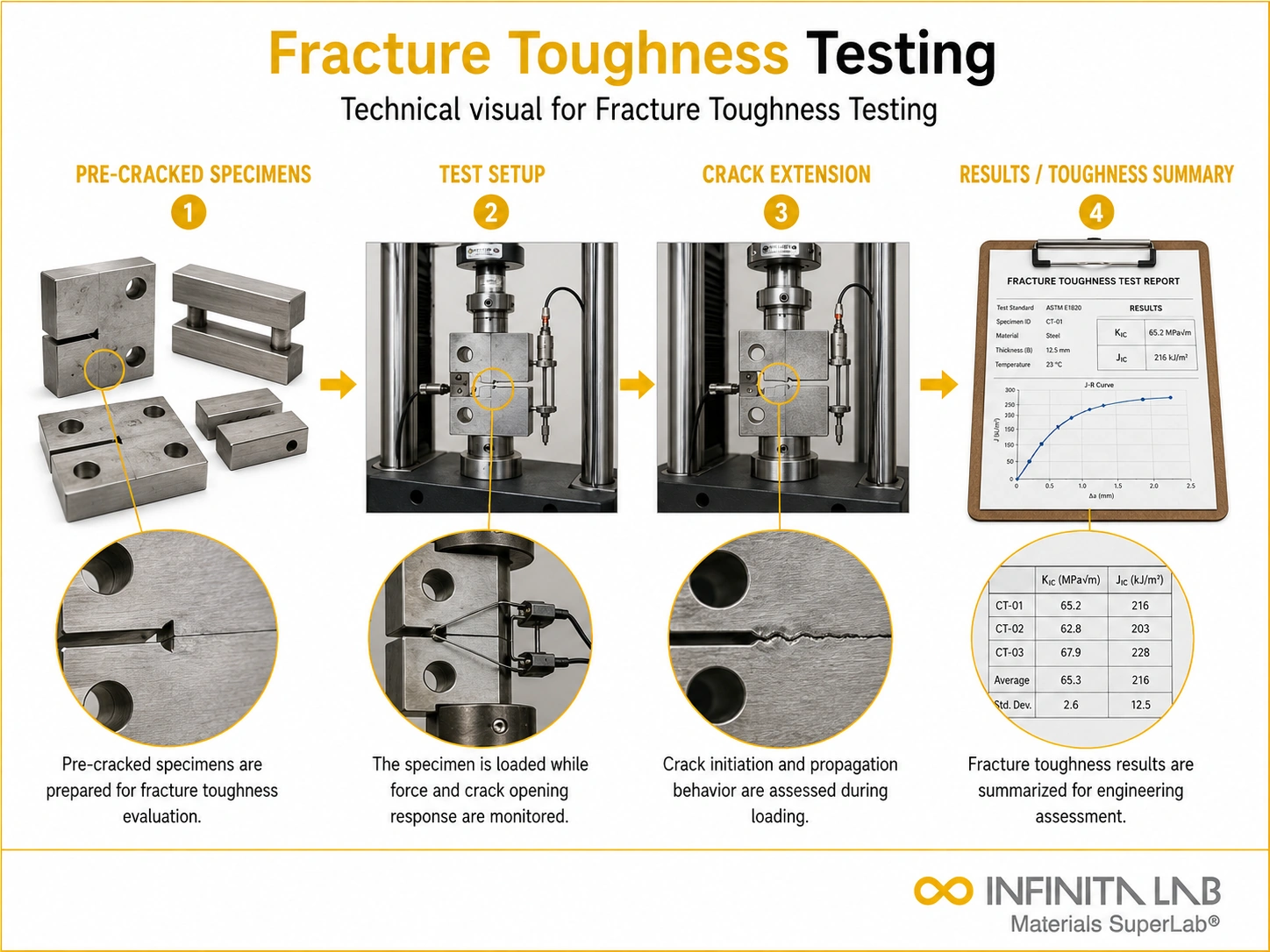
The required fracture toughness parameter (KIc, J, CTOD, GIc, GIIc, KIa, KTL) is identified based on the material
1Specimen Machining and Pre-Cracking
Specimens are machined to the required geometry with dimensional tolerances and surface finish confirmed.
2Fracture Testing and Data Acquisition
The fracture test is performed under the loading mode, rate, and temperature specified by the governing standard.
3Data Reduction, Validity Check, and Reporting
Fracture toughness parameters are calculated from the recorded data using the standard's analytical procedures.
4Fracture Toughness Testing Technical Specifications
| Parameter | Details |
|---|---|
| Service Type | Multi-method fracture toughness testing -method selected based on material, parameter required, and application |
| Metallic Materials Standards | ASTM E1820 (KIc, J, CTOD), ASTM E399 (KIc), ASTM E1304 (chevron notch), ASTM E1221 (KIa) |
| Composite Materials Standards | ASTM D5528 (GIc Mode I), ASTM D7905 (GIIc Mode II), ASTM E1922 (KTL translaminar) |
| Ceramics Standard | ASTM C1421 (KIc for advanced ceramics) |
| Specimen Geometries | CT, SENB, disk-shaped compact, arc-shaped compact, ENF, and others per applicable standard |
| Material Classes | Steels, aluminum alloys, titanium alloys, nickel alloys, polymer matrix composites, and advanced ceramics |


Instrumentation Used for Fracture Toughness Testing
- Servo-hydraulic or servo-electric testing machines with displacement and load control
- Crack mouth opening displacement (CMOD) clip gauges for crack length and J-integral measurement
- Back-face strain gauges for single-specimen compliance-crack-length monitoring.
- High-temperature and sub-ambient temperature conditioning systems
- Fatigue pre-cracking fixtures and load control systems for metallic specimen preparation
- Three-point and four-point bending fixtures for SENB and composite specimen geometries
- Optical and traveling microscopes for pre-crack and fracture surface measurement
- Fracture mechanics analysis software for J-R curve fitting, validity checking, and toughness calculation
Fracture Toughness Testing Results and Deliverables
- Fracture toughness values -KIc, K(J), J, CTOD, GIc, GIIc, KIa, or KTL as applicable to the test method
- J-R curve or CTOD-R curve for ductile materials tested with resistance curve methods
- Validity assessment confirming whether plane strain or other size requirements are satisfied.
- Pre-crack length measurements and fracture surface images with crack front geometry
- Load-displacement records and CMOD data from each specimen
- Test temperature, loading rate, and specimen orientation documentation
- Material identification, specimen geometry, and heat treatment or processing condition
- Full test report with all data, calculations, validity checks, and results formatted for design, qualification, or fitness-for-service use
Frequently Asked Questions
Fracture toughness testing measures a material’s resistance to crack initiation and propagation under stress. It provides a critical value (such as KIC) that indicates how likely a material is to fail once a crack is present.
Unlike tensile strength, fracture toughness accounts for existing flaws or cracks in a material. This makes it more representative of real-world failure conditions, especially in safety-critical components.
Common standards include ASTM E399, ASTM E1820, and ISO 12135, depending on material type and test method. These define specimen geometry, loading conditions, and valid data interpretation procedures.
The test can be applied to metals, alloys, polymers, composites, and ceramics, although specimen preparation and test method vary depending on material behavior (ductile vs brittle).
Results are influenced by material microstructure, temperature, loading rate, specimen thickness, and crack tip sharpness. Even small variations in preparation or testing conditions can significantly affect measured toughness.
Why Choose Infinita Lab for Advanced Materials Testing and Characterization?
At the core of this breadth is our network of 2,000+ accredited laboratories across the USA, offering access to over 10,000 testing methods and analytical services. From advanced materials characterization (SEM, TEM, RBS, XPS) to mechanical, chemical, environmental, biological, and standardized ASTM/ISO-compliant testing, we deliver unmatched flexibility, specialization, and scale. You are never limited by geography, facility, or methodology — Infinita Lab connects you to the right expertise and testing solution, every time.

Looking for a Trusted Partner for Accurate and Reliable Testing Services?
Send query us at hello@infinitlab.com or call us at (888) 878-3090 to learn more about our services and how we can support you.



Request a Quote
Submit your material details and receive testing procedures, pricing, and turnaround time within 24 hours.
 Quick Turnaround and Hasslefree process
 Confidentiality Guarantee
 Free, No-obligation Consultation
 100% Customer Satisfaction
