


ESD Testing Services
The endurance of electronic devices to electrostatic discharge incidents is assessed during ESD testing. Controlled discharges are used to evaluate performance, reliability, and protection levels. It makes goods more reliable overall and ensures they can resist real-world ESD events by helping to detect vulnerabilities and design flaws.
TRUSTED BY


Get compliant results — request your ESD testing quote
- Overview
- Scope, Applications, and Benefits
- Test Process
- Specifications
- Instrumentation
- Results and Deliverables
What Is ESD?
Electrostatic Discharge (ESD) testing evaluates how well an electronic device or component withstands the sudden transfer of electrical charge that occurs when two objects at different electrical potentials come into contact or close proximity. ESD events are extremely common – a person walking across a carpet can accumulate several thousand volts – and even a discharge too small to feel can damage or destroy sensitive electronic components. ESD testing applies controlled, repeatable discharges to a device to determine its threshold of damage and its ability to function during and after an ESD event.
ESD testing falls into two broad areas. Device-level (component) ESD testing characterizes the inherent robustness of semiconductor devices and ICs using models such as the Human Body Model (HBM), Charged Device Model (CDM), and Machine Model (MM). System-level ESD testing, governed by IEC 61000-4-2, evaluates whether a finished product continues to operate correctly when subjected to ESD events at its accessible surfaces, simulating real-world handling and use conditions.
ESD testing is essential across the electronics industry. Component-level data establishes the handling precautions and protection design needed for a device, while system-level testing confirms that a finished product will survive the ESD environment it will encounter in actual use. Both are key to product reliability and are required by industry standards and customer specifications.

Applications and Benefits of ESD Testing
Scope
ESD testing covers the evaluation of electronic components, devices, and finished products against controlled electrostatic discharge events, at both the device level and the system level. The applicable model and standard depend on whether the inherent robustness of a component or the performance of a finished system is being evaluated.
The testing covers:
- Human Body Model (HBM) – simulates the discharge from a charged person through a device; governed by ANSI/ESDA/JEDEC JS-001; the most common component-level ESD test
- Charged Device Model (CDM) – simulates discharge when a charged device contacts a conductive surface; governed by ANSI/ESDA/JEDEC JS-002; increasingly important for modern high-speed ICs
- Machine Model (MM) – simulates discharge from a charged conductive machine or tool through a device
- System-level ESD (IEC 61000-4-2) – applies contact and air discharges to the accessible surfaces of a finished product and evaluates its operation against defined performance criteria
- Discharge methods – contact discharge (direct application to conductive surfaces) and air discharge (approach to surfaces until arc-over)
- Performance evaluation – for components, the failure threshold voltage is determined; for systems, the device is monitored for upset, degradation, or damage against pass/fail criteria
Applications
- Semiconductor and IC robustness characterization – determining the HBM, CDM, and MM withstand voltage of components, which establishes the ESD protection level designed into the device and the handling precautions required in manufacturing
- System-level product evaluation – testing finished electronic products per IEC 61000-4-2 to confirm they continue to function when subjected to ESD events during handling and use
- Consumer electronics – ESD evaluation of devices with user-accessible surfaces, ports, and controls that will be handled by people who may carry electrostatic charge
- Automotive electronics – ESD testing of components and modules per automotive standards (such as ISO 10605 for system-level automotive ESD) where the in-vehicle environment presents specific discharge conditions
- Medical devices – ESD evaluation per IEC 60601-1-2 to ensure medical electronic equipment is not disrupted or damaged by ESD events in clinical use
- Industrial and IoT devices – confirming that equipment used in environments where ESD is likely will survive and continue operating
- Design validation and qualification – ESD testing during development to identify protection weaknesses early and verify that the ESD protection design meets the target levels before production
Benefits
- Quantifies ESD robustness in clear terms – component testing yields a withstand voltage threshold and system testing yields a pass/fail against defined levels, giving concrete data for design and qualification decisions
- Covers both inherent and in-use ESD risk – device-level models characterize the component’s built-in robustness, while system-level testing confirms real-world survivability; together they address the full ESD risk picture
- Identifies protection weaknesses before production – finding ESD vulnerabilities during development, when protection design can still be changed, avoids costly redesign and field failures after launch
- Establishes handling requirements – component ESD data defines the ESD-safe handling precautions needed in manufacturing and assembly, reducing damage and yield loss
- Required by industry standards and customers – ESD performance levels are specified in JEDEC, IEC, and customer requirements; ESD test data is needed to qualify components and products for use and sale
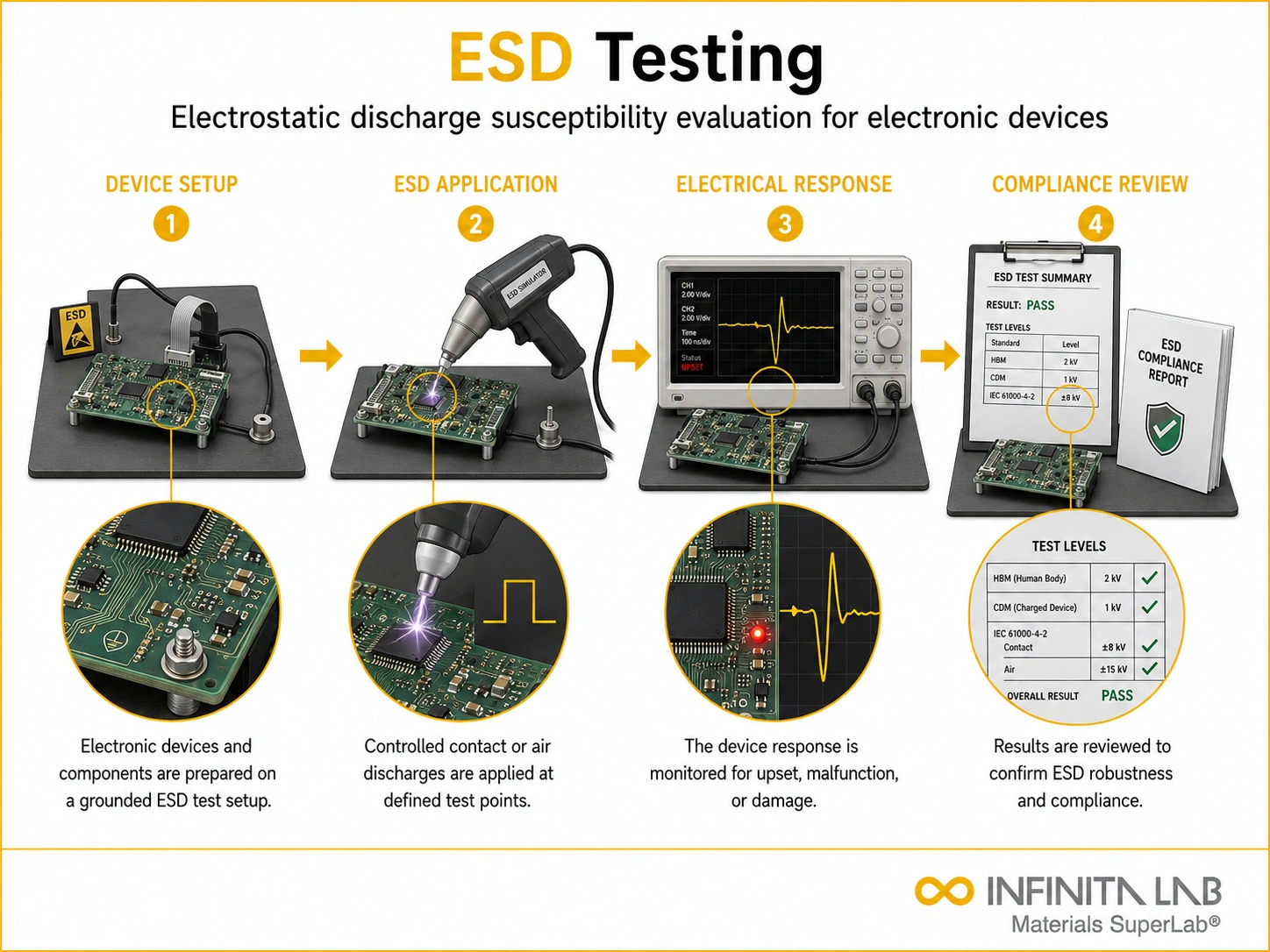
ESD (Electrostatic Discharge) Testing Process
Define the Test
Select the ESD standard, model, voltage levels, discharge points, and operating conditions.
1Establish the Baseline
Record initial electrical or functional performance before applying ESD.
2Apply ESD Pulses
Deliver controlled discharges at specified points and voltage levels while monitoring the device.
3Evaluate and Report
Check for electrical or functional failures and report the withstand level or pass/fail result.
4ESD (Electrostatic Discharge) Testing Technical Specifications
| Parameter | Details |
|---|---|
| Component Models | Human Body Model (HBM), Charged Device Model (CDM), Machine Model (MM) |
| Component Standards | ANSI/ESDA/JEDEC JS-001 (HBM), JS-002 (CDM) |
| System Standard | IEC 61000-4-2 (and ISO 10605 for automotive) |
| Discharge Methods | Contact discharge, air discharge |
| Voltage Levels | Stepped per standard (e.g., hundreds of volts to several kV or more) |
| Performance Criteria | Component: failure threshold voltage; System: operation vs. defined criteria |
| Device Types | Semiconductors, ICs, modules, finished electronic products |


- ESD simulator / ESD gun (contact and air discharge, IEC 61000-4-2)
- Component ESD test system (HBM/CDM/MM capable)
- Parametric test equipment for pre- and post-stress device measurement
- Discharge network and probes per the applicable model
- Ground reference plane and test table setup (system-level)
- Device monitoring equipment for functional evaluation during discharge
Equipment and Instrumentation Used for Testing
What You Receive: Test Report, Data, and Certification
- ESD test report – the model(s) and standard applied, voltage levels, discharge points, and the pass/fail or threshold outcome
- Component withstand threshold – the HBM, CDM, or MM voltage level the device withstood, establishing its ESD classification level
- System-level results – the device’s performance at each applied discharge level against the defined performance criteria, with any upset or damage documented
- Pre- and post-stress data – electrical parameter measurements (component) or functional status (system) before and after discharge
- Discharge point mapping – the locations on the device or product where discharges were applied (system-level)
- Device identification and setup records – device description, operating mode, test configuration, and conditions
ESD FAQs
Static discharge can damage sensitive circuits even when the discharge is not visible or felt. Testing helps improve product reliability, reduce manufacturing failures and verify that suitable ESD protection measures are in place.
ESD testing is commonly performed on integrated circuits, printed circuit boards, consumer electronics, medical devices, automotive electronics and industrial control equipment. It can be conducted at both component and complete-product levels.
The primary component-level test models are the Human Body Model and Charged Device Model. Equipment-level immunity testing commonly uses contact and air-discharge methods specified in IEC 61000-4-2.
In contact discharge testing, the ESD gun tip touches the test point before the discharge is applied. In air discharge testing, the charged tip approaches the product until the voltage breaks down the air gap and creates a spark.
Testing typically uses an ESD simulator or ESD gun, discharge tips, coupling planes, grounding cables and a test table. Monitoring equipment is also used to detect resets, data errors, performance changes or permanent damage.
Why Choose Infinita Lab for ESD Testing
At the core of this breadth is our network of 2,000+ accredited laboratories across the USA, offering access to over 10,000 testing methods and analytical services. From advanced materials characterization (SEM, TEM, RBS, XPS) to mechanical, chemical, environmental, biological, and standardized ASTM/ISO-compliant testing, we deliver unmatched flexibility, specialization, and scale. You are never limited by geography, facility, or methodology — Infinita Lab connects you to the right expertise and testing solution, every time.

Looking for an Accredited Partner for ESD Testing?
Send query us at hello@infinitalab.com or call us at (888) 878-3090 to learn more about our services and how we can support you.



Request a Quote
Submit your material details and receive testing procedures, pricing, and turnaround time within 24 hours.
 Quick Turnaround and Hasslefree process
 Confidentiality Guarantee
 Free, No-obligation Consultation
 100% Customer Satisfaction
