


Electrical Testing Services
Electrical testing comprises a suite of testing services, including inspection, certification, monitoring, compliance, and safety testing. Test results obtained from our testing labs are utilized for different stages of product development and manufacturing by industries all over the USA and other countries in the world.
TRUSTED BY


Get compliant results — request your electrical testing quote
- Overview
- Scope, Applications, and Benefits
- Test Process
- Specifications
- Instrumentation
- Results and Deliverables
What Is Electrical?
Electrical testing evaluates the electrical properties of materials, components, and finished products – how they conduct, insulate, withstand voltage, and respond to electrical stress. For electrical and electronic products, these properties are fundamental to both performance and safety. A wire insulation that breaks down under voltage, a connector housing that conducts instead of insulates, or a component that fails a high-potential test can all lead to product failure or a shock and fire hazard in service. Electrical testing verifies these properties before products reach the field.
The tests divide broadly into two related areas. Electrical properties testing of materials – primarily insulating and semi-conductive materials – determines properties such as dielectric strength (the voltage at which a material breaks down), volume and surface resistivity, dielectric constant, and dissipation factor. These are material characterization tests, widely standardized in ASTM D149 (dielectric strength), ASTM D257 (resistivity), ASTM D150 (dielectric constant and dissipation factor), and ASTM D3638 (comparative tracking index). Electrical safety testing of products – covering dielectric withstand (hipot), insulation resistance, ground continuity, and leakage current – verifies that finished products are electrically safe per IEC, UL, and related product safety standards.
Together these capabilities support material selection for electrical insulation, incoming and production quality control of insulating materials, and product safety verification across electronics, electrical equipment, cables and wiring, and medical devices.

Applications and Benefits of Electrical Testing
Scope
Electrical testing covers the determination of electrical properties of insulating and semi-conductive materials and the electrical safety verification of components and finished products, using standardized test methods.
Key tests within the scope include:
- Dielectric strength – the voltage per unit thickness at which an insulating material breaks down under an applied electric field (ASTM D149); short-time and step-by-step procedures
- Volume and surface resistivity – resistance to current flow through (volume) and across the surface of (surface) an insulating material (ASTM D257)
- Dielectric constant and dissipation factor – the material’s ability to store and dissipate energy in an electric field (ASTM D150), important for signal integrity and insulation loss
- Comparative tracking index (CTI) – resistance of a solid insulating material to surface tracking under electrical stress in the presence of a contaminant solution (ASTM D3638 / IEC 60112)
- Dielectric withstand / hipot test – applying a high voltage to a finished product to confirm its insulation withstands the test voltage without breakdown
- Insulation resistance – measuring the resistance of insulation between conductors or between a conductor and ground, confirming adequate isolation
- Ground continuity and leakage current – verifying that safety grounding is intact and that leakage current is within the safe limit for a product
- Applicable standards – ASTM D149, D257, D150, D3638; IEC 60243, IEC 60112; IEC 60950/62368 and UL product safety standards for equipment testing
Applications
- Insulating material characterization – determining the dielectric strength, resistivity, and dielectric constant of polymers, ceramics, laminates, films, and other electrical insulating materials
- Cable and wire insulation – verifying that insulation materials meet the dielectric and resistivity requirements for cable and wire applications
- Printed circuit board materials – characterizing the dielectric constant and loss tangent of PCB laminates that affect signal integrity
- Electrical equipment and appliances – hipot, insulation resistance, ground continuity, and leakage-current testing for product safety verification
- Medical devices – electrical safety testing of medical electrical equipment per IEC 60601 and related standards
- Incoming material QC – verifying that incoming insulating materials meet their electrical property specifications before use in production
- Comparative tracking index – qualifying insulating materials for equipment where tracking and creepage are safety concerns
Benefits
- Verifies both materials and products – the same electrical testing capability addresses material dielectric properties and finished-product safety, covering the full development and production chain
- Identifies insulation failures before field deployment – dielectric strength and hipot testing reveal insulation weaknesses before a product reaches the customer, preventing electrical failures and safety incidents
- Quantifies key insulation properties – resistivity, dielectric strength, and dissipation factor give objective, comparable data for insulating material selection and quality control
- Supports product safety standards – hipot, insulation resistance, and leakage-current testing provide the evidence needed for product safety qualification under IEC, UL, and equivalent standards
- CTI supports creepage/clearance design – comparative tracking index data informs the creepage and clearance decisions required in equipment design under IEC 60664 and similar standards
- Applicable across industries – the same core electrical testing capability serves electronics, cable, appliances, medical devices, aerospace, and automotive
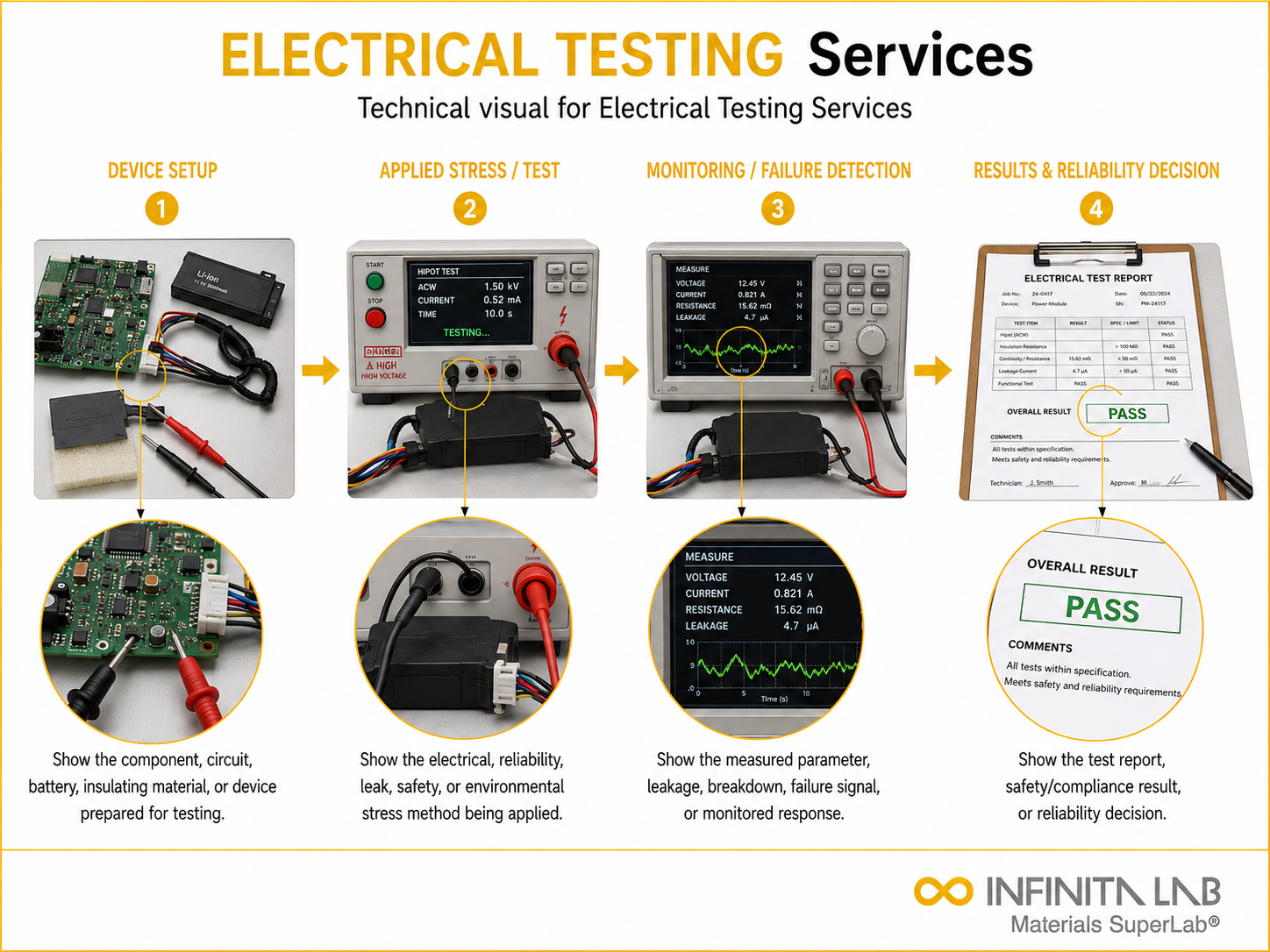
Our Testing Procedure
Select the Test
Choose the required electrical property or safety test, standard, voltage, and frequency.
1Prepare the Sample
Condition and configure the material specimen or product according to the test standard.
2Perform the Measurement
Apply the specified electrical test and record voltage, current, resistance, or breakdown.
3Evaluate and Report
Compare results with requirements and document the measured values and pass/fail outcome.
4Test parameters and requirements
| Parameter | Details |
|---|---|
| Volume/Surface Resistivity | ASTM D257 |
| Dielectric Constant / Loss | ASTM D150 |
| Comparative Tracking Index | ASTM D3638 / IEC 60112 |
| Dielectric Withstand (Hipot) | Product safety standards (IEC 60950/62368, UL, IEC 60601) |
| Insulation Resistance | Per applicable product or material standard |
| Ground Continuity | Per product safety standard |
| Leakage Current | Per product safety standard |


- High-voltage test set for dielectric strength and hipot testing
- Electrometer/high-resistance meter and guarded electrode assembly (resistivity per ASTM D257)
- LCR meter or impedance analyzer (dielectric constant and dissipation factor per ASTM D150)
- Tracking index test apparatus (CTI per ASTM D3638/IEC 60112)
- Insulation resistance tester (Megohmmeter)
- Ground bond/continuity tester
- Leakage current tester
- Conditioning chamber for humidity and temperature preconditioning
Equipment and Instrumentation Used for Testing
What You Receive: Test Report, Data, and Certification
- Electrical test report – measured properties or safety test results for each test performed, with the standard, test conditions, and pass/fail determination documented
- Dielectric strength – breakdown voltage and voltage gradient (V/mm) with the test procedure used
- Resistivity – volume resistivity and surface resistivity results
- Dielectric constant and dissipation factor – measured values at the specified frequency/frequencies
- CTI result – comparative tracking index value and the material classification
- Safety test results – hipot, insulation resistance, leakage current, and ground continuity pass/fail outcomes for product testing
- Specimen/product records – material or product identification, specimen dimensions, conditioning, and electrode/configuration details
Electrical FAQs
Testing helps reduce the risk of electric shock, fire, equipment damage and unexpected downtime. It also supports product certification, regulatory compliance and quality assurance.
Dielectric strength, or hipot testing, applies a high voltage across insulation to check for electrical breakdown. It verifies that the product can withstand voltage stress without unsafe current flow.
Insulation resistance testing measures the resistance between conductive parts separated by insulation. Low resistance may indicate moisture, contamination, ageing or damaged insulation.
Leakage current testing measures unintended current flowing through insulation, grounding paths or accessible surfaces. Excessive leakage may create an electric-shock hazard.
Functional testing verifies that a product operates correctly at specified voltage, current, frequency and load conditions. Performance may be monitored during normal operation and simulated fault conditions.
Why Choose Infinita Lab for Electrical Testing?
At the core of this breadth is our network of 2,000+ accredited laboratories across the USA, offering access to over 10,000 testing methods and analytical services. From advanced materials characterization (SEM, TEM, RBS, XPS) to mechanical, chemical, environmental, biological, and standardized ASTM/ISO-compliant testing, we deliver unmatched flexibility, specialization, and scale. You are never limited by geography, facility, or methodology — Infinita Lab connects you to the right expertise and testing solution, every time.

Looking for an Accredited Partner for Electrical Testing?
Send query us at hello@infinitalab.com or call us at (888) 878-3090 to learn more about our services and how we can support you.



Request a Quote
Submit your material details and receive testing procedures, pricing, and turnaround time within 24 hours.
 Quick Turnaround and Hasslefree process
 Confidentiality Guarantee
 Free, No-obligation Consultation
 100% Customer Satisfaction
