


Contact Angle Measurement Testing Services
The technique of measuring contact angles is used to quantify the wetting qualities of a liquid droplet on a solid surface. It is widely employed in a wide range of scientific disciplines, including surface chemistry, materials science, and fluid dynamics. The contact angle is the angle formed at the three-phase boundary where the liquid, solid, and gas (usually air) meet.
TRUSTED BY


Get compliant results — request your contact angle measurement testing quote
- Overview
- Scope, Applications, and Benefits
- Test Process
- Specifications
- Instrumentation
- Results and Deliverables
What Is Contact Angle Measurement?
Contact Angle Measurement is one of the more popular ways of determining the level of wetting between a liquid and a surface. By examining the angle at which the liquid rests on the surface, we can determine the balance between the adhesive forces holding the liquid to the surface and the cohesive forces within the liquid.
This concept is also vital in determining the hydrophilic or hydrophobic nature of the surface, as well as its surface energy properties. If the contact angle is small, then the surface is hydrophilic; otherwise, the surface is hydrophobic. It is widely used in the field of material science, coatings, polymers, and surface treatment processes.

Applications and Benefits of Contact Angle Measurement Testing
Scope
Contact angle measurement applies to a wide range of solid surfaces, including metals, polymers, glass, and ceramics, as well as coated and uncoated materials, thin films, and treated surfaces. This technique is used to evaluate how liquids interact with solid surfaces under controlled conditions, providing critical insights into surface properties such as wettability, adhesion, and cleanliness.
Key parameters evaluated include:
- Static contact angle
- Dynamic contact angle (advancing and receding)
- Surface energy and its components
- Wettability characteristics
Applications
- Surface treatment evaluation (plasma, corona, chemical)
- Coating adhesion studies
- Cleanliness assessment of surfaces
- Ink, paint, and adhesive performance testing
- Polymer surface characterisation
- Semiconductor and thin film industries
Benefits
- Provides quantitative measurement of wettability
- Helps optimise coating performance
- Detects surface contamination and cleanliness
- Supports surface modification studies
- Non-destructive and rapid analysis
- Applicable to a wide range of materials
- Enhances product quality and reliability
- Enables surface energy calculation
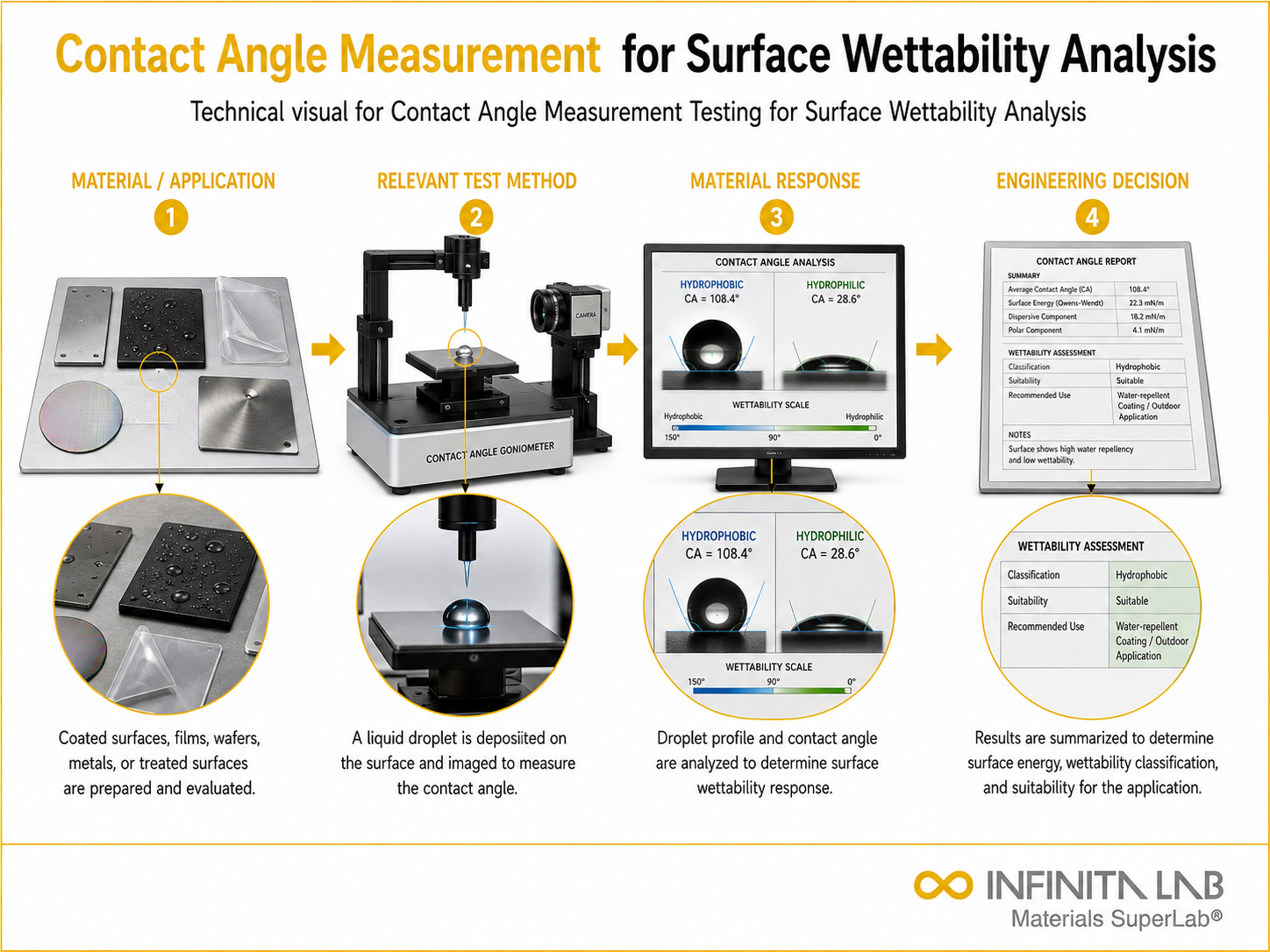
Our Testing Procedure
Sample Preparation & Droplet Deposition
The surface is cleaned and a small liquid droplet is placed on it using a micro-syringe.
1Image Capture & Angle Measurement
The droplet profile is captured and the contact angle is measured using image analysis.
2Dynamic Measurement
Advancing and receding contact angles are determined by varying the droplet volume.
3Surface Energy Calculation & Reporting
Surface energy is calculated using test liquids and results are analyzed.
4Test parameters and requirements
| Parameter | Details |
|---|---|
| Applicable Materials | Metals, polymers, glass, ceramics, coatings, thin films |
| Test Liquids | Water, diiodomethane, ethylene glycol (or similar) |
| Measurement Type | Static and dynamic contact angle |
| Output Units | Degrees (°) for contact angle, mN/m for surface energy |
| Analysis Type | Qualitative and quantitative |


- Contact angle goniometer
- Micro-syringe for droplet dispensing
- Illumination source
- Sample stage (manual or automated)
- Image analysis software
- Temperature and humidity control
Equipment and Instrumentation Used for Testing
What You Receive: Test Report, Data, and Certification
- Static contact angle values
- Advancing and receding contact angles
- Surface energy values and components
- Wettability classification (hydrophilic/hydrophobic)
- Surface cleanliness assessment
- Comparative analysis reports
Contact Angle Measurement FAQs
A low contact angle (< 90°) indicates a hydrophilic (wettable) surface, while a high contact angle (> 90°) indicates a hydrophobic (non-wettable) surface.
It can be used for metals, polymers, glass, ceramics, coatings, thin films, and treated surfaces.
Common test liquids include water, diiodomethane, and ethylene glycol, depending on the surface energy calculation method.
Static contact angle is measured from a stationary droplet, while dynamic contact angles (advancing and receding) are measured by increasing or decreasing the droplet volume.
Surface energy helps predict adhesion, coating performance, and wettability, which are critical for applications like painting, printing, and bonding.
Why Choose Infinita Lab for Contact Angle Measurement Testing?
At the core of this breadth is our network of 2,000+ accredited laboratories across the USA, offering access to over 10,000 testing methods and analytical services. From advanced materials characterization (SEM, TEM, RBS, XPS) to mechanical, chemical, environmental, biological, and standardized ASTM/ISO-compliant testing, we deliver unmatched flexibility, specialization, and scale. You are never limited by geography, facility, or methodology — Infinita Lab connects you to the right expertise and testing solution, every time.

Looking for an Accredited Partner for Contact Angle Measurement Testing?
Send query us at hello@infinitalab.com or call us at (888) 878-3090 to learn more about our services and how we can support you.



Request a Quote
Submit your material details and receive testing procedures, pricing, and turnaround time within 24 hours.
 Quick Turnaround and Hasslefree process
 Confidentiality Guarantee
 Free, No-obligation Consultation
 100% Customer Satisfaction
