


ASTM D6484: Composite Open Hole Compression Testing Services
ASTM D6484 describes the open-hole compressive strength of multidirectional polymer grid composite covers built up by high-modulus filaments. SI units or inch-pound units are the standards. Read more about astm D6484 below.
TRUSTED BY


Get ASTM D6484 compliant results — request your composite open hole compression testing quote
- Overview
- Scope, Applications, and Benefits
- Test Process
- Specifications
- Instrumentation
- Results and Deliverables
What Is ASTM D6484 Composite Open Hole Compression?
ASTM D6484 determines the open-hole compressive strength (OHC) of fiber-reinforced polymer matrix composites by evaluating how a material behaves under compressive load in the presence of a centrally located hole. The test simulates stress concentration effects found in bolted or fastened structures.
The method is essential for aerospace, automotive, and structural composite applications where holes are unavoidable. It provides critical data on load-bearing capacity, failure modes, and structural reliability, enabling engineers to design safer and more efficient composite components under compressive stress conditions.

Applications and Benefits of ASTM D6484 Composite Open Hole Compression Testing
Scope
This test evaluates compressive strength reduction due to stress concentration from a hole.
- Measurement of open-hole compressive strength
- Applicable to laminated composite materials
- Evaluation of stress concentration effects
- Simulation of real-world fastener holes
- Assessment of compressive failure behavior
- Used for material qualification and design validation
Applications
- Aerospace structural components
- Aircraft fuselage and wing structures
- Automotive composite parts
- Wind turbine blades
- Marine composite structures
- Industrial load-bearing composite panels
Benefits
- Evaluates structural integrity under realistic conditions
- Identifies stress concentration effects
- Supports material selection and design optimization
- Helps predict failure modes
- Improves safety in composite structures
- Enables standardized comparison of materials
Our ASTM D6484 Testing Procedure
Specimen Preparation
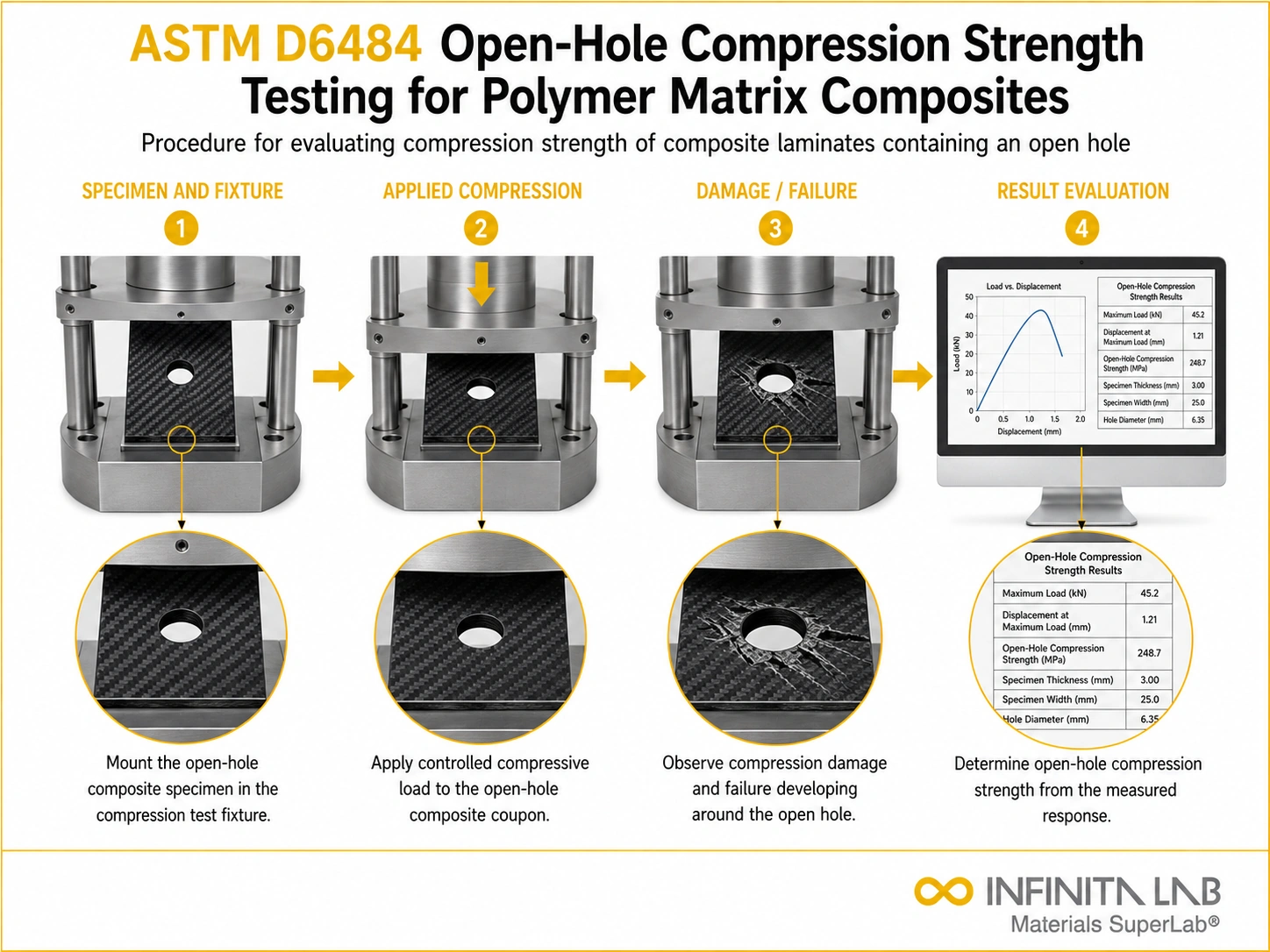
Composite specimens are machined with a centrally located hole and conditioned under controlled conditions.
1Fixture Setup
The specimen is placed in a compression fixture aligned to ensure uniform load application.
2Load Application
A compressive load is applied gradually until failure occurs, simulating structural stress conditions.
3Data Recording
Load, displacement, and failure mode are recorded to determine open-hole compressive strength.
4ASTM D6484 Test Parameters and Requirements
| Parameter | Details |
|---|---|
| Specimen type | Laminated fiber-reinforced composite |
| Hole diameter | Standardized based on specimen dimensions |
| Loading method | Axial compressive loading |
| Alignment tolerance | Strict alignment to prevent bending |
| Test speed | Controlled displacement or load rate |
| Support fixture | Anti-buckling compression fixture |
| Failure mode | Net-section or bearing failure |
| Environmental conditions | Controlled temperature and humidity |


- Universal Testing Machine (UTM)
- Compression test fixture with anti-buckling support
- Precision alignment fixtures
- Displacement measurement system (extensometer)
- Load cell
- Specimen machining tools
- Data acquisition system
Equipment and Instrumentation Used for ASTM D6484 Testing
What You Receive: Test Report, Data, and Certification
- Open-hole compressive strength value
- Load-displacement curves
- Failure mode analysis
- Stress-strain behavior data
- Specimen deformation details
- Test report with environmental conditions
ASTM D6484 Composite Open Hole Compression FAQs
The hole introduces stress concentration, reducing the material’s load-bearing capacity. This localized stress leads to earlier failure initiation compared to unnotched specimens, making OHC critical for understanding real structural performance in bolted or fastened composite components.
Stress concentration amplifies localized stress around the hole, often triggering premature failure. Understanding this effect helps engineers design structures that can withstand load redistribution and prevent catastrophic failure in real-world applications.
Fiber orientation significantly affects load distribution. Load-aligned fibers improve compressive strength, while off-axis orientations can reduce resistance to buckling and promote matrix cracking, influencing failure modes and overall performance.
Typical failures include fiber microbuckling, delamination, matrix cracking, and shear failure. The presence of the hole often accelerates these mechanisms, especially under high compressive loads.
The stacking sequence influences stress distribution. Balanced and symmetric layups improve stability, while unbalanced configurations may lead to uneven stress distribution and reduced compressive strength.
Why Choose Infinita Lab for Composite Open Hole Compression Testing?
At the core of this breadth is our network of 2,000+ accredited laboratories across the USA, offering access to over 10,000 testing methods and analytical services. From advanced materials characterization (SEM, TEM, RBS, XPS) to mechanical, chemical, environmental, biological, and standardized ASTM/ISO-compliant testing, we deliver unmatched flexibility, specialization, and scale. You are never limited by geography, facility, or methodology — Infinita Lab connects you to the right expertise and testing solution, every time.

Need ASTM D6484 Composite Open Hole Compression Testing You Can Rely On?
Send query us at hello@infinitalab.com or call us at (888) 878-3090 to learn more about our services and how we can support you.



Request a Quote
Submit your material details and receive testing procedures, pricing, and turnaround time within 24 hours.
 Quick Turnaround and Hasslefree process
 Confidentiality Guarantee
 Free, No-obligation Consultation
 100% Customer Satisfaction
