


ASTM D5946: Contact Angle Surface Energy Testing Services
Use of Water Contact Angle Measurements for Corona-Treated Polymer Films is done by ASTM D5946. The surface characteristics of a polymer film decide how well the polymer films can retain the surface coatings. The contact angle of a water droplet on the polymer film surface indicates its ability to accept and retain surface coatings.
TRUSTED BY


Get ASTM D5946 compliant results — request your contact angle surface energy testing quote
- Overview
- Scope, Applications, and Benefits
- Test Process
- Specifications
- Instrumentation
- Results and Deliverables
What Is ASTM D5946 Contact Angle Surface Energy?
ASTM D5946 evaluates the contact angle of liquids on corona-treated polymer film surfaces to determine surface wettability and surface energy characteristics. It measures the angle formed between a liquid droplet and the film surface, providing a quantitative indication of how well the surface can be wetted by liquids such as inks, coatings, or adhesives. This is critical for ensuring proper bonding and surface interaction.
The method is widely used to assess the effectiveness of surface treatments like corona discharge, which increase surface energy and improve adhesion properties. By analyzing contact angle values, ASTM D5946 helps manufacturers optimize treatment processes, maintain consistent surface quality, and ensure reliable performance in applications requiring strong adhesion and uniform coating behavior.

Applications and Benefits of ASTM D5946 Contact Angle Surface Energy Testing
Scope
ASTM D5946 covers the determination of contact angle on corona-treated polymer films to evaluate wettability and surface energy. It focuses on measuring liquid-solid interaction characteristics.
- Applicable to polymer film surfaces
- Measures contact angle (degrees)
- Evaluates surface wettability and energy
- Assesses effectiveness of corona treatment
- Supports adhesion and coating performance analysis
Applications
- Surface treatment evaluation of films
- Printing and ink adhesion testing
- Coating and lamination processes
- Packaging material quality control
- Adhesive bonding performance
- Film extrusion and conversion industries
- Research and development studies
Benefits
- Provides accurate wettability measurement
- Supports improved adhesion performance
- Ensures consistent surface treatment quality
- Helps optimize corona treatment processes
- Enhances coating and printing results
- Enables reliable material comparison
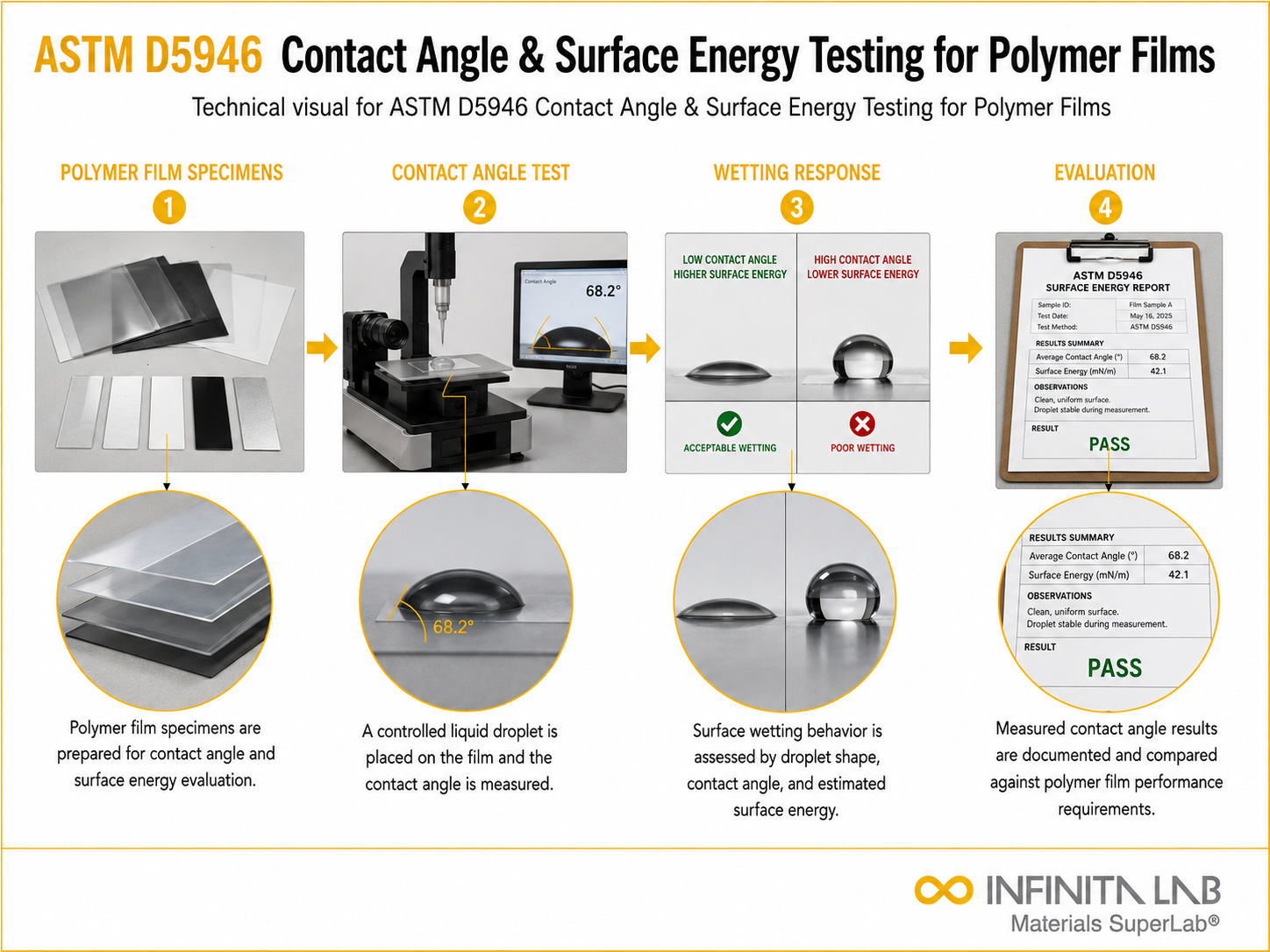
Our ASTM D5946 Testing Procedure
Sample Preparation
Film surface is cleaned and conditioned to ensure accurate contact angle measurement.
1Droplet Application
A controlled liquid droplet is placed on the film surface using a precision dispenser.
2Angle Measurement
The contact angle formed between the droplet and surface is measured using optical methods.
3Data Analysis
Contact angle values are analyzed to determine surface wettability and treatment effectiveness.
4ASTM D5946 Test Parameters and Requirements
| Parameter | Details |
|---|---|
| Material Type | Polymer films |
| Test Method | Optical droplet analysis |
| Output | Contact angle (degrees) |
| Liquids Used | Water or standard test liquids |
| Measurement System | Optical imaging |
| Surface Condition | Treated or untreated films |


- Contact angle goniometer
- Precision liquid dispenser
- Optical imaging system
- Sample stage
- Light source
- Data analysis software
Equipment and Instrumentation Used for ASTM D5946 Testing
What You Receive: Test Report, Data, and Certification
- Contact angle values (degrees)
- Surface wettability assessment
- Surface energy evaluation
- Treatment effectiveness analysis
- Comparative material performance
- Detailed test report
ASTM D5946 Contact Angle Surface Energy FAQs
ASTM D5946 is a standardized method for measuring the surface wettability of corona-treated polymer films using water contact angle measurements. It helps determine the film's ability to accept and retain surface coatings like inks, adhesives, and paints.
A lower contact angle means the polymer film has greater wettability, which signifies an increased ability to accept and hold coatings. It is essential for its functionality in different coating applications.
ASTM D5946 is important because it quantifies surface wettability through contact angle measurement, directly influencing adhesion, coating uniformity, and printing quality. Accurate evaluation ensures treated films meet performance requirements for bonding, coating, and surface interaction applications.
The contact angle measures the wettability of the polymer film's surface. The lower the contact angle, the higher the wettability, which reflects that the film will better accept and retain coatings. It is an essential factor for printing, coating, or adhesion processes.
ASTM D5946 measures changes in contact angle before and after treatment, allowing assessment of how effectively corona discharge has increased surface energy and improved wettability for better adhesion and coating performance.
Why Choose Infinita Lab for Contact Angle Surface Energy Testing?
At the core of this breadth is our network of 2,000+ accredited laboratories across the USA, offering access to over 10,000 testing methods and analytical services. From advanced materials characterization (SEM, TEM, RBS, XPS) to mechanical, chemical, environmental, biological, and standardized ASTM/ISO-compliant testing, we deliver unmatched flexibility, specialization, and scale. You are never limited by geography, facility, or methodology — Infinita Lab connects you to the right expertise and testing solution, every time.

Need ASTM D5946 Contact Angle Surface Energy Testing You Can Rely On?
Send query us at hello@infinitalab.com or call us at (888) 878-3090 to learn more about our services and how we can support you.



Request a Quote
Submit your material details and receive testing procedures, pricing, and turnaround time within 24 hours.
 Quick Turnaround and Hasslefree process
 Confidentiality Guarantee
 Free, No-obligation Consultation
 100% Customer Satisfaction
