


Ceramic Tube Hoop Tensile Strength
The hoop tensile strength of an advanced ceramic tube is a measure of its ability to withstand tensile stresses applied in a circumferential direction around the tube. This type of testing is typically performed to evaluate the mechanical properties of advanced ceramic materials, which are often used in high-performance applications such as aerospace, automotive, and biomedical engineering.
TRUSTED BY


Ceramic Tube Hoop Tensile Strength
- Overview
- Scope, Applications, and Benefits
- Test Process
- Specifications
- Instrumentation
- Results and Deliverables
Ceramic Tube Hoop Tensile Strength Overview
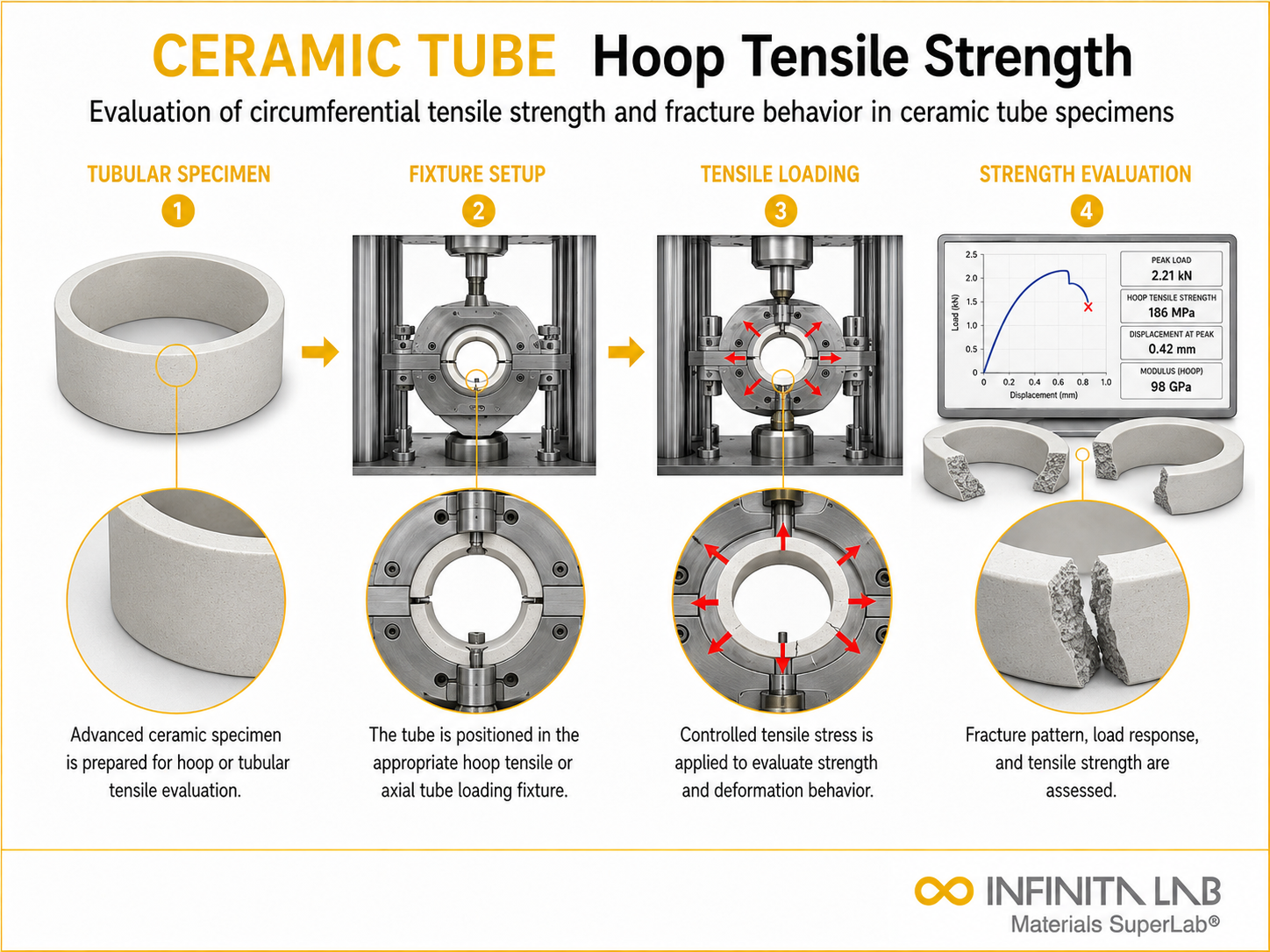
Hoop tensile strength testing of ceramic tubes measures the circumferential tensile stress that a tubular ceramic component can withstand before fracturing. When a ceramic tube is subjected to internal pressure – from a pressurized fluid, gas, or mechanical expansion – the tube wall develops hoop (circumferential) stress. This stress acts perpendicular to the tube axis and is the primary failure driver for internally pressurized ceramic tubes, which makes hoop tensile strength a design-critical property for ceramic components used in pressure containment, heat exchange, and flow system applications.
The test is performed by applying a controlled internal pressure to the ceramic tube, typically through hydraulic pressurization of the tube bore or by using a mechanical split-ring or C-ring loading fixture. Hydraulic pressurization most closely replicates actual service loading and allows uniform pressure distribution along the tube length. The C-ring method, standardized in ASTM C1323, uses mechanical loading applied to a ring cut from the tube wall and is more practical for small-diameter tubes or when hydraulic test equipment is not available.
Ceramic tubes are used in heat exchangers, thermocouple protection tubes, ceramic membranes for filtration, kiln furniture, and high-temperature chemical processing equipment. In all these applications, the wall must sustain differential pressure without fracturing. Because ceramics are brittle and fail at stress concentrations without plastic deformation, hoop tensile strength data must be combined with Weibull statistical analysis to characterize the probability of failure at a given stress level across a population of tubes.

Ceramic Tube Hoop Tensile Strength Scope, Applications, and Benefits
Scope
Hoop tensile strength testing applies to tubular ceramic components in alumina, silicon carbide, silicon nitride, zirconia, cordierite, and other technical ceramic systems. The test is relevant wherever the tube is subjected to radial or internal pressure loading in service. Evaluation areas include:
- Hoop tensile strength and fracture stress of ceramic tube walls
- Weibull modulus and characteristic strength for statistical failure probability analysis
- Effect of wall thickness and tube diameter on hoop strength
- Influence of manufacturing method (extrusion, isostatic pressing, slip casting) on strength
- Effect of surface finish and post-processing treatments on hoop strength
- Strength retention after thermal cycling or environmental exposure
Applications
- High-temperature heat exchanger tube qualification
- Thermocouple protection tube pressure rating verification
- Ceramic membrane and filter tube structural qualification
- Kiln furniture tube and roller assessment
- Chemical and petrochemical reactor tube material evaluation
- Research and development for new ceramic tube compositions and geometries
Benefits
- Measures the failure mode most relevant to internally pressurized ceramic tube service
- Provides Weibull statistical data for reliability-based design
- Detects manufacturing variability that affects structural reliability
- Supports pressure rating calculations for ceramic tube components
- Applicable to a wide range of ceramic material systems and tube geometries
- Data directly usable in finite element stress analysis and design verification
Ceramic Tube Hoop Tensile Strength Process
Specimen Preparation
Tubes are cut to the specified gauge length and end conditions are prepared.
1Test Setup
For hydraulic testing, the tube ends are sealed and pressurization connections are made
2Load Application to Fracture
Pressure or mechanical load is applied at a controlled rate until the ceramic fractures.
3Data Analysis
Hoop stress at fracture is calculated from fracture pressure and tube geometry.
4Ceramic Tube Hoop Tensile Strength Technical Specifications
| Parameter | Details |
|---|---|
| Test Methods | Hydraulic internal pressurization, C-ring mechanical loading (ASTM C1323) |
| Applicable Materials | Alumina, silicon carbide, silicon nitride, zirconia, cordierite, and other technical ceramics |
| Measured Property | Hoop tensile strength (fracture stress in circumferential direction) |
| Statistical Analysis | Weibull modulus and characteristic strength from population data |
| Output Units | MPa (hoop stress at fracture) |
| Specimen Form | Tubular sections or C-rings cut from tubes |


Instrumentation Used for Ceramic Tube Hoop Tensile Strength
- Hydraulic pressurization system with pressure measurement and control
- C-ring loading fixture and universal testing machine (ASTM C1323 method)
- High-pressure tubing and sealing end caps for hydraulic testing
- Dimensional measurement tools for tube wall geometry characterization
- Data acquisition system for pressure or load recording at fracture
- Weibull analysis software for statistical strength distribution characterization
Ceramic Tube Hoop Tensile Strength Results and Deliverables
- Hoop tensile strength at fracture for each specimen
- Weibull characteristic strength and modulus from population analysis
- Failure probability curve as a function of applied hoop stress
- Fracture origin location and morphology were determined
- Tube dimensional records (wall thickness, diameter, gauge length)
- Quality assurance documentation
Frequently Asked Questions
Hoop tensile strength measures a ceramic tube's ability to resist circumferential tensile stresses before failure. It is an important property for components subjected to internal pressure or thermal expansion.
This test is widely used for ceramics intended for aerospace, energy, chemical processing, electronics, and high-temperature industrial applications where mechanical reliability is critical.
The test applies a controlled radial load that induces tensile stress around the tube's circumference until fracture occurs. The maximum stress sustained before failure is reported as the hoop tensile strength.
Yes. Hoop tensile testing can be performed on various advanced ceramics, including alumina, zirconia, silicon carbide, silicon nitride, and other engineered ceramic materials, provided suitable fixtures are used.
Why Choose Infinita Lab for Advanced Materials Testing and Characterization?
At the core of this breadth is our network of 2,000+ accredited laboratories across the USA, offering access to over 10,000 testing methods and analytical services. From advanced materials characterization (SEM, TEM, RBS, XPS) to mechanical, chemical, environmental, biological, and standardized ASTM/ISO-compliant testing, we deliver unmatched flexibility, specialization, and scale. You are never limited by geography, facility, or methodology — Infinita Lab connects you to the right expertise and testing solution, every time.

Looking for a Trusted Partner for Accurate and Reliable Testing Services?
Send query us at hello@infinitlab.com or call us at (888) 878-3090 to learn more about our services and how we can support you.



Request a Quote
Submit your material details and receive testing procedures, pricing, and turnaround time within 24 hours.
 Quick Turnaround and Hasslefree process
 Confidentiality Guarantee
 Free, No-obligation Consultation
 100% Customer Satisfaction
