


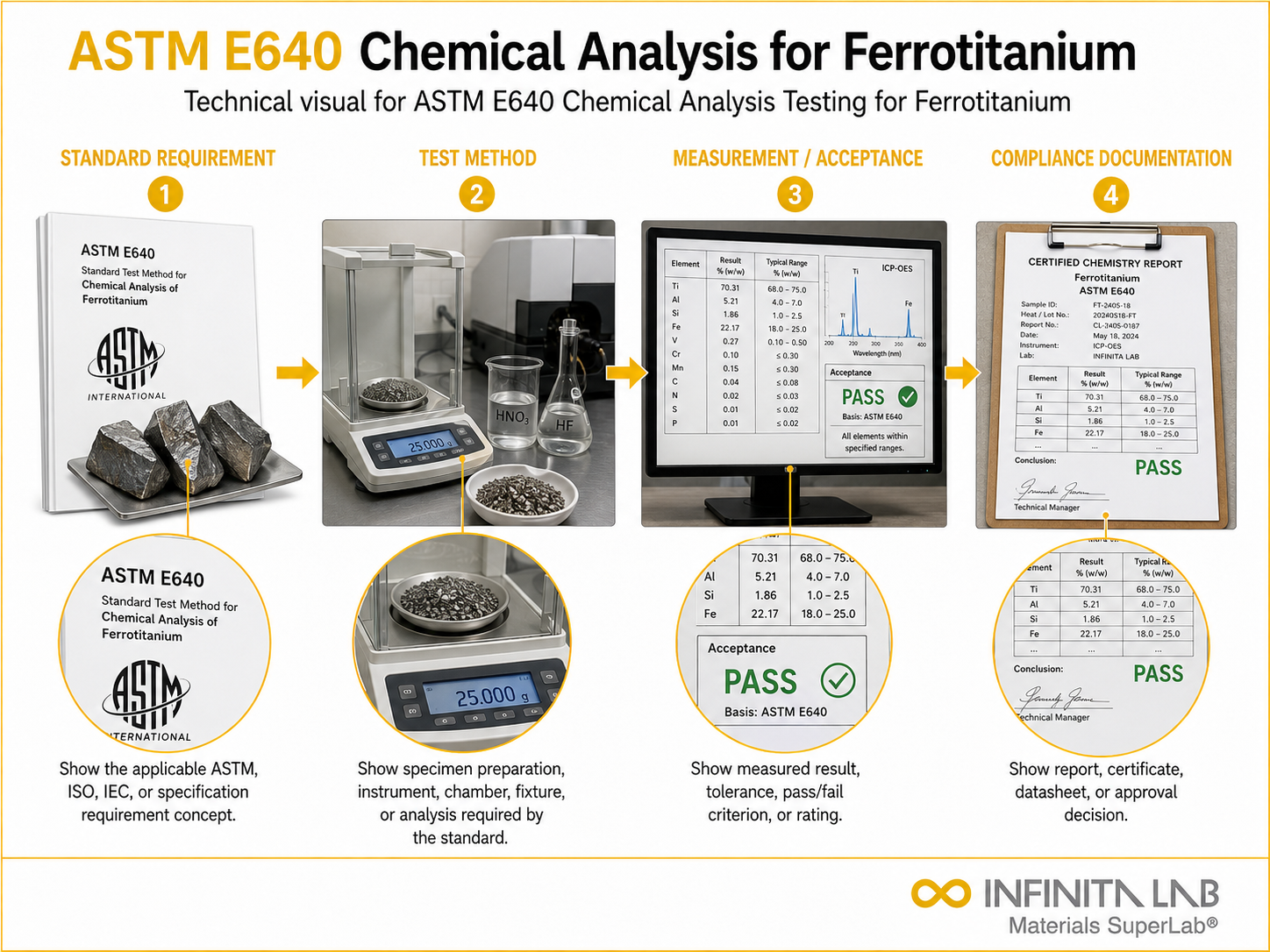
ASTM E640: Ferrotitanium Chemical Analysis Testing Services
ASTM E640 − 06 method is used to determine whether preservatives are suitable for use in cosmetic compositions. It establishes the model's minimum standards for preservation performance formulations. Values expressed in SI units are to be regarded as standard.
TRUSTED BY


Get ASTM E640 compliant results — request your ferrotitanium chemical analysis testing quote
- Overview
- Scope, Applications, and Benefits
- Test Process
- Specifications
- Instrumentation
- Results and Deliverables
What Is ASTM E640 Ferrotitanium Chemical Analysis?
ASTM E640 – 06 defines analytical procedures for determining preservatives in water-containing cosmetic products. The method focuses on identifying and quantifying antimicrobial agents used to prevent microbial growth and ensure product safety and shelf stability.
This standard is critical for quality control and regulatory compliance in cosmetic formulations. Accurate preservative analysis ensures effectiveness against contamination while maintaining safe concentration levels, supporting product integrity and consumer safety in water-based cosmetic systems.

Applications and Benefits of ASTM E640 Ferrotitanium Chemical Analysis Testing
Scope
ASTM E640 establishes methods for the qualitative and quantitative analysis of preservatives in cosmetics containing water. It ensures reliable detection and measurement under controlled laboratory conditions.
The method addresses complex cosmetic matrices where preservatives must be extracted and analyzed without interference from other formulation components such as emulsifiers, oils, and fragrances.
- Applicable to creams, lotions, shampoos, and other water-based cosmetics
- Identifies and quantifies antimicrobial preservatives
- Suitable for complex multi-component formulations
- Supports both qualitative and quantitative analysis
- Ensures accurate separation from interfering substances
- Enables compliance verification with formulation standards
Applications
- Quality control of cosmetic formulations
- Regulatory compliance verification
- Shelf-life and stability studies
- Product safety assessment
- Raw material and finished product testing
- Research and formulation development
- Detection of preservative degradation
- Validation of antimicrobial effectiveness
Benefits
- Ensures accurate preservative concentration measurement
- Supports product safety and microbial stability
- Detects formulation inconsistencies and degradation
- Enables compliance with cosmetic regulations
- Improves formulation quality and reliability
- Reduces risk of microbial contamination
- Provides standardized analytical methodology
- Supports product development and validation
Our ASTM E640 Testing Procedure
Sample Preparation
Prepare cosmetic sample by homogenization and extraction to isolate preservative compounds from the matrix.
1Separation Technique
Apply chromatographic or chemical separation methods to isolate individual preservatives.
2Detection & Quantification
Measure preservative concentration using appropriate analytical instruments and calibration standards.
3Data Analysis & Reporting
Analyze results against specifications and report concentration levels and compliance status.
4ASTM E640 Test Parameters and Requirements
| Parameter | Details |
|---|---|
| Standard | ASTM E640 – 06 |
| Method | Chemical and chromatographic analysis |
| Analytes | Cosmetic preservatives |
| Sample Type | Water-containing cosmetic products |
| Extraction Type | Solvent extraction or chemical preparation |
| Measurement Type | Qualitative and quantitative determination |
| Units | Percentage (%) or ppm |


- High-performance liquid chromatography (HPLC) system
- Gas chromatography (GC) system (if applicable)
- UV-Visible detector or spectrophotometer
- Analytical balance for precise weighing
- Sample preparation and extraction equipment
- Data acquisition and processing system
Equipment and Instrumentation Used for ASTM E640 Testing
What You Receive: Test Report, Data, and Certification
- Concentration of preservatives (% or ppm)
- Identification of individual preservative compounds
- Calibration and analytical data
- Compliance status with formulation limits
- Test conditions and methodology details
- Final analytical report
ASTM E640 Ferrotitanium Chemical Analysis FAQs
ASTM E640 uses selective extraction and chromatographic separation techniques to isolate preservatives from emulsifiers, oils, and fragrances, ensuring accurate quantification without interference from other formulation components present in water-containing cosmetics.
Insufficient preservative levels can allow microbial growth, while excessive concentrations may cause skin irritation or regulatory non-compliance, making precise quantification essential for balancing safety and effectiveness.
Chromatography separates individual components based on chemical properties, preventing co-elution and enabling precise identification and quantification of each preservative compound.
Degradation products may interfere with detection or co-elute with target compounds, requiring careful method selection and validation to avoid inaccurate quantification.
Advancements such as high-resolution chromatography, automated sample preparation, and sensitive detectors enhance accuracy, reduce analysis time, and improve reproducibility in preservative testing.
Why Choose Infinita Lab for Ferrotitanium Chemical Analysis Testing
At the core of this breadth is our network of 2,000+ accredited laboratories across the USA, offering access to over 10,000 testing methods and analytical services. From advanced materials characterization (SEM, TEM, RBS, XPS) to mechanical, chemical, environmental, biological, and standardized ASTM/ISO-compliant testing, we deliver unmatched flexibility, specialization, and scale. You are never limited by geography, facility, or methodology — Infinita Lab connects you to the right expertise and testing solution, every time.

Looking for an Accredited Partner for ASTM E640 Ferrotitanium Chemical Analysis Testing?
Send query us at hello@infinitalab.com or call us at (888) 878-3090 to learn more about our services and how we can support you.



Request a Quote
Submit your material details and receive testing procedures, pricing, and turnaround time within 24 hours.
 Quick Turnaround and Hasslefree process
 Confidentiality Guarantee
 Free, No-obligation Consultation
 100% Customer Satisfaction
