


ASTM E1178: Acrylonitrile Analysis Testing Services
ASTM E1178 test method determines characteristics of acrylonitrile by covering its analysis to detect impurities. The final results of this method are displayed keeping in view the international standards and inch-pound units.
TRUSTED BY


Get ASTM E1178 compliant results — request your acrylonitrile analysis testing quote
- Overview
- Scope, Applications, and Benefits
- Test Process
- Specifications
- Instrumentation
- Results and Deliverables
What Is ASTM E1178 Acrylonitrile Analysis?
ASTM E1178 specifies a standardized analytical method for the quantitative determination of acrylonitrile in various matrices using chromatographic techniques. Acrylonitrile is a volatile, toxic monomer widely used in polymer production, making its accurate detection critical for safety, quality control, and regulatory compliance.
The method typically employs gas chromatography (GC) for precise separation and quantification, ensuring reliable detection even at low concentrations. ASTM E1178 is widely applied in industrial hygiene, environmental monitoring, and product testing, helping identify contamination, verify material composition, and ensure adherence to safety standards.

Applications and Benefits of ASTM E1178 Acrylonitrile Analysis Testing
Scope
ASTM E1178 establishes procedures for determining acrylonitrile concentration in samples using chromatographic analysis. It ensures accurate identification and quantification through controlled sample preparation and analytical conditions.
- Determines acrylonitrile content in various matrices
- Applicable to environmental, industrial, and material samples
- Uses gas chromatographic separation and detection
- Requires proper sample preparation and calibration
- Ensures reproducible and sensitive analytical results
Applications
- Monitoring acrylonitrile levels in industrial environments
- Quality control in polymer and chemical manufacturing
- Environmental contamination assessment
- Occupational safety and exposure analysis
- Raw material and product verification
- Research and analytical studies
Benefits
- Provides accurate and sensitive acrylonitrile detection
- Supports regulatory compliance and safety standards
- Enables early identification of contamination
- Ensures product quality and consistency
- Allows trace-level analysis with high precision
- Enhances reliability of analytical results
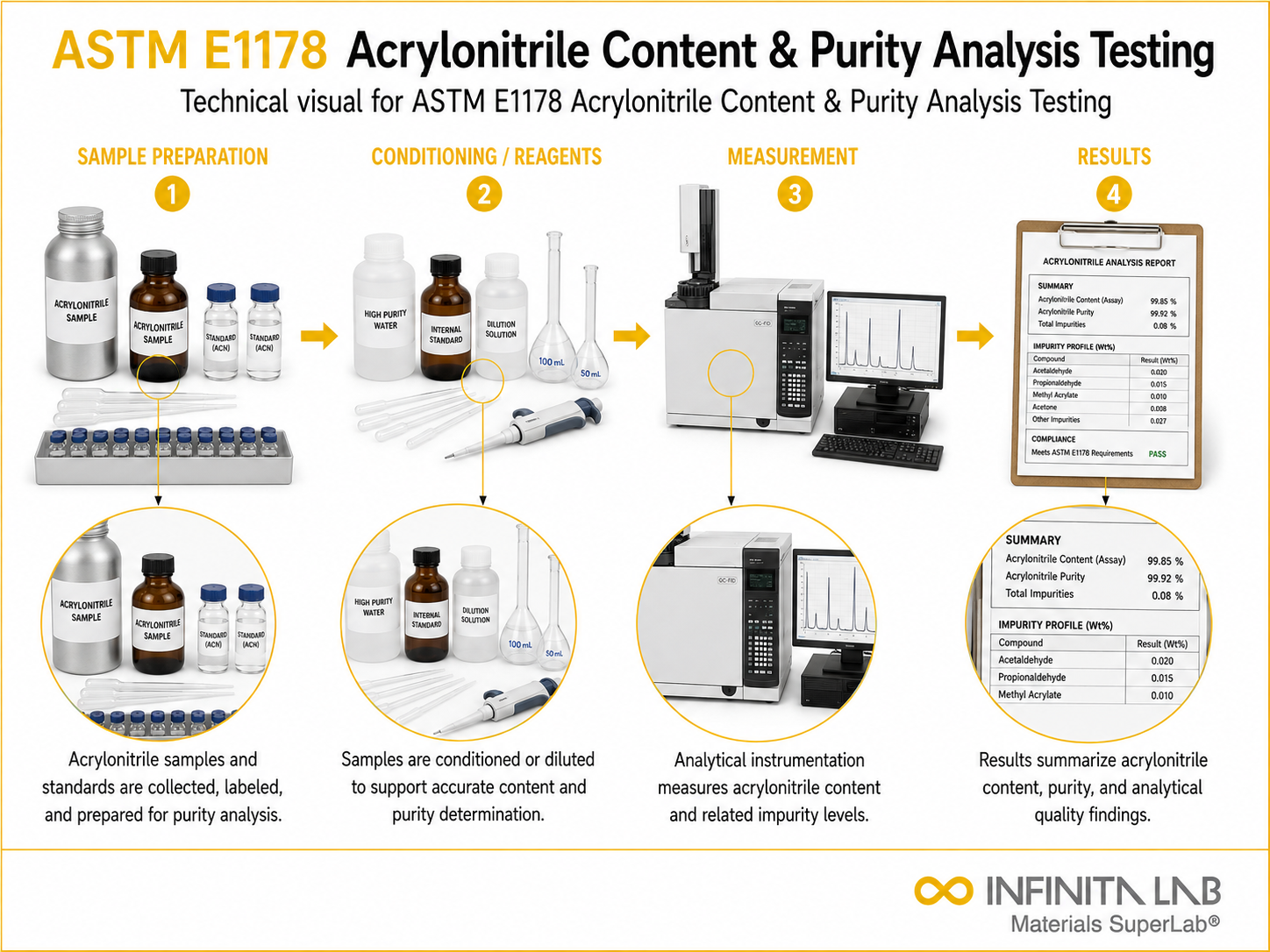
Our ASTM E1178 Testing Procedure
Sample Preparation
Samples are collected and prepared using appropriate extraction or dilution techniques.
1Chromatographic Separation
Acrylonitrile is separated from other components using gas chromatography.
2Detection and Quantification
The compound is detected and quantified using calibrated detectors.
3Data Analysis
Concentration is calculated based on calibration curves and reported.
4ASTM E1178 Test Parameters and Requirements
| Parameter | Details |
|---|---|
| Standard | ASTM E1178 |
| Test Principle | Gas chromatographic separation and quantification of acrylonitrile |
| Applicable Materials | Environmental samples, industrial products, and chemical mixtures |
| Measurement Output | Concentration of acrylonitrile (ppm or mg/L) |
| Analytical Technique | Gas chromatography (GC) |
| Detector Type | Flame ionization detector (FID) or equivalent |
| Detection Limit | Trace-level detection capability (ppm range or lower) |


- Gas chromatograph (GC)
- Flame ionization detector (FID) or equivalent
- Sample injection system
- Analytical columns suitable for volatile compounds
- Calibration standards
- Sample preparation tools
- Data acquisition and analysis software
Equipment and Instrumentation Used for ASTM E1178 Testing
What You Receive: Test Report, Data, and Certification
- Quantitative acrylonitrile concentration values
- Chromatograms showing compound separation
- Calibration curve and analytical data
- Test report with methodology and conditions
- Compliance verification with ASTM E1178
- Quality control and validation data
ASTM E1178 Acrylonitrile Analysis FAQs
Acrylonitrile is toxic and volatile, posing health and environmental risks. Accurate analysis ensures safe handling, regulatory compliance, and quality control in manufacturing processes where it is used as a raw material.
Gas chromatography separates acrylonitrile from other volatile components based on retention time, allowing precise identification and quantification even in complex mixtures.
Sensitivity depends on detector type, column selection, calibration accuracy, and sample preparation quality, all of which must be optimized for reliable trace-level detection.
Chromatograms show separation and peak identification, enabling accurate determination of acrylonitrile concentration and detection of impurities.
By accurately measuring acrylonitrile content, it ensures materials meet specifications, preventing defects and ensuring consistent product performance.
Why Choose Infinita Lab for Acrylonitrile Analysis Testing?
At the core of this breadth is our network of 2,000+ accredited laboratories across the USA, offering access to over 10,000 testing methods and analytical services. From advanced materials characterization (SEM, TEM, RBS, XPS) to mechanical, chemical, environmental, biological, and standardized ASTM/ISO-compliant testing, we deliver unmatched flexibility, specialization, and scale. You are never limited by geography, facility, or methodology — Infinita Lab connects you to the right expertise and testing solution, every time.

Looking for an Accredited Partner for ASTM E1178 Acrylonitrile Analysis Testing?
Send query us at hello@infinitalab.com or call us at (888) 878-3090 to learn more about our services and how we can support you.



Request a Quote
Submit your material details and receive testing procedures, pricing, and turnaround time within 24 hours.
 Quick Turnaround and Hasslefree process
 Confidentiality Guarantee
 Free, No-obligation Consultation
 100% Customer Satisfaction
