


ASTM E561: Fracture Toughness Kr Curve Testing Services
ASTM E561-10 involves the resistance to fracture of metallic materials that is determined using one of the following notched and precracked specimens: the compact tension (CT) specimen or the middle cracked tension (MT) specimen. The values stated in SI should be considered as standard.
TRUSTED BY


Get ASTM E561 compliant results — request your fracture toughness kr curve testing quote
- Overview
- Scope, Applications, and Benefits
- Test Process
- Specifications
- Instrumentation
- Results and Deliverables
What Is ASTM E561 Fracture Toughness Kr Curve?
ASTM E561 is the standard test method for determining the K-R curve -the fracture resistance curve expressed as stress intensity factor K as a function of crack extension -for metallic materials that exhibit stable crack growth before reaching instability. While ASTM E399 tests for a single-value plane-strain fracture toughness, KIc, under conditions that suppress stable crack growth, E561 is designed specifically for materials and specimen thicknesses where stable crack extension occurs and the resistance to crack advance increases further as the crack grows. The K-R curve captures this rising resistance behavior. It is characteristic of thin sheet metals, certain aluminum alloys, and other materials used in aerospace skin and panel applications.
The physical mechanism behind a rising K-R curve is crack-tip plasticity. As a crack extends stably, the plastic zone at the crack tip grows, and the crack flanks experience relaxation of constraint. More energy is needed to drive the crack further with each increment of extension, so the apparent fracture toughness rises. This means that a thin-sheet component can sustain considerably more applied load after initial crack extension than a simple single-value KIc would predict. Capturing the full K-R curve, rather than just an initiation value, gives designers and analysts a much more accurate picture of the component’s resistance to fracture under real-world loading conditions.
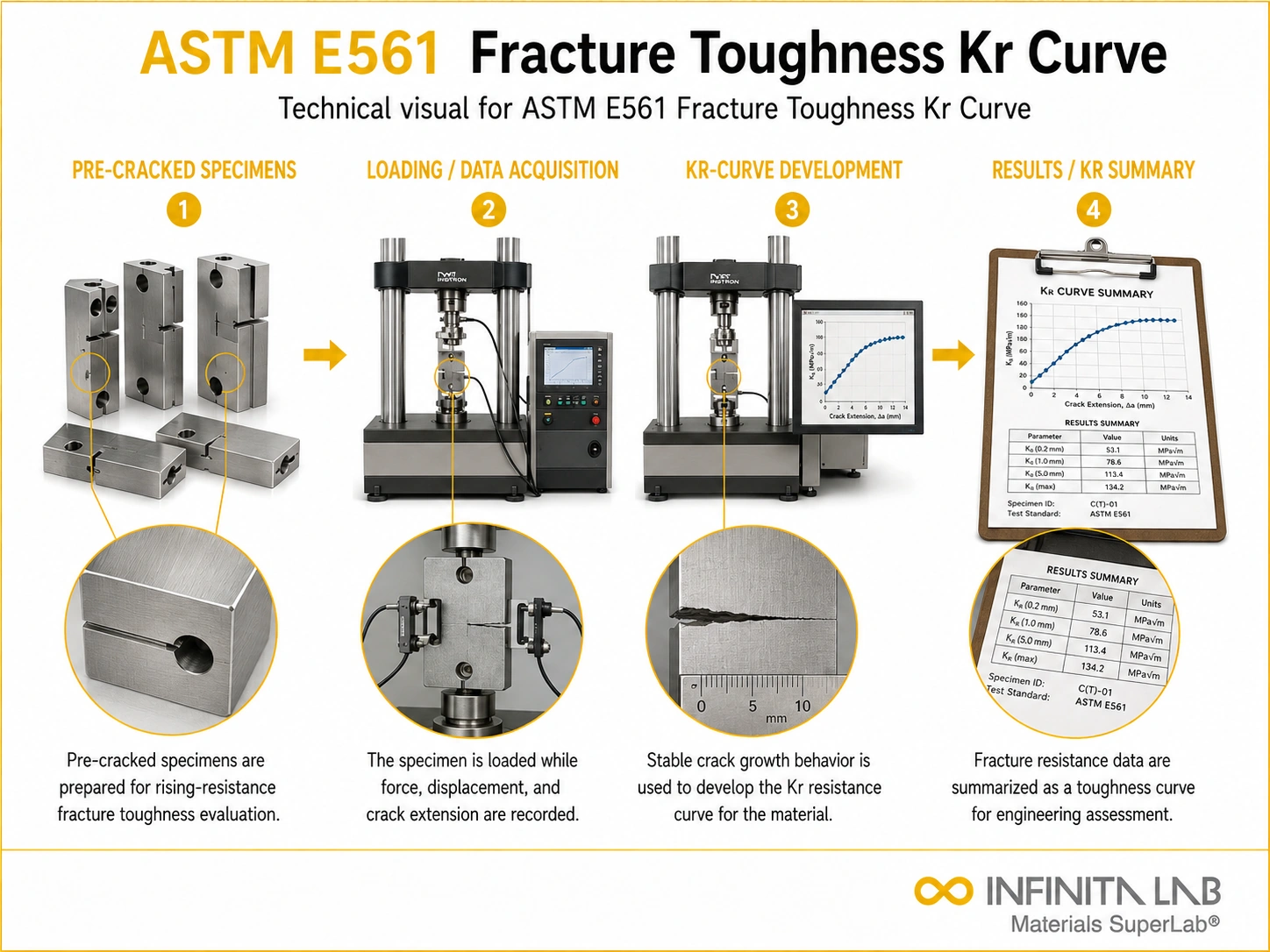
The K-R curve is determined by driving crack growth stably in a compact tension (CT) or middle-cracked tension (MT) specimen while recording crack length and applied load at each step. Crack opening displacement and compliance are used to track crack length between visual measurements. The K-R curve can then be matched against crack driving-force curves for a specific component geometry to predict the onset of unstable crack propagation and the extent of stable crack extension that will precede it.

Applications and Benefits of ASTM E561 Fracture Toughness Kr Curve Testing
Scope
ASTM E561 covers the determination of K-R curves for metallic materials using compact tension (CT) and middle-cracked tension (MT) specimens. The standard applies to materials and specimen thicknesses in which stable crack extension occurs and a rising K-R curve is observed -conditions typically associated with thin-sheet products and intermediate-to-low-constraint geometries. Crack length is monitored by visual observation through a traveling microscope or optical system, combined with compliance-based crack length estimation from the crack-opening displacement record. The K-R curve is constructed as a plot of K against physical crack extension (delta-a) corrected for crack-tip plasticity using the effective crack length concept. The standard defines the secant and offset methods for determining effective crack extension and guides K-R curve instability analysis using the tangency condition. Results are expressed in SI units. The standard falls under the jurisdiction of ASTM Committee E08 on Fatigue and Fracture.
Applications
- Fracture analysis of thin sheet aerospace structural alloys -aluminum alloys, titanium, and high-strength steels used in skin and panel applications
- Residual strength analysis of aircraft structures with known or assumed crack sizes
- Damage-tolerant design where stable crack extension precedes instability, and a single KIc is non-conservative or unavailable.e
- Material comparison and alloy selection based on the shape and magnitude of the K-R curve
- Structural life assessment for thin-walled pressure vessels and cylindrical shell structures
- Determination of instability conditions -crack size and applied stress at which unstable fracture occurs -using tangency analysis
- Validation of fracture mechanics models that predict stable crack extension within-section components
- Effect of thickness, temper, or processing on crack growth resistance in sheet and plate products
Benefits
- Captures the full resistance curve rather than a single initiation point, providing a more accurate and complete picture of fracture behavior for thin materials
- Directly applicable to residual strength and damage tolerance analysis methods used in aerospace structural assessment
- MT specimen geometry is representative of panel configurations commonly found in aircraft skins and fuselage structures.
- Tangency-condition analysis of the K-R curve predicts both the instability load and the extent of stable crack extension preceding failure.
- More informative than KIc for materials that do not satisfy E399 plane strain validity requirements
- Compliance-based crack length monitoring allows continuous tracking of crack extension between visual measurements.s
- Results in SI units consistent with international fracture mechanics and airworthiness documentation standards
Our ASTM E561 Testing Procedure
Specimen Preparation and Pre-Cracking
CT or MT specimens are machined from the material of interest to the required dimensions, with crack starter notches machined at the center
1Test Setup and Instrumentation
The specimen is loaded in the test machine, with a clip-on crack-opening displacement (COD) gauge attached at the crack mouth.
2Stable Crack Growth and Data Collection
The load is applied slowly and monotonically. At defined intervals, the load is partially unloaded to obtain compliance measurements
3K-R Curve Construction and Reporting
Effective crack length is calculated at each data point using the secant or offset plasticity correction methods.
4ASTM E561 K-R Curve Fracture Toughness Technical Specifications
| Parameter | Details |
|---|---|
| Standard | ASTM E561-20 |
| Specimen Geometries | Compact tension (CT), middle-cracked tension (MT) |
| Applicable Materials | Metallic materials exhibiting stable crack extension -thin sheet aluminum alloys, titanium, high-strength steels |
| Crack Length Monitoring | Compliance (COD gauge), traveling microscope visual measurement |
| Plasticity Correction | Effective crack length by the secant or offset method |
| Loading Mode | Monotonic quasi-static tensile loading with partial unloading for compliance measurements |


- Servo-hydraulic or screw-driven testing machine with load and displacement control
- Calibrated load cell covering the expected fracture load range
- Clip-on crack opening displacement (COD) gauge for compliance measurement
- Traveling microscope or optical measurement system for visual crack length measurement on specimen surfaces
- Data acquisition system for continuous load, displacement, and COD recording
- Fracture mechanics analysis software for compliance-based crack length calculation, K computation, and K-R curve construction
- Precision measurement tools for pre-crack and specimen dimension verification
Equipment and Instrumentation Used for ASTM E561 Testing
What You Receive: Test Report, Data, and Certification
- K-R curve -K as a function of physical crack extension (delta-a) from initiation through the full stable growth range tested
- Effective crack extension data, including plasticity correction values at each measurement point
- Compliance-based crack length estimates at each unloading event
- Visual crack length measurements from both specimen surfaces
- Instability analysis using the tangency condition -predicted instability K and crack size, where applicable
- Load-displacement and load-COD records from the full test
- Pre-crack length and symmetry measurements
- Specimen geometry, material identification, and loading history
- Full test report with K-R curve plot, tabulated data, and analysis formatted for damage tolerance assessment, residual strength analysis, or material qualification documentation
ASTM E561 Fracture Toughness Kr Curve FAQs
ASTM E561 defines the procedure to generate the K–R curve, which describes a material’s resistance to crack growth as a function of crack extension. It is used to evaluate stable crack growth behavior in metallic materials.
Unlike a single value such as KIC, the K–R curve shows how fracture resistance increases with crack growth. This provides a more complete understanding of material behavior under progressive loading.
Common specimen geometries include compact tension (CT) and center-cracked tension (CCT) specimens. These are pre-cracked and loaded under controlled conditions to monitor crack extension.
Accurate tracking of crack extension is essential because the K–R curve depends on incremental crack growth data. Techniques like compliance measurements or optical methods are used to monitor crack length during loading.
The results are used in damage tolerance design, structural integrity assessment, and fatigue life prediction for aerospace, automotive, and pressure vessel components where crack stability is critical.
Why Choose Infinita Lab for Fracture Toughness Kr Curve Testing
At the core of this breadth is our network of 2,000+ accredited laboratories across the USA, offering access to over 10,000 testing methods and analytical services. From advanced materials characterization (SEM, TEM, RBS, XPS) to mechanical, chemical, environmental, biological, and standardized ASTM/ISO-compliant testing, we deliver unmatched flexibility, specialization, and scale. You are never limited by geography, facility, or methodology — Infinita Lab connects you to the right expertise and testing solution, every time.

Need ASTM E561 Fracture Toughness Kr Curve Testing You Can Rely On?
Send query us at hello@infinitalab.com or call us at (888) 878-3090 to learn more about our services and how we can support you.



Request a Quote
Submit your material details and receive testing procedures, pricing, and turnaround time within 24 hours.
 Quick Turnaround and Hasslefree process
 Confidentiality Guarantee
 Free, No-obligation Consultation
 100% Customer Satisfaction
