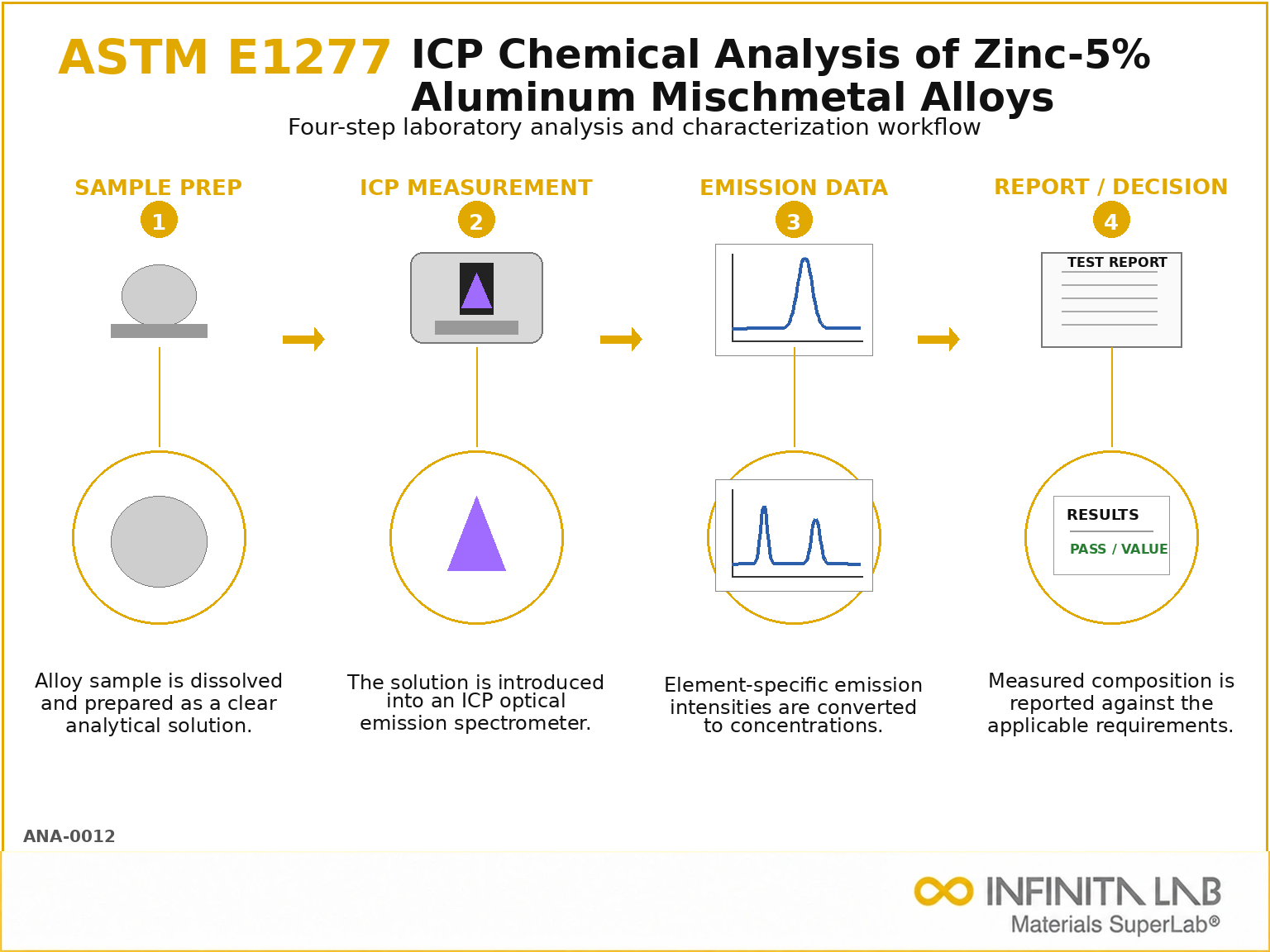


What Is ASTM E1277 Zinc Aluminum Mischmetal Alloy ICP?
ASTM E1277 describes a standardized analytical method for determining the chemical composition of zinc-5% aluminum-mischmetal alloys using Inductively Coupled Plasma (ICP) emission spectrometry. The technique enables simultaneous multi-element analysis with high sensitivity and precision, making it suitable for complex alloy systems containing rare earth elements.
The method involves dissolving alloy samples into solution followed by excitation in a high-temperature plasma, where emitted light at characteristic wavelengths is measured. This ensures accurate quantification of major, minor, and trace elements, supporting quality control, alloy verification, and compliance with compositional specifications.

Applications and Benefits of ASTM E1277 Zinc Aluminum Mischmetal Alloy ICP Testing
Scope
ASTM E1277 covers procedures for the quantitative determination of elemental composition in zinc-aluminum-mischmetal alloys using ICP emission spectrometry. It ensures reproducible and accurate multi-element analysis under controlled laboratory conditions.
- Determination of zinc, aluminum, and rare earth elements
- Use of ICP optical emission spectrometry (ICP-OES)
- Applicable to alloy samples requiring dissolution
- Calibration using certified reference standards
- Covers interference correction and matrix effects
Applications
- Quality control of zinc-aluminum alloy production
- Analysis of mischmetal (rare earth) content
- Metallurgical research and alloy development
- Verification of alloy composition for specifications
- Process control in foundries and casting industries
- Failure analysis and material certification
Benefits
- Enables simultaneous multi-element detection
- Provides high sensitivity and analytical precision
- Reduces analysis time compared to single-element methods
- Ensures traceability through standard calibration
- Handles complex alloy matrices effectively
- Improves reliability of compositional data
Our ASTM E1277 Testing Procedure
Sample Preparation
Dissolve the alloy sample using appropriate acids to obtain a homogeneous solution.
1Calibration Setup
Prepare calibration standards with known elemental concentrations matching the sample matrix.
2ICP Measurement
Introduce the solution into the plasma and measure emitted wavelengths for each element.
3Data Evaluation
Convert emission intensities into concentrations using calibration curves and apply corrections.
4ASTM D3030 Test Parameters and Requirements
| Parameter | Details |
|---|---|
| Technique | ICP Optical Emission Spectrometry (ICP-OES) |
| Plasma Temperature | ~6000–10,000 K for excitation |
| Detection Range | ppm to percent levels depending on element |
| Elements Analyzed | Zn, Al, rare earths (Ce, La, Nd, etc.) |
| Calibration Method | Multi-point standard calibration |
| Interference Correction | Spectral and matrix correction applied |
| Detection Limits | Low ppm for trace elements |


- ICP Optical Emission Spectrometer
- Sample digestion system (acid digestion setup)
- Analytical balance
- Volumetric flasks and pipettes
- High-purity acids and reagents
- Calibration standard solutions
- Data acquisition and analysis software
Equipment and Instrumentation Used for ASTM E1277 Testing
What You Receive: Test Report, Data, and Certification
- Elemental concentration report (Zn, Al, rare earth elements)
- Calibration curves and standardization data
- Measurement uncertainty evaluation
- Quality control and validation results
- Compliance with alloy specifications
- Complete analytical test report
ASTM E1277 Zinc Aluminum Mischmetal Alloy ICP FAQs
ICP emission spectrometry excites atoms in a high-temperature plasma, causing them to emit light at characteristic wavelengths. The intensity of this light is proportional to element concentration, enabling accurate multi-element analysis of alloy compositions.
ICP-OES allows simultaneous detection of multiple elements with high sensitivity and wide dynamic range. It is particularly effective for complex alloys containing both major components and trace rare earth elements, ensuring efficient and precise analysis.
High plasma temperature ensures complete atomization and excitation of elements, resulting in stable and intense emission signals, which are critical for accurate and reproducible measurements.
Yes, ICP-OES has a wide dynamic range, allowing it to measure both high concentration elements like zinc and low-level trace elements within the same analysis.
It ensures accurate and reliable determination of alloy composition, supporting product quality, regulatory compliance, and performance optimization in industries using zinc-aluminum-mischmetal alloys.
Why Choose Infinita Lab for Zinc Aluminum Mischmetal Alloy ICP Testing?
When your Zinc Aluminum Mischmetal Alloy ICP results have to hold up - for compliance, a customer audit, or an engineering decision - ASTM E1277 accuracy and an unbiased third-party report matter more than price. Infinita Lab routes your ASTM E1277 zinc aluminum mischmetal alloy ICP testing to ISO/IEC 17025-accredited U.S. partner labs with hands-on method experience, so you get defensible data, transparent reporting, and turnaround times built around your project deadline - not ours.

Looking for an Accredited Partner for ASTM E1277 Zinc Aluminum Mischmetal Alloy ICP Testing?
Send query us at hello@infinitalab.com or call us at (888) 878-3090 to learn more about our services and how we can support you.





