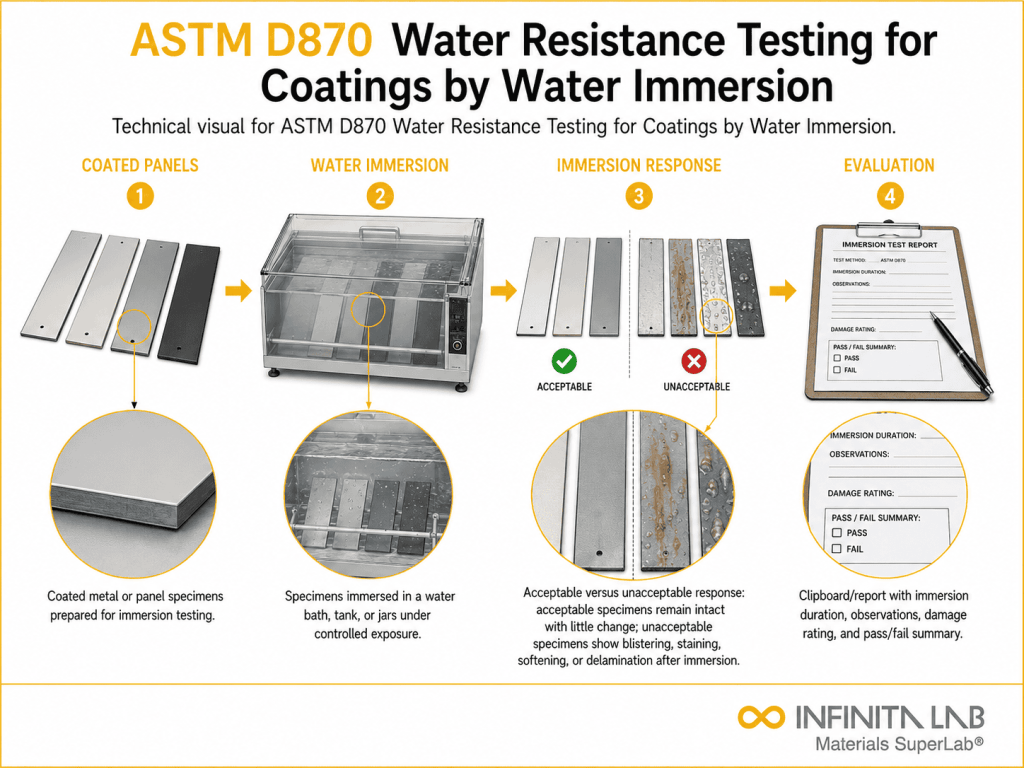


What Is ASTM D870 Coating Water Resistance Immersion?
ASTM D870 is a standardized test method for assessing the resistance of coatings to water through soaking the coated materials in water.
This method is vital for assessing the longevity of coatings and the future performance of the coatings when exposed to humid or water-containing environments. This helps prevent early degradation of materials and informs the development of better coatings, specifications, control, and research.
Applications and Benefits of ASTM D870 Coating Water Resistance Immersion Testing
Scope
ASTM D870 specifically addresses coated materials such as metals, plastics, and woods, and it measures the ability of the protective coatings on such materials to withstand long immersion in water at specific temperatures. The test measures the durability and resistance of the material to moisture through the evaluation of several factors, such as the resistance of the material to water, the formation of blisters, changes in colour, adhesion, softening or becoming brittle, and degradation.
Applications
- Quality control of protective coatings
- Performance evaluation of marine coatings
- Automotive coating durability testing
- Industrial protective coatings
- Architectural coatings
- Research and development of coating formulations
- Corrosion protection assessment
Benefits
- Determines resistance to prolonged water exposure
- Identifies blistering and adhesion failure
- Evaluates coating permeability
- Supports product durability assessment
- Helps optimize coating formulations
- Reduces risk of coating failure in service
Our ASTM D870 Testing Procedure
Specimen Preparation
Apply coating uniformly on metal, plastic, or wood substrates.
1Immersion Setup
Immerse specimens in water with the coated surface exposed and maintain specified temperature.
2Exposure Period
Keep specimens immersed for the defined test duration.
3Evaluation
Remove specimens and assess color change, blistering, adhesion loss, softening, or embrittlement within 5–10 minutes.
4ASTM D870 Test Parameters and Requirements
| Parameter | Details |
|---|---|
| Applicable Materials | Coated metals, plastics, and wood |
| Exposure Medium | Water |
| Temperature Range | As specified (varies per test requirement) |
| Evaluation Time | 5–10 minutes after removal from immersion |
| Observed Properties | Blistering, colour change, adhesion loss, softening, embrittlement |
| Specimen Size | Adequate to fit test chamber |
| Output | Visual rating and performance assessment report |


- Corrosion-resistant immersion container
- Temperature-controlled water bath or chamber
- Thermometer or temperature controller
- Adhesion testing tools (if required)
- Visual inspection tools
- Blister rating standards
- Documentation and reporting system
Equipment and Instrumentation Used for ASTM D870 Testing
What You Receive: Test Report, Data, and Certification
- Water resistance performance evaluation
- Blister resistance rating
- Adhesion assessment results
- Surface degradation analysis
- Comparative performance report
- Durability assessment report
ASTM D870 Coating Water Resistance Immersion FAQs
This test is used to determine the durability of coating systems when subjected to continuous or repeated water immersion. The test evaluates the water permeability and adhesion of the coating systems by accelerating the failure mechanisms like blistering, softening, and delamination.
Distilled or deionized water removes the variables that are introduced by the presence of minerals, salts, or chlorine in tap water. The use of purified water ensures that coating failures are due to material properties and not due to the presence of chemicals.
After immersion and a recovery period, the samples are evaluated for blistering, corrosion, and loss of adhesion. Scoring systems and photographs are employed to provide an objective evaluation of the degradation of the coating.
Yes, immersion temperature, time, and water aeration can be varied to simulate more adverse conditions. Such variations can help simulate actual conditions of use, such as exposure to a marine environment, underground use, or high-temperature operational conditions.
The immersion time in ASTM D870 depends on the requirements of the project, and it can range from twenty-four hours to one thousand hours. This enables the testing of the short-term and long-term water resistance.
ASTM D870 evaluates the water resistance of coatings by partially or completely immersing coated specimens in distilled or demineralized water at ambient or elevated temperatures. The specimens are inspected for water-related deterioration to assess coating durability.
Under ASTM D870, coated specimens are immersed in water under controlled conditions for a specified period. After exposure, they are examined for defects such as blistering, peeling, or loss of adhesion to evaluate water resistance.
ASTM D870 uses equipment such as a water immersion tank or container, temperature-control system, and suitable specimen holders. The setup maintains the required water temperature and immersion conditions throughout testing. Specific equipment requirements depend on the test conditions selected.
Why Choose Infinita Lab for Coating Water Resistance Immersion Testing
When your Coating Water Resistance Immersion results have to hold up - for compliance, a customer audit, or an engineering decision - ASTM D870 accuracy and an unbiased third-party report matter more than price. Infinita Lab routes your ASTM D870 coating water resistance immersion testing to ISO/IEC 17025-accredited U.S. partner labs with hands-on method experience, so you get defensible data, transparent reporting, and turnaround times built around your project deadline - not ours.

Need ASTM D870 Coating Water Resistance Immersion Testing You Can Rely On?
Send query us at hello@infinitalab.com or call us at (888) 878-3090 to learn more about our services and how we can support you.



