


ASTM D7773: Volatile Inorganic Acids Testing Services
This test method, ASTM D7773, determines the average mass concentration of hydrogen chloride gas and hydrochloric acid mist, hydrogen bromide vapor and hydrobromic acid mist, nitric acid vapor, and nitric acid mist. The samples are taken using a quartz fiber filter impregnated with alkali and ion chromatography. The ASTM D7773 test method can also be used to measure exposures for a limited time.
TRUSTED BY


Get ASTM D7773 compliant results — request your volatile inorganic acids testing quote
- Overview
- Scope, Applications, and Benefits
- Test Process
- Specifications
- Instrumentation
- Results and Deliverables
What Is ASTM D7773 Volatile Inorganic Acids?
ASTM D7773 is the standard test method for determining the average mass concentration of volatile inorganic acids in workplace air – specifically hydrogen chloride gas and hydrochloric acid mist, hydrogen bromide vapor and hydrobromic acid mist, and nitric acid vapor and nitric acid mist. These acids are common in industrial processes such as metal treatment, etching, plating, and chemical manufacturing, and exposure to them can cause irritation of the skin, eyes, and respiratory tract. Occupational exposure limits exist for each of these acids, and measuring their airborne concentration is essential to protecting workers.
The method works by drawing a known volume of workplace air through an alkali-impregnated quartz fiber filter. As the air passes through, the acidic gases and mists are captured and neutralized on the alkaline filter, forming the corresponding chloride, bromide, and nitrate salts. The filter is then extracted and analyzed by ion chromatography, which separates and quantifies the anions, allowing the original airborne acid concentrations to be calculated from the sampled air volume.
ASTM D7773 is used for occupational hygiene monitoring and worker exposure assessment. It supports both longer-duration sampling for time-weighted average exposures and shorter-duration sampling for limited-time (short-term) exposure measurements, giving industrial hygienists the data needed for risk assessment and the design of exposure controls.

Applications and Benefits of ASTM D7773 Volatile Inorganic Acids Testing
Scope
ASTM D7773 covers the sampling and analysis of volatile inorganic acids in air for the assessment of worker exposure. Air is sampled onto an alkali-impregnated quartz fiber filter and analyzed by ion chromatography to determine the average mass concentration of each acid.
Key aspects of the test scope include:
- Analytes – hydrogen chloride gas and hydrochloric acid mist (as chloride), hydrogen bromide vapor and hydrobromic acid mist (as bromide), and nitric acid vapor and mist (as nitrate)
- Sampling medium – an alkali-impregnated quartz fiber filter that captures and neutralizes the acidic gases and mists
- Analytical technique – ion chromatography (IC) to separate and quantify the chloride, bromide, and nitrate anions collected on the filter
- Result basis – average mass concentration in air (e.g., mg/m³), calculated from the measured anion mass and the sampled air volume
- Sampling duration – suitable for full-period sampling for time-weighted average exposures and for shorter, limited-time (short-term) exposure measurements
- Application context – occupational/workplace air monitoring for worker exposure assessment
Applications
- Occupational exposure monitoring – measuring worker exposure to HCl, HBr, and HNO₃ in workplace air against established occupational exposure limits
- Metal finishing and surface treatment – monitoring acid mists and vapors in pickling, etching, plating, and anodizing operations where these acids are used
- Chemical manufacturing – assessing airborne acid concentrations in processes that produce or use hydrochloric, hydrobromic, or nitric acid
- Industrial hygiene surveys – providing the airborne acid data needed for workplace risk assessments and exposure characterization
- Ventilation and control evaluation – measuring acid concentrations before and after engineering controls (local exhaust ventilation, scrubbers) to verify their effectiveness
- Short-term exposure assessment – measuring limited-duration exposures during specific tasks or operations where short-term peaks are a concern
- Regulatory and safety documentation – generating exposure data to support occupational health programs and worker protection measures
Benefits
- Measures multiple acids in a single sampling approach – chloride, bromide, and nitrate from their respective acids are all captured on one filter type and quantified together by ion chromatography
- Directly supports worker protection – the airborne concentration data is exactly what is needed to compare against occupational exposure limits and assess the risk to workers
- Captures both gas and mist forms – the alkali-impregnated filter collects both the vapor/gas and the acid mist of each analyte, giving a complete measure of airborne acid
- Ion chromatography gives sensitive, selective results – IC cleanly separates and quantifies the individual anions, providing reliable low-level measurement of each acid
- Supports both full-shift and short-term sampling – the method accommodates time-weighted average exposure assessment as well as limited-time measurements for short-duration exposures
- Enables evaluation of controls – before/after measurements provide an objective basis for verifying that ventilation and other exposure controls are working
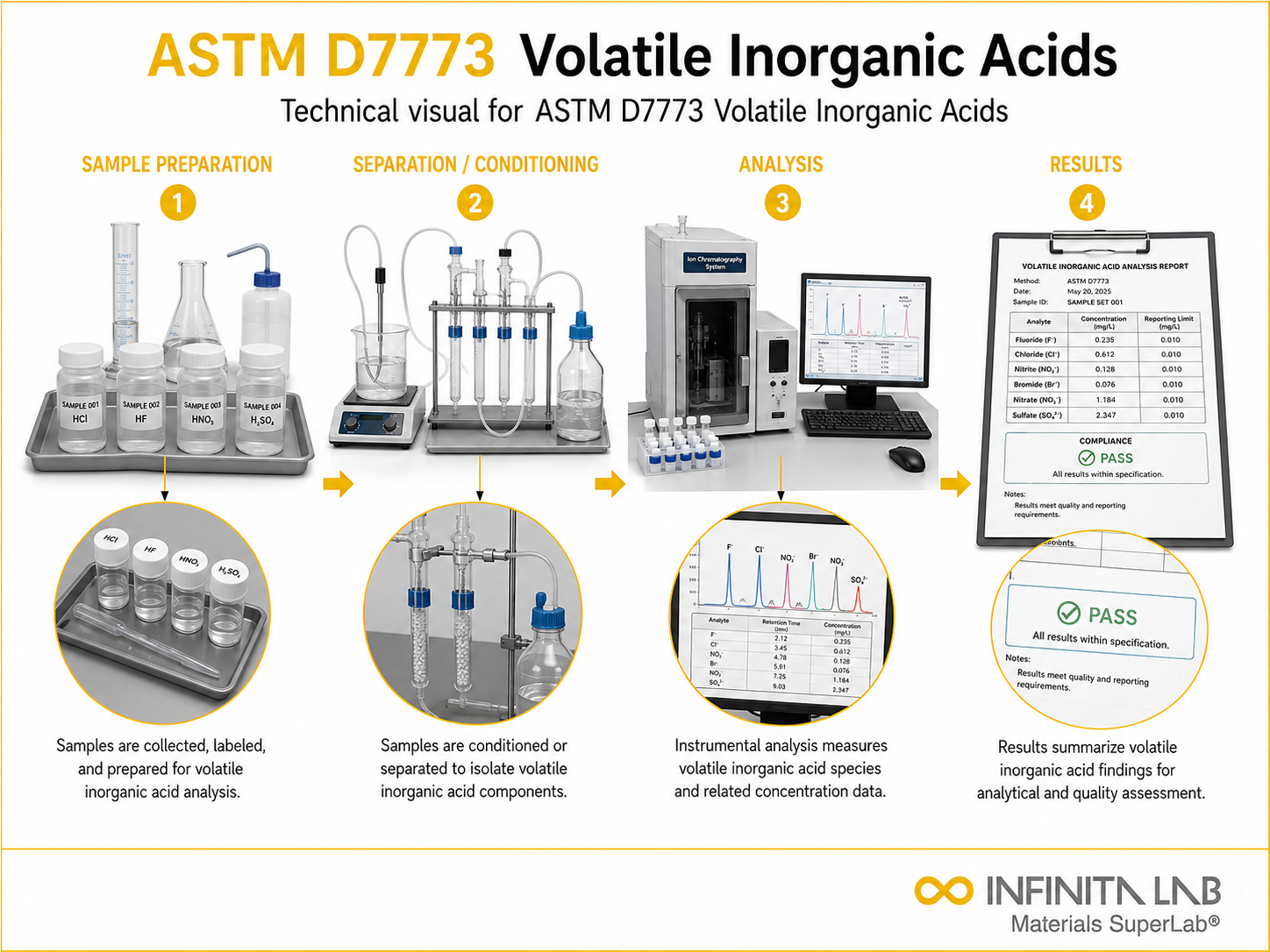
Our ASTM D7773 Testing Procedure
Prepare and Calibrate
Install the treated filter and calibrate the sampling pump to the required flow rate.
1Collect the Air Sample
Draw a measured volume of workplace air through the filter to capture volatile inorganic acids.
2Extract and Analyse
Extract the filter and measure chloride, bromide, and nitrate using ion chromatography.
3Calculate and Report
Determine airborne acid concentrations in mg/m³ and compare them with applicable exposure limits.
4ASTM D7773 Test Parameters and Requirements
| Parameter | Details |
|---|---|
| Analytes | HCl gas + HCl mist (chloride), HBr vapor + HBr mist (bromide), HNO₃ vapor + mist (nitrate) |
| Sampling Medium | Alkali-impregnated quartz fiber filter |
| Analytical Technique | Ion chromatography (IC) |
| Quantified Ions | Chloride, bromide, nitrate |
| Result Basis | Average mass concentration in air (e.g., mg/m³) from sampled volume |
| Sampling Duration | Full-period (time-weighted average) and limited-time (short-term) sampling |
| Application | Occupational/workplace air monitoring, worker exposure assessment |


- Ion chromatograph (IC) with conductivity or equivalent detection
- Calibrated air sampling pump with controlled flow rate
- Filter sampling holders/cassettes for the impregnated quartz fiber filters
- Alkali-impregnated quartz fiber filters
- Flow calibration equipment for the sampling pump
- Extraction equipment and volumetric glassware
- Anion calibration standards (chloride, bromide, nitrate)
Equipment and Instrumentation Used for ASTM D7773 Testing
What You Receive: Test Report, Data, and Certification
- Exposure monitoring report – average airborne mass concentration of each acid (HCl, HBr, HNO₃) with the sampling conditions documented
- Per-analyte results – chloride, bromide, and nitrate measured by IC, converted to the corresponding acid concentrations
- Sampling data – sampling flow rate, duration, and total air volume used in the concentration calculation
- Comparison against exposure limits (where provided) – measured concentrations against the relevant occupational exposure limits
- Ion chromatography data – chromatograms and calibration supporting the reported anion quantities
- Sample records – sampling location, filter identification, sampling period, and any field/blank samples run alongside
ASTM D7773 Volatile Inorganic Acids FAQs
The method measures hydrogen chloride and hydrochloric acid mist, hydrogen bromide and hydrobromic acid mist, and nitric acid vapour and mist. These compounds are reported as airborne mass concentrations.
Testing is used to assess worker exposure to airborne inorganic acids that may irritate the skin, eyes and respiratory system. The results support occupational hygiene monitoring and exposure-risk reduction.
The collected sample is extracted from the filter and analysed using suppressed ion chromatography. The instrument separates and measures chloride, bromide and nitrate ions associated with the captured acids.
Suppressed ion chromatography is an analytical technique that separates ionic compounds and reduces background conductivity before detection. This improves sensitivity when measuring low concentrations of inorganic acid anions.
The method is used in workplaces where acids may be released during chemical processing, metal treatment, semiconductor manufacturing or laboratory operations. It is primarily intended for occupational and environmental hygiene monitoring.
Why Choose Infinita Lab for Volatile Inorganic Acids Testing?
At the core of this breadth is our network of 2,000+ accredited laboratories across the USA, offering access to over 10,000 testing methods and analytical services. From advanced materials characterization (SEM, TEM, RBS, XPS) to mechanical, chemical, environmental, biological, and standardized ASTM/ISO-compliant testing, we deliver unmatched flexibility, specialization, and scale. You are never limited by geography, facility, or methodology — Infinita Lab connects you to the right expertise and testing solution, every time.

Looking for an Accredited Partner for ASTM D7773 Volatile Inorganic Acids Testing?
Send query us at hello@infinitalab.com or call us at (888) 878-3090 to learn more about our services and how we can support you.



Request a Quote
Submit your material details and receive testing procedures, pricing, and turnaround time within 24 hours.
 Quick Turnaround and Hasslefree process
 Confidentiality Guarantee
 Free, No-obligation Consultation
 100% Customer Satisfaction
