


ASTM D792: Plastic Density Specific Gravity Testing Services
Accredited ASTM D792 plastic density specific gravity testing from Infinita Lab, performed to the exact standard requirements - accurate, reproducible results with full documentation for compliance, R&D, and quality control programs.
TRUSTED BY


Get ASTM D792 compliant results - request your plastic density specific gravity testing quote
- Overview
- Scope, Applications, and Benefits
- Test Process
- Specifications
- Instrumentation
- Results and Deliverables
What Is ASTM D792 Plastic Density Specific Gravity?
ASTM D792, titled Standard Test Methods for Density and Specific Gravity (Relative Density) of Plastics by Displacement, is one of the most widely used test methods for characterising solid plastic materials. The standard defines two related procedures: Method A, for testing specimens in water, and Method B, for testing specimens in liquids other than water when the material is water-soluble, water-reactive, or less dense than water. Both methods rely on the Archimedes principle of buoyant displacement, in which a specimen is first weighed in air and then weighed again while fully immersed in a liquid of known density. The difference between the two weight readings equals the weight of the liquid displaced by the specimen’s volume, and this relationship is used to calculate the material’s density and specific gravity relative to water at a controlled test temperature. Because the procedure requires only an analytical balance fitted with a density-determination kit or sinker apparatus, it is comparatively fast, low-cost, and adaptable to specimens of nearly any convenient size or shape, including sheets, rods, tubes, and moulded or extruded parts. Density and specific gravity testing play an important role throughout the plastics industry because even small variations in these values can indicate differences in polymer composition, filler or additive content, processing conditions, void content, or crystallinity. Manufacturers rely on ASTM D792 results to confirm that incoming resin lots match specifications, verify that moulded or extruded parts meet design requirements, identify unknown materials, and detect contamination or mixing of different polymer grades. For quality control laboratories and product development teams alike, ASTM D792 offers a practical, repeatable, and industry-recognised method for confirming material consistency before parts move further down the production or supply chain.

Applications and Benefits of ASTM D792 Plastic Density Specific Gravity Testing
Scope
- ASTM D792 (Standard Test Methods for Density and Specific Gravity (Relative Density) of Plastics by Displacement) defines two related test methods for determining the density and specific gravity of solid plastics.
- Method A covers testing specimens by immersion in distilled water and is used for most solid plastic materials with a density greater than water.
- Method B covers testing specimens in liquids other than water, such as an alcohol or other suitable immersion medium, for materials that are water-soluble, water-reactive, or less dense than water.
- The standard applies to solid plastics in nearly any convenient shape or form, including sheets, rods, tubes, films, and molded or extruded parts, without requiring a specific geometry.
- Specimens must be free of voids, air bubbles, and surface contamination, since trapped air or surface films can introduce measurable error into the displacement calculation.
- ASTM D792 is generally less precise than the density-gradient-column method of ASTM D1505. Still, it is faster, simpler, and requires far less specimen preparation, making it well suited to routine quality-control testing.
- Unlike ASTM D1505, which requires small, carefully cut specimens sized to fit a calibrated gradient column, ASTM D792 can accommodate larger or irregularly shaped parts directly.
- The method is used throughout the plastics, packaging, automotive, consumer goods, electronics, and medical device industries wherever density or specific gravity is a specified material property.
- Results obtained under ASTM D792 support material identification, incoming-resin verification, and confirmation that finished parts conform to drawing or specification requirements.
- Testing is typically performed at a controlled temperature, most commonly 23°C, to ensure that results are comparable between specimens, batches, and laboratories.
Applications
- Quality control testing of incoming plastic resins, pellets, and compounds before processing.
- Verification of injection-molded, blow-molded, and extruded plastic parts against drawing or specification density requirements.
- Density characterisation of foamed, cellular, and low-density plastic materials used in packaging and cushioning applications.
- Quality verification of filled, reinforced, or compounded materials, including masterbatches, where filler content affects density.
- Confirmation and sorting of recycled and reprocessed resins, where density can indicate polymer type or contamination.
- Material identification and failure analysis when you must confirm the polymer type of an unknown sample.
- Formulation verification during product development, ensuring that changes to additive or filler loading produce the intended density.
Benefits
- Provides a fast, low-cost, and repeatable method for confirming plastic material density and specific gravity.
- Requires only a standard analytical balance and a density-determination kit, avoiding the need for specialised gradient-column equipment.
- Accommodates specimens of nearly any convenient size or shape, reducing specimen preparation time compared with other density test methods.
- Supports both raw material qualification and finished-part verification within a single standardised method.
- Is widely recognized and specified across plastics industry specifications, purchase orders, and quality standards.
- Generates objective, quantitative data that can be trended over time to monitor process and material consistency.
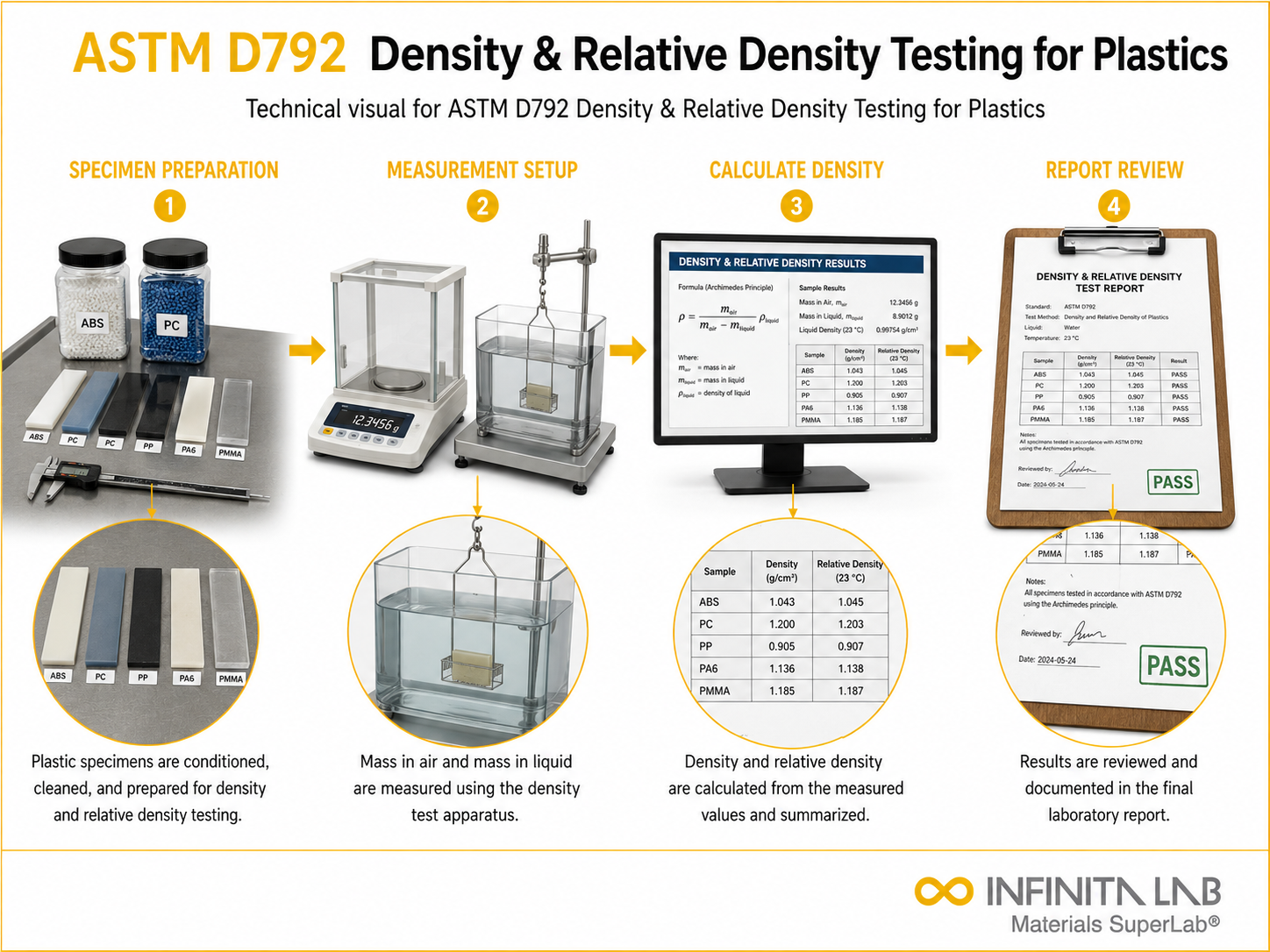
Our ASTM D792 Testing Procedure
Specimen Preparation
A solid plastic specimen of suitable mass (1–5 g) is prepared free from visible voids, flaws, or surface contamination; specimen is dried if hygroscopic.
1Weight in Air
The specimen is weighed in air on an analytical balance to four decimal places (weight a).
2Weight in Immersion Liquid
The specimen is suspended by a fine wire in distilled water (or specified liquid for Method B) and the immersed weight is recorded (weight w).
3Density Calculation
Specific gravity is calculated as a/(a−w), and density as SG × immersion-liquid density, with results reported to four decimal places.
4ASTM D792 Test Parameters and Requirements
| Parameter | Details |
|---|---|
| Principle | Archimedes displacement in immersion liquid |
| Immersion Liquid | Distilled water (Method A); 2-propanol, ethanol (Method B) |
| Balance Precision | ±0.1 mg |
| Test Temperature | 23 °C ± 1 °C |
| Applicable Materials | Solid plastics, including filled and unfilled grades |


- Analytical Balance – A high-precision balance used to record the specimen’s weight in air and its apparent weight while immersed.
- Density-Determination Kit / Sinker Apparatus – An accessory that attaches to the balance to suspend the specimen beneath the liquid surface for the immersed weighing.
- Immersion Liquid and Beaker – Distilled water or an alternate liquid of known density held in a beaker or vessel sized to submerge the specimen fully.
- Specimen Holder Wire – A fine wire or sinker used to hold buoyant specimens fully underwater without altering the measured buoyant force.
- Thermometer – Used to confirm and monitor the temperature of the immersion liquid, since density calculations depend on liquid density at the test temperature.
- Wetting Agent – A small amount of surfactant added to the immersion liquid to eliminate air bubbles that could otherwise cling to the specimen and distort results.
- Specimen Preparation Tools – Cutting and finishing equipment used to prepare specimens free of voids, flash, or surface contamination before testing.
Equipment and Instrumentation Used for ASTM D792 Testing
What You Receive: Test Report, Data, and Certification
- A calculated density value for the tested specimen, reported in grams per cubic centimetre (g/cm³).
- A calculated specific gravity value expressing the material’s density relative to water at the test temperature.
- Documentation of the test method and procedure used, including whether Method A or Method B was performed.
- Comparison of results against customer specification limits or reference values, where provided.
- Confirmation supporting material identification or verification that a sample matches an expected polymer type or grade.
- A signed test report suitable for quality records, supplier qualification files, or regulatory submissions.
ASTM D792 Plastic Density Specific Gravity FAQs
Specific gravity is the dimensionless ratio of the material's density to water density at the same temperature. Density (g/cm³ or kg/m³) is the absolute mass per unit volume. Both are reported because specific gravity enables simple comparison without temperature correction, while absolute density is needed for engineering calculations.
No. The immersion method is not suitable for open-cell foams or highly porous materials that absorb the immersion liquid. ISO 845 (foam density) or ASTM D1622 (apparent density of rigid foams) should be used for cellular materials.
Each plastic material has a characteristic density range (e.g., LDPE: 0.910–0.940, POM: 1.39–1.43, PTFE: 2.14–2.20 g/cm³). Density measurement provides a rapid first-pass identity check, though it cannot uniquely distinguish all polymer types, especially filled or blended materials.
With proper balance calibration, specimen preparation, and temperature control, ASTM D792 achieves repeatability of ±0.001 g/cm³ and reproducibility of ±0.003 g/cm³ for most solid plastics.
Yes. Mineral fillers (calcium carbonate, talc, glass fiber) have densities of 2.5–4.0 g/cm³ — significantly higher than the polymer matrix. Increasing filler loading proportionally increases compound density, making density measurement a useful indirect check on filler loading.
ASTM D792 determines specific gravity and density by weighing a plastic specimen in air and in a suitable liquid, typically water.
Specific gravity compares a plastic's density with the density of water, providing a dimensionless value useful for material characterization.
A conditioned specimen is weighed in air and while immersed in liquid. The measurements are used to calculate its specific gravity and density.
Why Choose Infinita Lab for Plastic Density Specific Gravity Testing
At the core of this breadth is our network of 2,000+ accredited laboratories across the USA, offering access to over 10,000 testing methods and analytical services. From advanced materials characterization (SEM, TEM, RBS, XPS) to mechanical, chemical, environmental, biological, and standardized ASTM/ISO-compliant testing, we deliver unmatched flexibility, specialization, and scale. You are never limited by geography, facility, or methodology — Infinita Lab connects you to the right expertise and testing solution, every time.

Need ASTM D792 Plastic Density Specific Gravity Testing You Can Rely On?
Send query us at hello@infinitalab.com or call us at (888) 878-3090 to learn more about our services and how we can support you.



Request a Quote
Submit your material details and receive testing procedures, pricing, and turnaround time within 24 hours.
 Quick Turnaround and Hasslefree process
 Confidentiality Guarantee
 Free, No-obligation Consultation
 100% Customer Satisfaction
