


ASTM D7905 Mode II Fracture Toughness
ASTM D7905 is used to determine the resistance of a laminated composite sample to the sliding of its layers. Laminated Composites are made of two or more materials arranged in layers. The test evaluates how strong the products are and how suitable the given material is for industrial purposes.
TRUSTED BY


ASTM D7905 Mode II Fracture Toughness
- Overview
- Scope, Applications, and Benefits
- Test Process
- Specifications
- Instrumentation
- Results and Deliverables
ASTM D7905 Mode II Fracture Toughness Overview
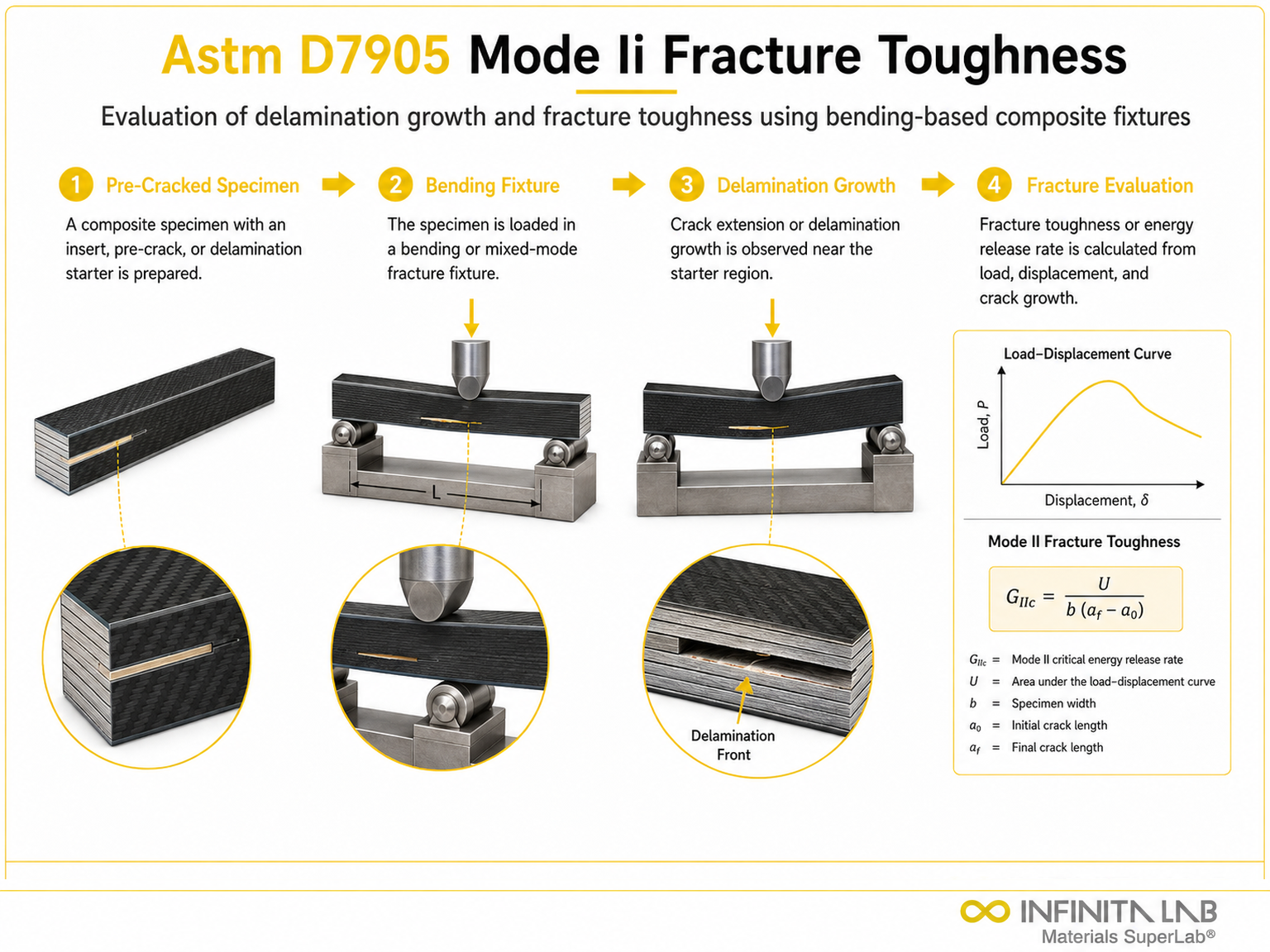
ASTM D7905 is the standard test method for determining the Mode II interlaminar fracture toughness (GIIC) of polymer matrix composite laminates using the End-Notched Flexure (ENF) test. Interlaminar fracture is one of the most common and critical damage modes in laminated composite structures -delamination between plies can grow under service loads and, if undetected or uncontrolled, can lead to catastrophic loss of structural stiffness and strength. Understanding how resistant a laminate is to delamination under in-plane shear loading, which is what Mode II characterizes, is essential for designing with composite materials in aerospace, automotive, wind energy, and marine structural applications.
Mode II loading is in-plane shear -the two crack faces slide parallel to each other rather than opening as in Mode I. The ENF test achieves this by loading a beam specimen with a pre-existing midplane delamination in three-point bending. As the beam deflects, the portion ahead of the crack tip is loaded in shear, driving the delamination to grow in sliding mode. The critical strain energy release rate at the onset of crack growth -GIIC -is calculated from the applied load, beam compliance, and crack length using the standard data reduction method.
ASTM D7905 is limited to unidirectional, continuous carbon-fiber- and glass-fiber-reinforced polymer matrix laminates. The restriction to unidirectional layups ensures that the interlaminar crack grows in a controlled manner along the fiber direction, making the fracture mechanics analysis tractable. The result is used in material selection, prepreg and resin system comparison, process qualification, and as design allowable input for composite structure damage tolerance analysis.

ASTM D7905 Mode II Fracture Toughness Scope, Applications, and Benefits
Scope
ASTM D7905 covers the determination of Mode II interlaminar fracture toughness (GIIC) of unidirectional continuous carbon-fiber- and glass-fiber-reinforced polymer matrix composite laminates using the End-Notched Flexure (ENF) test geometry. The test specimen is a symmetric unidirectional laminate beam with a nonadhesively bonded insert at the midplane to initiate a delamination. A pre-crack is grown from the insert before the main GIIC test to establish a sharp natural crack front. The specimen is loaded in three-point bending at a defined support span, driving Mode II crack growth. GIIC is calculated using the Compliance Calibration (CC) or Corrected Beam Theory (CBT) data reduction methods defined in the standard. Testing is performed at ambient conditions unless otherwise specified. The standard falls under ASTM Committee D30 on Composite Materials and is published in BOS Vol. 15.03.
Applications
- Aerospace composite structural material qualification -carbon fiber reinforced polymer (CFRP) laminates for primary and secondary structures.
- Prepreg and resin system selection based on Mode II delamination resistance
- Matrix toughening evaluation -comparing toughened versus untoughened resin systems
- Process qualification for autoclave, out-of-autoclave, and resin transfer molding (RTM) fabrication routes
- Damage tolerance allowables generation for composite structure design under in-plane shear loading
- Interlaminar fracture toughness database development for material qualification
- Effect of environmental conditioning -moisture absorption, elevated temperature -on Mode II toughness
- Comparison of GIIC across fiber surface treatments and sizing chemistries to evaluate fiber-matrix interface quality
- Wind turbine blade and marine structure composite material characterization
Benefits
- Provides GIIC -the Mode II interlaminar fracture toughness -as a quantitative, materials-level design input for composite damage tolerance analysis
- ENF test geometry is straightforward and produces stable crack growth suitable for accurate GIIC determination
- Two data reduction methods (CC and CBT) provide consistency and allow cross-check of results.
- Pre-cracking from the insert produces a sharp natural crack front that eliminates insert-tip effects on the measured toughness.
- Results are directly comparable across labs and material systems when standard specimen geometry and procedure are followed.
- Paired with ASTM D5528 (Mode I, GIC) to characterize both opening and shear delamination resistance of a laminate system
- Applicable to both carbon and glass fiber reinforced systems, covering the majority of structural composite applications
ASTM D7905 Mode II Fracture Toughness Process
Panel Fabrication and Specimen Preparation
A unidirectional laminate panel is fabricated with a nonadhesively bonded insert (typically PTFE film) at the midplane
1Pre-Cracking
The specimen is loaded in Mode I using the hinges or tabs to grow a pre-crack from the insert tip to the required initial crack length ahead of the ENF loading span.
2ENF Test Loading and Data Collection
The pre-cracked specimen is placed on the three-point bending fixture at the specified support span with the pre-crack
3Data Reduction and Reporting
GIIC is calculated from the load-displacement data and crack length using the Compliance Calibration (CC) or Corrected Beam Theory (CBT) method.
4ASTM D7905 Mode II Fracture Toughness Technical Specifications
| Parameter | Details |
|---|---|
| Standard | ASTM D7905/D7905M-19 |
| ASTM Committee | D30 – Composite Materials |
| BOS Volume | 15.03 |
| Test Method | End-Notched Flexure (ENF) three-point bending |
| Material Scope | Unidirectional continuous carbon-fiber and glass-fiber reinforced polymer matrix composites |
| Fracture Mode | Mode II (in-plane shear, sliding mode) |


Instrumentation Used for ASTM D7905 Mode II Fracture Toughness
- Universal testing machine with displacement control and load-displacement data acquisition
- Three-point bending fixture with defined span, loading nose radius, and support roller radius
- Calibrated load cell appropriate to the expected fracture load range
- An optical microscope or a traveling microscope for crack length measurement on specimen edges
- Digital image correlation (DIC) or an edge-tracking camera system for crack front monitoring, where applicable
- Micrometer for laminate thickness and specimen dimension measurement
- Mode I pre-cracking fixture (hinges or tabs) for producing the natural crack front before ENF testing
ASTM D7905 Mode II Fracture Toughness Results and Deliverables
- GIIC (Mode II interlaminar fracture toughness) in J/m2 for each specimen
- Average GIIC and standard deviation across the specimen set
- Load-displacement curves for each specimen
- Pre-crack length and crack front straightness verification
- Data reduction method used (CC or CBT) with supporting compliance or beam theory calculations
- Specimen dimensions -length, width, thickness, and fiber volume fraction
- Insert material and pre-cracking method documentation
- Material identification, laminate layup, fabrication process, and cure cycle
- Test report with all individual and averaged results formatted for material qualification, design allowables generation, or research documentation
Frequently Asked Questions
ASTM D7905 measures the Mode II interlaminar fracture toughness, which represents resistance to shear-driven delamination between layers in polymer matrix composites. It helps quantify how well a composite resists sliding-type crack growth under loading.
Mode II focuses on in-plane shear (sliding) crack propagation, while Mode I (ASTM D5528) evaluates opening-mode delamination. Mode II is generally more representative of real structural loading in aerospace and automotive composite applications.
The test typically uses a Double Notched Shear (DNS) or similar configuration to promote stable Mode II crack growth. The setup ensures controlled shear loading so crack propagation can be accurately measured.
It directly influences resistance to delamination under shear-dominated conditions such as torsion, impact, and complex multi-axial loading. Low Mode II toughness can lead to sudden structural failure even if tensile strength is high.
It is widely used for carbon fiber and glass fiber reinforced polymer matrix composites in aerospace, automotive, marine, and wind energy structures. The data is essential for validating damage tolerance and structural reliability.
Why Choose Infinita Lab for Advanced Materials Testing and Characterization?
At the core of this breadth is our network of 2,000+ accredited laboratories across the USA, offering access to over 10,000 testing methods and analytical services. From advanced materials characterization (SEM, TEM, RBS, XPS) to mechanical, chemical, environmental, biological, and standardized ASTM/ISO-compliant testing, we deliver unmatched flexibility, specialization, and scale. You are never limited by geography, facility, or methodology — Infinita Lab connects you to the right expertise and testing solution, every time.

Looking for a Trusted Partner for Accurate and Reliable Testing Services?
Send query us at hello@infinitlab.com or call us at (888) 878-3090 to learn more about our services and how we can support you.



Request a Quote
Submit your material details and receive testing procedures, pricing, and turnaround time within 24 hours.
 Quick Turnaround and Hasslefree process
 Confidentiality Guarantee
 Free, No-obligation Consultation
 100% Customer Satisfaction
