


ASTM D789: Polyamide Relative Viscosity Testing Services
Determination of Relative Viscosity of Polyamide (PA) by Brookfield Method is done by ASTM D789, D4878. As the flow behavior depends on a polymer's molecular weight distribution, the determination of relative viscosity is a sensitive method for material characterization.
TRUSTED BY


Get ASTM D789 compliant results — request your polyamide relative viscosity testing quote
- Overview
- Scope, Applications, and Benefits
- Test Process
- Specifications
- Instrumentation
- Results and Deliverables
What Is ASTM D789 Polyamide Relative Viscosity?
ASTM D789 and D4878 provide standard test methods for measuring the relative viscosity (RV) and solution viscosity of polyamides (nylons). Relative viscosity is the ratio of the viscosity of a polyamide solution to the viscosity of the pure solvent, providing a rapid and reproducible measure of polyamide molecular weight that correlates with melt flow, mechanical properties, and processability.
RV measurement is a fundamental quality-control parameter for nylon resin producers, compounders, and processors, enabling verification of batch-to-batch molecular-weight consistency and incoming-material qualification.

Applications and Benefits of ASTM D789 Polyamide Relative Viscosity Testing
Scope
ASTM D789 / D4878 evaluates:
- Relative viscosity (RV) of polyamide solutions at defined concentrations
- Solution viscosity ratio (ηr) as a molecular weight indicator
- Applicable to PA 6, PA 66, PA 6/10, PA 12, and other polyamide grades
- Both formic acid (ASTM D789) and sulfuric acid (ASTM D4878) solvent systems
Applications
- Nylon resin incoming material QC and specification compliance
- Polyamide fiber and film grade differentiation
- PA compounding and masterbatch quality control
- Engineering plastic part material verification
- Polyamide degradation and hydrolysis assessment
Benefits
- Simple, rapid molecular weight indicator without GPC instrumentation
- Highly reproducible with proper temperature control (±0.1 °C)
- Widely specified in nylon resin commercial specifications
- Applicable to a broad range of polyamide types and grades
- Correlates with melt viscosity, mechanical properties, and processability
Our ASTM D789 Testing Procedure
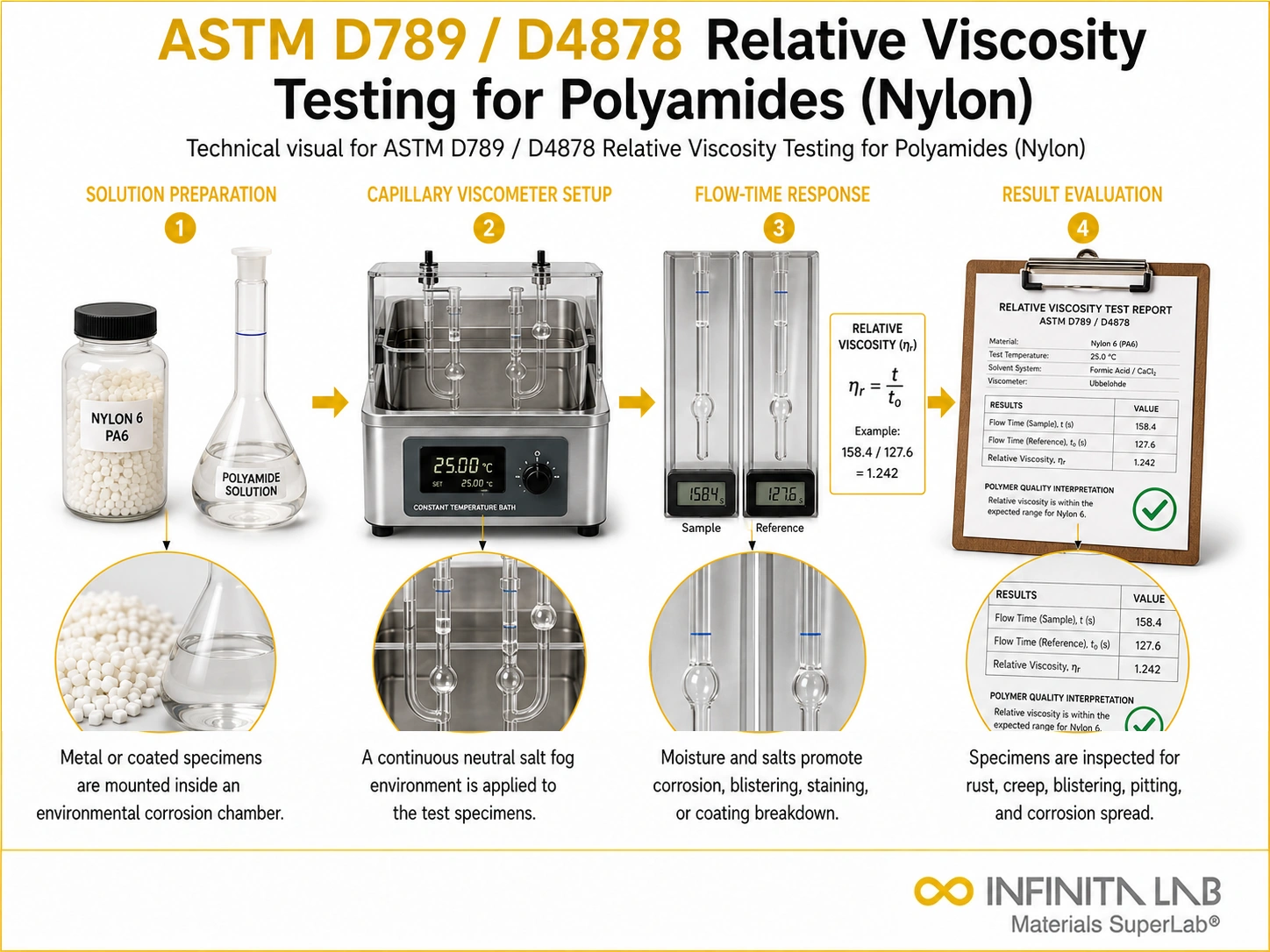
Sample Dissolution
A precisely weighed polyamide sample is dissolved in formic acid (ASTM D789) or concentrated sulfuric acid (ASTM D4878) at a defined concentration (8.4% or 1%) with controlled conditions.
1Viscometer Setup
The solution and pure solvent are each loaded into calibrated glass capillary viscometers; the viscometer is immersed in a constant-temperature bath at 25 °C ± 0.01 °C.
2Flow Time Measurement
Efflux time for the solution and solvent through the capillary under gravity is measured; multiple readings are taken and averaged.
3RV Calculation
Relative viscosity = (solution efflux time × solution density) / (solvent efflux time × solvent density); the result is reported to three decimal places.
4ASTM D789 Test Parameters and Requirements
| Parameter | Details |
|---|---|
| Solvent Systems | 90% formic acid (D789); 96% H₂SO₄ (D4878) |
| Concentration | 8.4 g/100 mL (D789); 1.0 g/100 mL (D4878) |
| Temperature | 25 °C ± 0.01 °C |
| Typical RV Range | 2.0–5.0 (PA 66 extrusion/injection grades) |
| Measurement Precision | ±0.02 RV units |


- Calibrated Ubbelohde or Cannon-Fenske glass viscometer
- Constant temperature water bath (±0.01 °C)
- Analytical balance (±0.1 mg)
- Calibrated timing device
- Fume hood (for acid handling)
- Density measurement device
Equipment and Instrumentation Used for ASTM D789 Testing
What You Receive: Test Report, Data, and Certification
- Relative viscosity (RV) value
- Solution and solvent efflux times
- Test temperature and concentration documentation
- Specification compliance statement
- Full test report per ASTM D789 or D4878
ASTM D789 Polyamide Relative Viscosity FAQs
Higher RV indicates higher molecular weight. High-RV nylons have better melt strength, impact resistance, and toughness, but higher melt viscosity requiring higher processing temperatures and pressures. Low-RV grades process more easily and are preferred for injection molding of thin-wall parts.
Formic acid (ASTM D789) is most commonly used for PA 66 and PA 6 in commercial QC. Sulfuric acid (ASTM D4878) provides better solubility for some high-performance polyamides (PA 46, aromatic PA) and is preferred for certain fiber grades. The two methods give different RV values for the same material and are not directly interchangeable.
Polyamides are hygroscopic. Absorbed moisture causes hydrolysis of amide bonds during measurement at elevated temperatures or in acidic solutions, reducing the apparent molecular weight and RV. Samples must be dried before dissolution for accurate, reproducible results.
No. Relative viscosity (ηr) is the ratio of solution to solvent viscosity at a defined concentration. Intrinsic viscosity [η] is the limiting value of reduced viscosity at zero concentration. Intrinsic viscosity is more rigorously related to molecular weight via the Mark-Houwink equation.
PA 66 for injection molding typically has RV of 2.4–2.8. Extrusion and fiber grades range from 2.8–4.0. High-RV grades (3.5–5.0) are used for blow molding and applications requiring high melt strength.
Why Choose Infinita Lab for Polyamide Relative Viscosity Testing
At the core of this breadth is our network of 2,000+ accredited laboratories across the USA, offering access to over 10,000 testing methods and analytical services. From advanced materials characterization (SEM, TEM, RBS, XPS) to mechanical, chemical, environmental, biological, and standardized ASTM/ISO-compliant testing, we deliver unmatched flexibility, specialization, and scale. You are never limited by geography, facility, or methodology — Infinita Lab connects you to the right expertise and testing solution, every time.

Looking for an Accredited Partner for ASTM D789 Polyamide Relative Viscosity Testing?
Send query us at hello@infinitalab.com or call us at (888) 878-3090 to learn more about our services and how we can support you.



Request a Quote
Submit your material details and receive testing procedures, pricing, and turnaround time within 24 hours.
 Quick Turnaround and Hasslefree process
 Confidentiality Guarantee
 Free, No-obligation Consultation
 100% Customer Satisfaction
