


ASTM D785 Rockwell Hardness of Plastics
The two methods for determining the indentation hardness of plastics and plastic electrical insulating materials using the rockwell hardness tester are described in this ASTM D 785 Standard test method. The methods offer a trustworthy method of measurement, assisting in the evaluation of the characteristics of the material and quality control in a variety of applications.
TRUSTED BY


ASTM D785 Rockwell Hardness of Plastics
- Overview
- Scope, Applications, and Benefits
- Test Process
- Specifications
- Instrumentation
- Results and Deliverables
ASTM D785 Rockwell Hardness of Plastics Overview
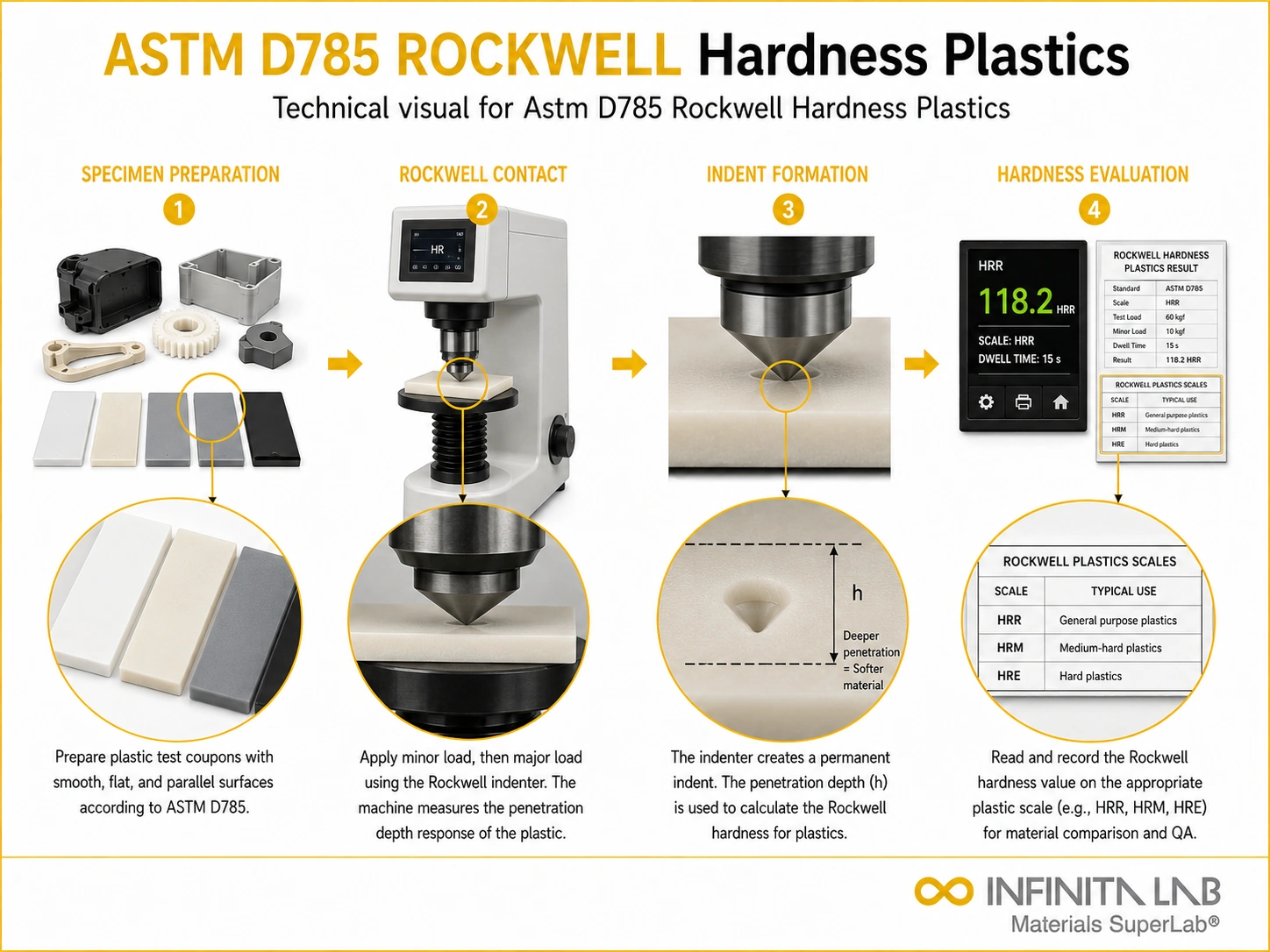
ASTM D785 defines the test method for measuring Rockwell hardness of plastics and electrical insulating materials. Rockwell hardness is determined by measuring the permanent depth of indentation made by a ball indenter under two successive loads – a minor load that seats the indenter, followed by a major load that drives it deeper. The hardness number is derived from the difference in indentation depth between the minor and major load positions.
For plastics, ASTM D785 specifies the use of ball indenters rather than the diamond cone used in metal hardness testing, because plastics deform differently and require larger contact areas to generate meaningful data. The test uses scales R, L, M, E, and K, each corresponding to a different ball diameter and major load combination. Scale selection is based on the expected hardness range of the material – softer materials use larger balls and lower loads to avoid excessive penetration.
Rockwell hardness is commonly used in plastics quality control because the test is fast, requires minimal specimen preparation, and produces a single number that correlates with other mechanical properties such as stiffness, scratch resistance, and wear performance. The Rockwell M scale is the most commonly used for engineering thermoplastics, while the R scale is used for softer plastics.

ASTM D785 Rockwell Hardness of Plastics Scope, Applications, and Benefits
Scope
ASTM D785 applies to rigid and semi-rigid thermoplastic and thermoset materials, as well as electrical insulating materials that can be prepared as flat-surfaced specimens. It is not applicable to soft or highly elastic materials where complete elastic recovery after indentation prevents a stable hardness reading. The test evaluates:
- Surface hardness of molded, extruded, and sheet plastic materials
- Lot-to-lot hardness consistency in production quality control
- Effect of fillers, reinforcements, and additives on hardness
- Impact of processing conditions on surface hardness
- Correlation of hardness with wear resistance and scratch performance
Applications
- Quality control in thermoplastic and thermoset manufacturing
- Material selection for wear-resistant plastic components
- Specification conformance testing for engineering plastics
- Comparative evaluation of competing plastic grades
- Electrical insulating material hardness qualification
- Research and development for new plastic formulations
Benefits
- Simple, fast test requiring minimal specimen preparation
- Standardized scales allow direct comparison across materials and laboratories
- Non-destructive when indentation remains within acceptable size limits
- Sensitive to formulation and processing changes in production materials
- Results correlate with functional properties like wear and scratch resistance
- Applicable to a wide range of plastic types and hardness levels
ASTM D785 Rockwell Hardness of Plastics Process
Specimen Preparation
Flat-surfaced specimens are prepared to the minimum thickness required for the selected scale.
1Scale and Indenter Selection
The appropriate Rockwell scale (R, L, M, E, or K) is selected based on the expected hardness range of the material.
2Hardness Measurement
The minor load is applied to seat the indenter, followed by the major load.
3Data Recording and Reporting
Multiple readings are taken per specimen to account for surface variation
4ASTM D785 Rockwell Hardness of Plastics Technical Specifications
| Parameter | Details |
|---|---|
| Standard | ASTM D785 |
| Test Principle | Differential depth indentation under minor and major loads |
| Available Scales | R, L, M, E, K (ball indenters of varying diameter) |
| Most Common Scale for Engineering Plastics | Rockwell M (1/4 inch ball, 100 kgf major load) |
| Applicable Materials | Rigid and semi-rigid thermoplastics, thermosets, electrical insulators |
| Output | Rockwell hardness number on designated scale (e.g., 70 M) |


Instrumentation Used for ASTM D785 Rockwell Hardness of Plastics
- Rockwell hardness tester configured for plastics testing
- Ball indenters (1/4 inch, 1/2 inch, 1 inch diameter per scale)
- Dead-weight or load-cell load application system
- Depth measurement system (dial indicator or electronic)
- Calibration test blocks for plastics hardness scales
- Data recording software
ASTM D785 Rockwell Hardness of Plastics Results and Deliverables
- Rockwell hardness value on the designated scale
- Number of measurements and statistical summary
- Scale and indenter configuration used
- Specimen thickness and conditioning records
- Calibration verification data
- Quality assurance documentation
Frequently Asked Questions
ASTM D785 uses a Rockwell hardness tester to measure the indentation hardness of plastics and electrical insulating materials. It helps evaluate the material's resistance to deformation.
The Rockwell hardness test describes how resistant the plastic material is to indentation. This data is helpful for quality control and performance evaluation when choosing a material for manufacturing processes.
Edge clearance is critical in avoiding damage to the specimen during testing and ensuring that results are not affected by inaccuracies in a test machine due to its proximity to the specimen's edge.
If it is too deep, the manufacturer should use a lower load scale to avoid damaging the specimen with more profound induction. It may also show that the material is softer than expected, which can influence the outcome.
ASTM D785 provides the hardness value and information related to the relative toughness, wear resistance, and elastic deformation of material regarding load, which are vital issues in selecting various materials.
Why Choose Infinita Lab for Advanced Materials Testing and Characterization?
At the core of this breadth is our network of 2,000+ accredited laboratories across the USA, offering access to over 10,000 testing methods and analytical services. From advanced materials characterization (SEM, TEM, RBS, XPS) to mechanical, chemical, environmental, biological, and standardized ASTM/ISO-compliant testing, we deliver unmatched flexibility, specialization, and scale. You are never limited by geography, facility, or methodology — Infinita Lab connects you to the right expertise and testing solution, every time.

Looking for a Trusted Partner for Accurate and Reliable Testing Services?
Send query us at hello@infinitalab.com or call us at (888) 878-3090 to learn more about our services and how we can support you.



Request a Quote
Submit your material details and receive testing procedures, pricing, and turnaround time within 24 hours.
 Quick Turnaround and Hasslefree process
 Confidentiality Guarantee
 Free, No-obligation Consultation
 100% Customer Satisfaction
