


ASTM D7724: Carbon Black Nitrogen Surface Area Testing Services
The determination of non-dispersible materials following mechanical water flushing of ordinary untreated carbon blacks is covered by the test technique ASTM D7724. It may not be appropriate for carbon black samples that have been coated with oil since the oil would hinder proper wetting of the sample by water. The values expressed in SI units are regarded as standard.
TRUSTED BY


Get ASTM D7724 compliant results — request your carbon black nitrogen surface area testing quote
- Overview
- Scope, Applications, and Benefits
- Test Process
- Specifications
- Instrumentation
- Results and Deliverables
What Is ASTM D7724 Carbon Black Nitrogen Surface Area?
ASTM D7724 describes a standard test method for evaluating the macrodispersion of carbon black in polyolefin pipe, fittings, and sheet materials. The method assesses the number and size of undispersed carbon black agglomerates in thin microtomed sections, providing a direct measure of mixing quality and material homogeneity.
Carbon black dispersion is critical in polyolefin products used outdoors, as well-dispersed carbon black provides uniform UV protection. Poorly dispersed agglomerates reduce UV stability, mechanical performance, and the long-term service life of the product.

Applications and Benefits of ASTM D7724 Carbon Black Nitrogen Surface Area Testing
Scope
ASTM D7724 evaluates:
- Carbon black agglomerate count and size in polyolefin sections
- Dispersion category rating (1–3) per ASTM D7724
- Effect of processing conditions on carbon black distribution
- Compliance with PE pipe and fitting carbon black dispersion requirements
Applications
- HDPE pressure pipe and fitting quality control
- Polyethylene geomembrane carbon black dispersion testing
- Gas distribution pipe material qualification
- Black polyethylene sheet and film inspection
- Carbon black masterbatch performance evaluation
Benefits
- Verifies UV protection homogeneity in black polyolefin products
- Ensures compliance with ASTM D3350 and ISO 11420 pipe specifications
- Detects inadequate mixing before the product enters service
- Supports material supplier qualification
- Rapid and cost-effective screening method
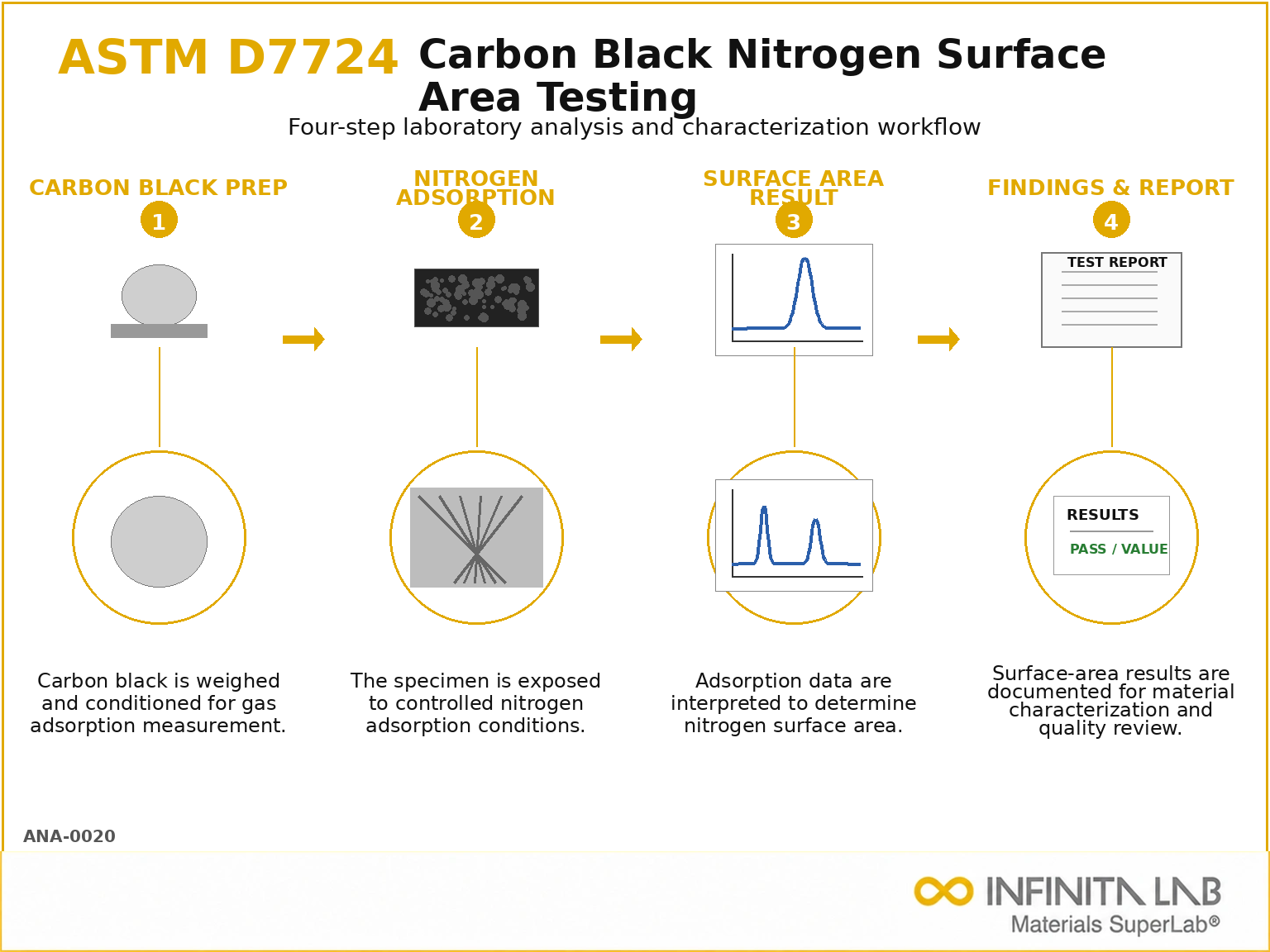
Our ASTM D7724 Testing Procedure
Microtomed Section Preparation
Thin sections (5–30 µm) are cut from the specimen using a microtome; sections are mounted on glass slides for transmitted light microscopy.
1Microscopic Examination
Sections are examined under transmitted light at 100× magnification; agglomerates are identified against the background.
2Category Assignment
The number and size of agglomerates are assessed per the ASTM D7724 rating criteria; a Category 1 (good), 2 (acceptable), or 3 (poor) rating is assigned.
3Reporting
Dispersion category, agglomerate images, and test conditions are documented and reported against the applicable pipe specification limits.
4ASTM D7724 Test Parameters and Requirements
| Parameter | Details |
|---|---|
| Applicable Materials | Polyolefin pipes, fittings, geomembranes, black sheet |
| Section Thickness | 5–30 µm (microtomed) |
| Magnification | 100× (transmitted light) |
| Rating Categories | Category 1 (≤5 agglomerates), 2, 3 (>15 agglomerates) |
| Related Standards | ASTM D3350, ISO 11420 |


- Rotary or sliding microtome
- Transmitted light optical microscope (100×)
- Glass slides and coverslips
- Calibrated eyepiece graticule
- Digital camera and image documentation system
Equipment and Instrumentation Used for ASTM D7724 Testing
What You Receive: Test Report, Data, and Certification
- Carbon black dispersion category (1, 2, or 3)
- Agglomerate count and representative micrographs
- Section thickness and preparation notes
- Compliance statement vs. pipe or fitting specification
- Full test report per ASTM D7724
ASTM D7724 Carbon Black Nitrogen Surface Area FAQs
Carbon black provides UV stabilization in outdoor polyethylene applications. Poorly dispersed agglomerates create zones of insufficient UV protection, leading to localized photo-oxidative degradation, surface cracking, and premature pipe failure in sunlight-exposed installations.
ASTM D3350 requires 2–3% carbon black by weight in black polyethylene pipe compounds. Both the carbon black content and its dispersion (per ASTM D7724 or ISO 11420) must meet specification requirements.
Both standards evaluate carbon black dispersion in polyolefin pipes using microtomed sections and optical microscopy. ISO 11420 uses a 1–5 rating scale, while ASTM D7724 uses a 1–3 category system. Both are widely specified and broadly equivalent in their assessment approach.
Yes. Agglomerates visible in the microtomed section can originate from incomplete let-down of the masterbatch during compounding. D7724 testing can identify this issue before pipe or fitting production is completed.
A minimum of 3 sections from different locations in the specimen are typically evaluated to represent the spatial variation in carbon black distribution across the product cross-section.
Why Choose Infinita Lab for Carbon Black Nitrogen Surface Area Testing?
At the core of this breadth is our network of 2,000+ accredited laboratories across the USA, offering access to over 10,000 testing methods and analytical services. From advanced materials characterization (SEM, TEM, RBS, XPS) to mechanical, chemical, environmental, biological, and standardized ASTM/ISO-compliant testing, we deliver unmatched flexibility, specialization, and scale. You are never limited by geography, facility, or methodology — Infinita Lab connects you to the right expertise and testing solution, every time.

Looking for an Accredited Partner for ASTM D7724 Carbon Black Nitrogen Surface Area Testing?
Send query us at hello@infinitalab.com or call us at (888) 878-3090 to learn more about our services and how we can support you.



Request a Quote
Submit your material details and receive testing procedures, pricing, and turnaround time within 24 hours.
 Quick Turnaround and Hasslefree process
 Confidentiality Guarantee
 Free, No-obligation Consultation
 100% Customer Satisfaction
