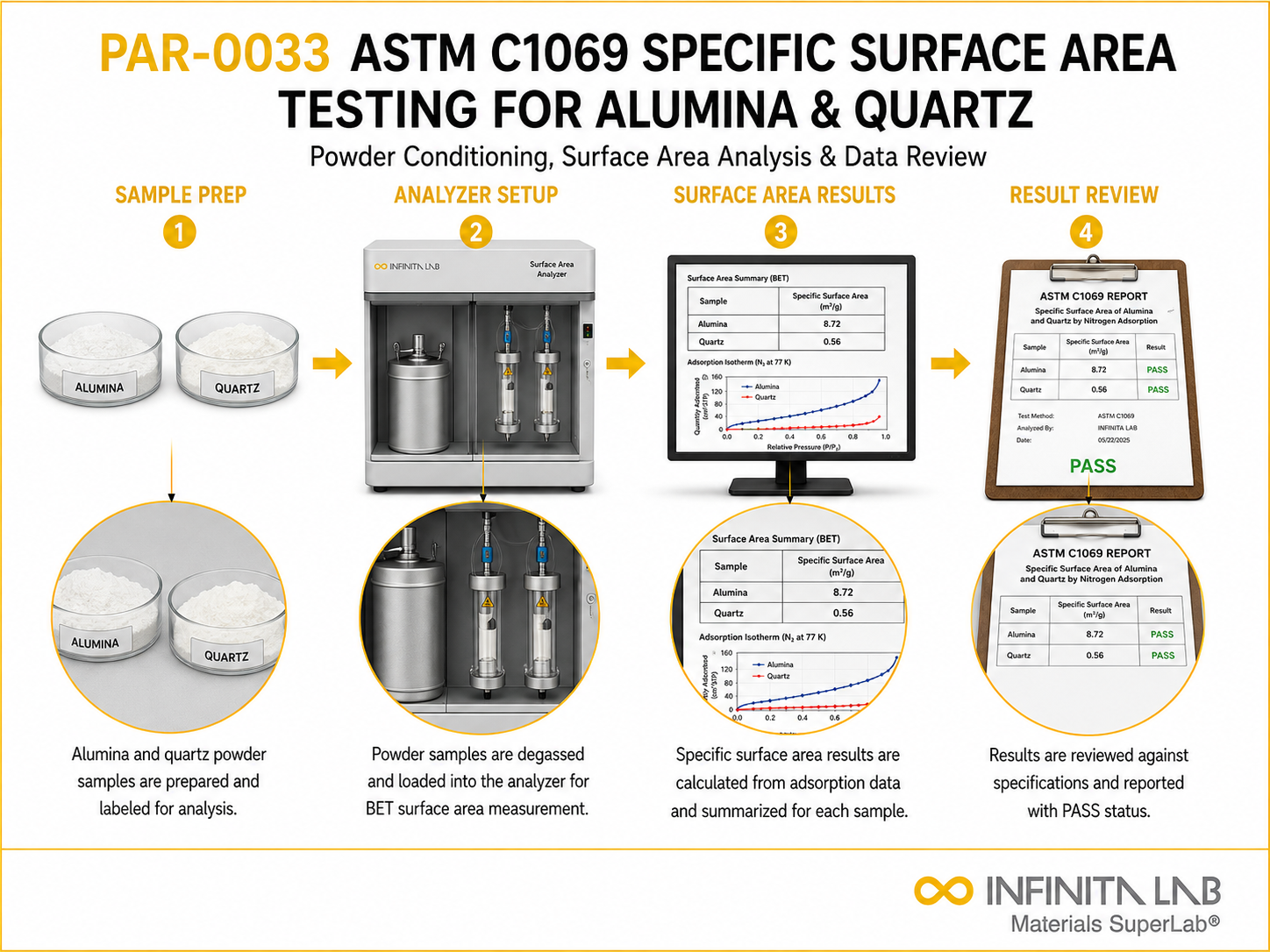


What Is ASTM C1069 Alumina Quartz Specific Surface Area?
ASTM C1069, Standard Test Method for Specific Surface Area of Alumina or Quartz by Nitrogen Adsorption, defines a general procedure for determining the specific surface area of aluminas and silicas used in the manufacture of ceramics. ASTM Committee C21 maintains the method, and it’s currently active as C1069-09(2022), reapproved in 2022. The standard doesn’t prescribe a single proprietary instrument. It permits any modern commercial nitrogen adsorption apparatus but strictly defines the outgassing procedure, because pretreatment of the powder is the step that most directly controls whether a reproducible result can be obtained. The document derives surface area from nitrogen adsorption data using the Brunauer-Emmett-Teller (BET) equation and adopts SI units as the standard. For a given powder, specific surface area is inversely related to particle size. That’s why the method also serves as an indirect measure of particle size. Sellers and purchasers of alumina and quartz are the intended users, and the results support material specifications, manufacturing control, and research. The document is brief, roughly two pages, and deliberately framed as a general test method rather than a full instrument manual. It sits alongside other gas adsorption standards, including ASTM D3663 for catalysts and catalyst carriers, ASTM D4567 for single-point continuous flow determinations on catalysts, and ISO 9277 for BET gas adsorption measurement of solids. C1069 is the one written specifically for ceramic raw materials. Infinita Lab coordinates C1069 testing through accredited partner laboratories, so sellers, purchasers, and researchers can obtain BET surface area data on alumina and quartz powders that follow the published procedure.

Applications and Benefits of ASTM C1069 Alumina Quartz Specific Surface Area Testing
Scope
ASTM C1069 outlines procedures for measuring the specific surface area of alumina and quartz powders through low-temperature nitrogen adsorption.
It evaluates:
- ASTM C1069 covers the determination of the specific surface area of aluminas and silicas used in the manufacture of ceramics, as stated in the standard’s scope text.
- The official title says alumina or quartz, so in practice the method is applied to alumina and quartz powders.
- Nitrogen adsorption is the technique, with surface area calculated using the Brunauer-Emmett-Teller (BET) equation.
- A general test procedure that permits any modern commercial nitrogen adsorption apparatus.
- Outgassing is strictly defined. It’s the main point where the method constrains how laboratories prepare the sample.
- Specific surface area measured by this method serves as an indirect measure of particle size.
- Sellers and purchasers of alumina and quartz materials are the intended users.
- Results may feed material specifications and manufacturing control, as well as research.
- SI units are the standard measurement system.
- It’s a short, general method, distinct from ASTM D3663 and ASTM D4567, which address catalysts and catalyst carriers.
Applications
- Verifying incoming alumina or quartz powder lots against purchase specifications agreed between seller and purchaser.
- Monitoring surface area as a manufacturing control parameter while ceramic raw materials are being produced.
- Where direct particle size measurement is impractical, estimating relative particle fineness indirectly.
- Comparing batches of calcined or milled alumina to track the effect of processing changes.
- Research and development of ceramic formulations that depend on powder reactivity and packing behavior.
- Settling disputes between suppliers and customers with a shared, published procedure.
Benefits
- A standardized, widely recognized basis for specifying powder surface area in ceramic supply contracts.
- Laboratories aren’t locked into one apparatus, since modern commercial adsorption instruments are allowed.
- Repeatability improves because the outgassing step is strictly defined.
- You get an indirect particle size indicator without separate sizing equipment.
- One consistent measurement supports both quality control and research.
- Less ambiguity in reported results because sellers and purchasers share a common reference.
Our ASTM C1069 Testing Procedure
Sample Preparation
Representative powder samples are weighed and degassed to remove moisture and adsorbed gases.
1Degassing
Samples are heated under vacuum or inert gas to ensure a clean surface for adsorption.
2Nitrogen Adsorption
Nitrogen gas adsorption is measured at 77 K using a surface area analyzer.
3Data Analysis
Specific surface area is calculated using the BET equation from adsorption isotherms.
4ASTM C1069 Test Parameters and Requirements
| Parameter | Details |
|---|---|
| Test Principle | BET nitrogen adsorption method |
| Applicable Materials | Alumina and quartz powders |
| Sample Size | Typically 0.1 g to 1.0 g |
| Measurement Temperature | 77 K (liquid nitrogen) |
| Result Unit | m²/g (specific surface area) |


- Nitrogen Adsorption Surface Area Analyzer – Commercial instrument that doses nitrogen onto the sample and records the adsorbed quantity used for BET analysis.
- Outgassing Station – Heated vacuum or flow preparation unit. It removes adsorbed species from the powder according to the defined outgassing procedure.
- Analytical Balance – Determines the outgassed sample mass so that surface area can be expressed per gram.
- Sample Tubes and Heating Mantles – Hold the powder during outgassing and analysis, with controlled, uniform heating.
- Cryogenic Coolant Bath – Keeps the sample at the low temperature nitrogen adsorption needs during measurement.
- BET Data Analysis Software – Runs the Brunauer-Emmett-Teller equation on the adsorption data and generates the surface area result.
Equipment and Instrumentation Used for ASTM C1069 Testing
What You Receive: Test Report, Data, and Certification
- A reported specific surface area value for each alumina or quartz sample, calculated using the BET equation.
- Outgassing conditions applied before measurement, documented.
- Sample identification, mass, and instrument details recorded for traceability.
- An indirect particle size indication derived from the surface area result, where requested.
- A formal test report referencing ASTM C1069, suitable for specification compliance, quality control, or research records.
ASTM C1069 Alumina Quartz Specific Surface Area FAQs
The BET theory is frequently utilized to assess the gas adsorption data and produce a particular surface area result stated in area units per sample mass (m2/g). Area per volume of sample (m2/cm3) is another way to represent specific surface area.
Activated Alumina is manufactured by dehydroxylation of aluminum oxide hydroxide (Boehmite), which produces a highly porous substance with a surface area typically 150–380 m2 per gram.
The tested values of the quartz sand's specific surface area were 1300 cm2/g, 2600 cm2/g, and 3600 cm2/g.
ASTM C1069 is the Standard Test Method for Specific Surface Area of Alumina or Quartz by Nitrogen Adsorption. It measures specific surface area using nitrogen adsorption, with calculations based on the Brunauer-Emmett-Teller (BET) equation.
The alumina sample is prepared and analyzed using an appropriate chemical, physical, or instrumental method depending on the property being measured. For specific surface area, ASTM C1069 uses nitrogen adsorption and BET calculations to determine the surface area of the alumina.
Why Choose Infinita Lab for Alumina Quartz Specific Surface Area Testing
When your Alumina Quartz Specific Surface Area results have to hold up - for compliance, a customer audit, or an engineering decision - ASTM C1069 accuracy and an unbiased third-party report matter more than price. Infinita Lab routes your ASTM C1069 alumina quartz specific surface area testing to ISO/IEC 17025-accredited U.S. partner labs with hands-on method experience, so you get defensible data, transparent reporting, and turnaround times built around your project deadline - not ours.

Need ASTM C1069 Alumina Quartz Specific Surface Area Testing You Can Rely On?
Send query us at hello@infinitalab.com or call us at (888) 878-3090 to learn more about our services and how we can support you.





