


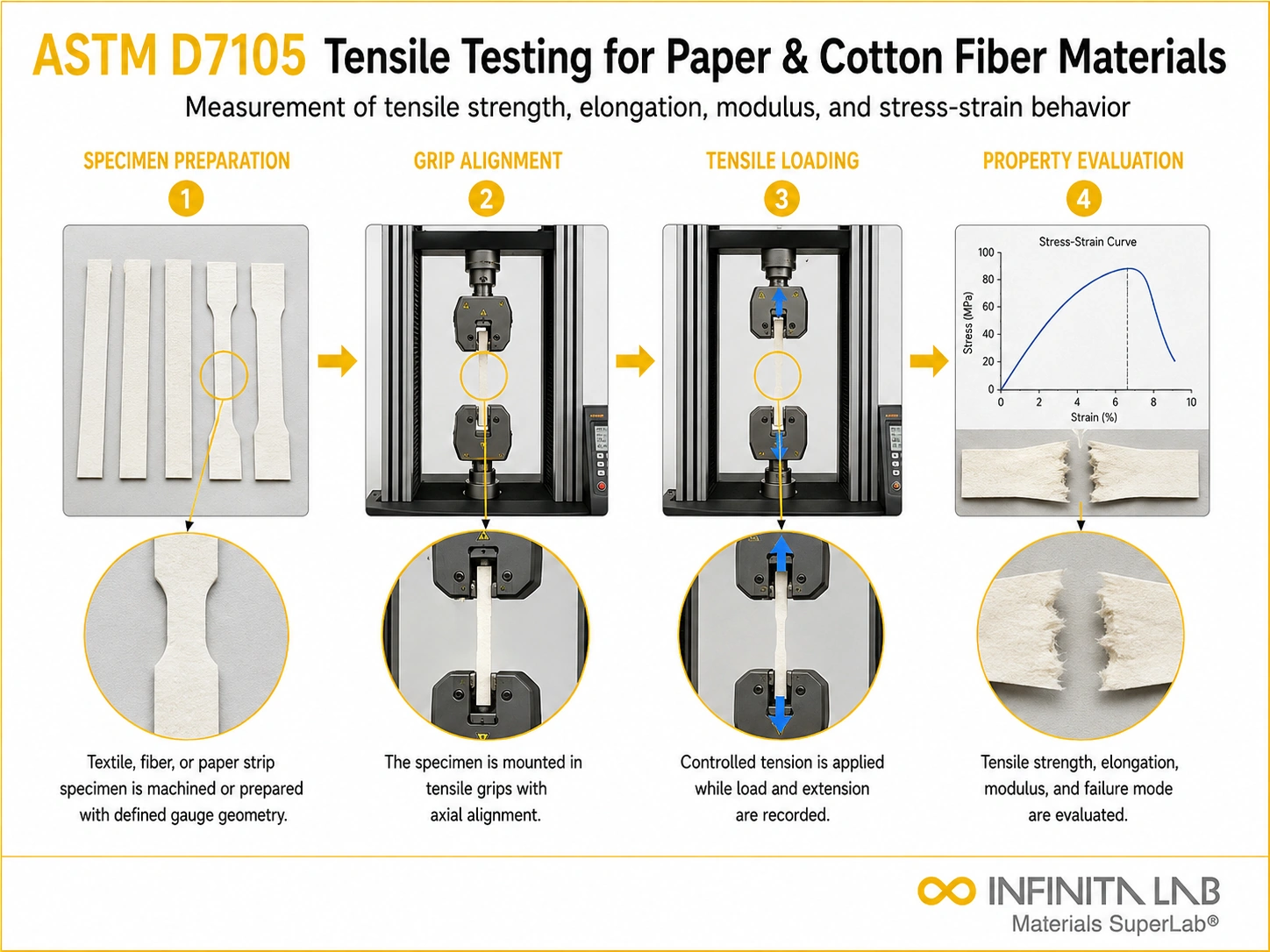
ASTM D7105 Tensile Testing for Paper & Cotton Fiber Materials
ASTM D7105-06 is the standardized test method for determining the adhesive and cohesive strengths between materials in roofing or waterproofing membranes or systems. The method is useful in identifying the weakest plane in the system. The values are reported in SI units or inch-pound units.
TRUSTED BY


Precision-driven testing for dimensional accuracy and compliance
- Overview
- Scope, Applications, and Benefits
- Test Process
- Specifications
- Instrumentation
- Results and Deliverables
Overview
ASTM D7105-06 describes a test method for determining the amount of metallic contamination, particularly lead and other heavy metals, that can be extracted from architectural paint films under simulated exposure conditions. This test is critical for assessing potential human health risks from toxic metal-containing paints in residential and commercial buildings.
The method supports regulatory compliance, renovation and demolition safety assessments, and paint product reformulation efforts to reduce hazardous metal content in coatings.

Scope, Applications, and Benefits
Scope
ASTM D7105-06 covers the extraction and quantification of metals from dried paint films using simulated biological or environmental extraction fluids and includes:
- Lead (Pb), cadmium (Cd), chromium (Cr), and other regulated metals
- Bioaccessibility estimation under simulated gastric extraction
- Compliance screening relative to regulatory thresholds
- Comparison between paint systems for relative metal extractability
Applications
- Lead paint hazard assessment in older buildings
- Regulatory compliance testing for architectural coatings
- Paint renovation and abatement planning
- Children’s product safety coating evaluation
- Environmental impact assessment for painted surface weathering
Benefits
- Provides bioaccessible metal fraction data relevant to health risk assessment
- More relevant to actual exposure than total metal content alone
- Supports regulatory compliance with EPA and CPSC limits
- Applicable to wet, dry, and weathered paint films
- Enables reformulation guidance for lower-extractability alternatives
Test Process
Paint Film Preparation
Paint film specimens are prepared on an inert substrate, cured, and sampled by scraping or cutting to a defined particle size.
1Extraction
Ground paint film is exposed to a simulated extraction fluid (e.g., simulated gastric fluid or acidified solution) at controlled temperature and duration.
2Elemental Analysis
The extraction fluid is analyzed by ICP-OES or AAS for target metal concentrations.
3Reporting
Extractable metal content is expressed as mg/g of paint film and compared to regulatory limits or reference values.
4Technical Specifications
| Parameter | Details |
|---|---|
| Test Principle | Simulated extraction followed by elemental analysis |
| Target Metals | Pb, Cd, Cr, and others as specified |
| Extraction Medium | Simulated gastric or environmental fluid |
| Analytical Method | ICP-OES or AAS |
| Measured Output | Extractable metal content (mg/g paint film) |


- ICP-OES or atomic absorption spectrometer (AAS)
- Controlled-temperature extraction bath or oven
- Ball mill or micronizer for paint film particle size reduction
- Analytical balance (0.01 mg resolution)
- Certified reference materials for metal calibration
Instrumentation Used for Testing
Results and Deliverables
- Extractable concentration of each target metal (mg/g)
- Comparison to regulatory thresholds (e.g., EPA 1.0 mg/cm²)
- Relative extractability across paint film types
- Risk characterization summary for hazard assessment
- Full analytical test report with traceability
Frequently Asked Question
Extractable (bioaccessible) lead represents the fraction that could be absorbed if ingested — this is more relevant to health risk than total lead content, which may be largely non-bioavailable.
The U.S. Consumer Product Safety Commission (CPSC) limits lead in architectural paint to 90 ppm (0.009%) total lead by dry film weight, while EPA hazard thresholds differ; D7105 extractability data informs risk-based interpretations
Yes — ASTM D7105 is designed for both new and aged paint films, including weathered exterior paints where metal mobilization from surface erosion is a concern.
Cadmium (from yellow and red pigments), hexavalent chromium (from anticorrosive primers), and barium are commonly included alongside lead in extractability screening.
Not directly — if layer-specific data is needed, individual layers must be sampled separately before extraction.
Why Choose Infinita Lab for Advanced Materials Testing and Characterization?
At the core of this breadth is our network of 2,000+ accredited laboratories across the USA, offering access to over 10,000 testing methods and analytical services. From advanced materials characterization (SEM, TEM, RBS, XPS) to mechanical, chemical, environmental, biological, and standardized ASTM/ISO-compliant testing, we deliver unmatched flexibility, specialization, and scale. You are never limited by geography, facility, or methodology — Infinita Lab connects you to the right expertise and testing solution, every time.

Looking for a Trusted Partner for Accurate and Reliable Testing Services?
Send query us at hello@infinitalab.com or call us at (888) 878-3090 to learn more about our services and how we can support you.



Request a Quote
Submit your material details and receive testing procedures, pricing, and turnaround time within 24 hours.
 Quick Turnaround and Hasslefree process
 Confidentiality Guarantee
 Free, No-obligation Consultation
 100% Customer Satisfaction
