

What Is ASTM D698 Soil Standard Proctor Compaction?
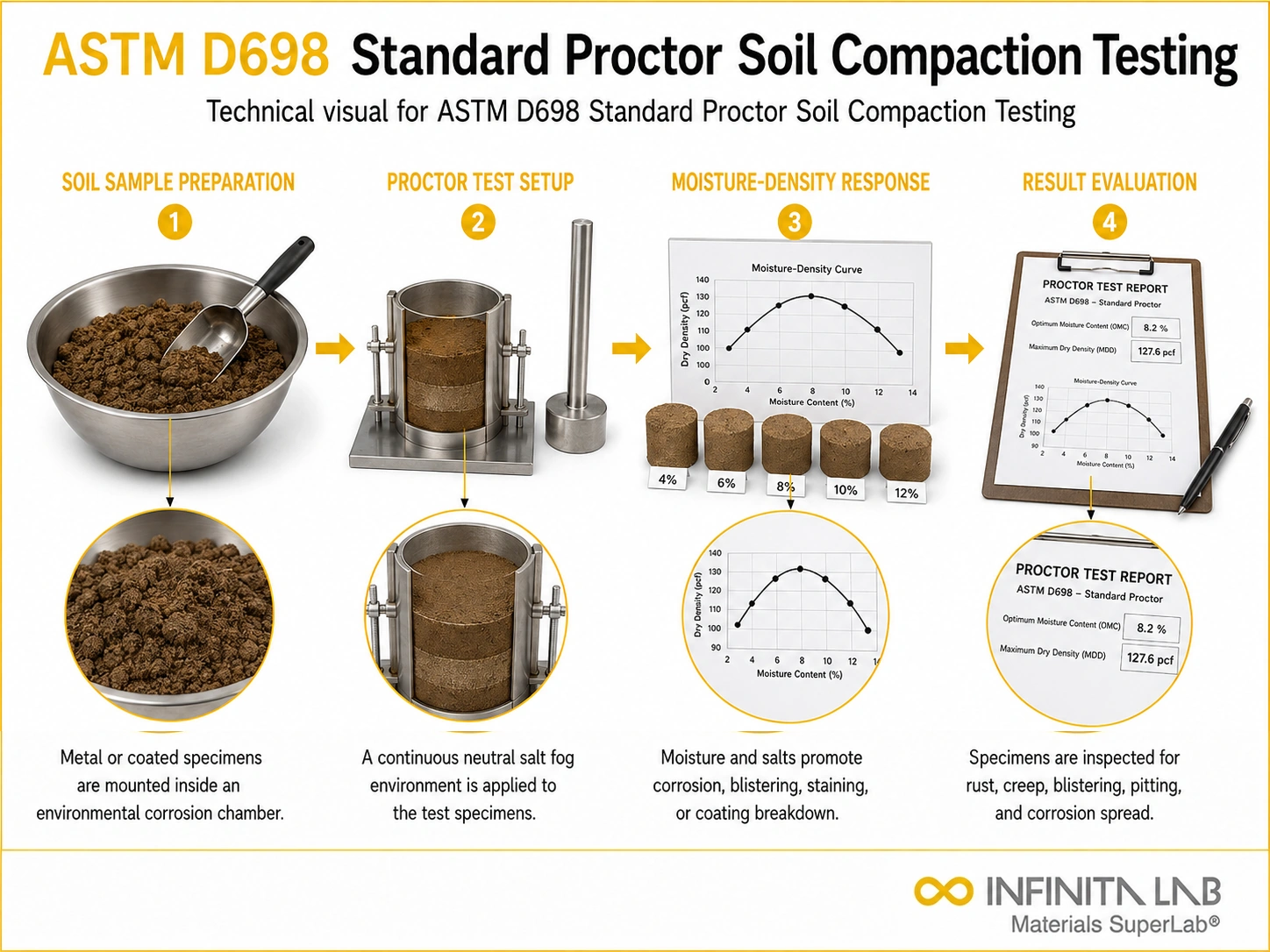
ASTM D698-12 determines the relationship between moisture content and dry density of soils using a standard compaction effort. It identifies the optimum moisture content (OMC) at which soil achieves maximum dry density (MDD), which is critical for stable construction foundations.
This method is widely used in the geotechnical and construction industry to ensure proper soil compaction for foundations, embankments, and roadworks. It helps engineers achieve desired soil strength, reduce settlement risks, and improve load-bearing capacity for long-term structural performance.

Applications and Benefits of ASTM D698 Soil Standard Proctor Compaction Testing
Scope
ASTM D698-12 evaluates soil compaction characteristics by applying controlled mechanical energy to soil samples at varying moisture contents.
It helps determine optimum moisture and maximum density for construction applications.
- Moisture-density relationship determination
- Optimum moisture content (OMC) identification
- Maximum dry density (MDD) evaluation
- Soil compaction performance assessment
- Material suitability for construction
- Quality control of field compaction
- Compliance verification
Applications
- Road and highway construction
- Embankments and earth dams
- Building foundations
- Landfill and backfill operations
- Soil stabilization projects
Benefits
- Ensures proper soil compaction
- Improves load-bearing capacity
- Reduces settlement and deformation
- Enhances structural stability
- Supports quality control in construction
- Optimizes moisture conditions
- Meets industry standards
Our ASTM D698 Testing Procedure
Sample Preparation
Soil is air-dried, sieved, and mixed with varying moisture contents.
1Compaction
Soil is compacted in a mold using standard hammer energy in layers.
2Density Measurement
Wet density is determined and converted to dry density values.
3Curve Development
Moisture vs. dry density curve is plotted to find OMC and MDD.
4ASTM D698 Test Parameters and Requirements
| Parameter | Details |
|---|---|
| Material Type | Fine and coarse-grained soils. |
| Compaction Energy | Defined hammer weight and drop height. |
| Mold Volume | Standard mold size specified. |
| Layer Compaction | Soil compacted in multiple layers. |
| Measured Parameter | Dry density and moisture content. |
| Result Output | OMC and MDD values. |
| Sample Condition | Controlled moisture variations. |
| Test Environment | Laboratory-controlled conditions. |


- Proctor compaction mold and base plate
- Standard Proctor hammer
- Weighing balance
- Drying oven
- Moisture content containers
- Sieve set
Equipment and Instrumentation Used for ASTM D698 Testing
What You Receive: Test Report, Data, and Certification
- Moisture-density curve
- Optimum moisture content (OMC)
- Maximum dry density (MDD)
- Compaction test report
- Soil suitability assessment
- Compliance with ASTM D698-12
- Final test certification
ASTM D698 Soil Standard Proctor Compaction FAQs
ASTM D698-12 is a laboratory test that determines the relationship between moisture content and dry density of soil, helping identify optimum moisture conditions for achieving maximum compaction and stability.
Proper soil compaction increases load-bearing capacity, reduces settlement, and improves stability, ensuring safe and durable foundations for structures and infrastructure projects.
OMC is the moisture level at which soil achieves its maximum dry density under a given compaction effort, ensuring the best possible compaction efficiency.
Factors include soil type, moisture content, compaction energy, and particle size distribution.
MDD is the highest dry density achieved by soil at optimum moisture content, indicating maximum compaction and strength.
ASTM D698 determines the relationship between soil moisture content and dry density using standard compactive effort. Soil samples are compacted at different moisture levels in a mold, and the results are used to identify the maximum dry density and optimum moisture content.
The ASTM D698 standard compaction test involves placing soil in a mold in three layers and compacting each layer with a 2.5 kg (5.5 lb) rammer dropped from a height of 305 mm (12 in). The dry density is calculated at different moisture contents to establish the soil compaction curve.
The Modified Proctor test uses greater compactive effort than ASTM D698 and is covered by ASTM D1557, not D698. ASTM D1557 uses a heavier rammer and greater drop height to determine maximum dry density and optimum moisture content under modified compaction energy.
Why Choose Infinita Lab for Soil Standard Proctor Compaction Testing
When your Soil Standard Proctor Compaction results have to hold up - for compliance, a customer audit, or an engineering decision - ASTM D698 accuracy and an unbiased third-party report matter more than price. Infinita Lab routes your ASTM D698 soil standard proctor compaction testing to ISO/IEC 17025-accredited U.S. partner labs with hands-on method experience, so you get defensible data, transparent reporting, and turnaround times built around your project deadline - not ours.

Need ASTM D698 Soil Standard Proctor Compaction Testing You Can Rely On?
Send query us at hello@infinitalab.com or call us at (888) 878-3090 to learn more about our services and how we can support you.