


ASTM D6264: Composite Quasi Static Indentation Damage Testing Services
ASTM D6264-17 test method determines the damage resistance of multidirectional polymer matrix composite laminated plates when subjected to a concentrated indentation force. The damage resistance is quantified in terms of a critical contact force to cause a specific size and type of damage in the specimen.
TRUSTED BY


Get ASTM D6264 compliant results — request your composite quasi static indentation damage testing quote
- Overview
- Scope, Applications, and Benefits
- Test Process
- Specifications
- Instrumentation
- Results and Deliverables
What Is ASTM D6264 Composite Quasi Static Indentation Damage?
ASTM D6264-17 provides a test method for evaluating the damage resistance of fiber-reinforced polymer-matrix composites under a concentrated quasi-static indentation force. This test simulates conditions where localized loads, such as tool drops or impacts, may cause internal damage without visible surface failure.
The method helps assess the ability of composite materials to resist indentation-induced damage, including matrix cracking, fiber breakage, and delamination. It is widely used in aerospace, automotive, and structural applications where composite durability and damage tolerance are critical.

Applications and Benefits of ASTM D6264 Composite Quasi Static Indentation Damage Testing
Scope
ASTM D6264-17 measures the resistance of composite laminates to damage under a controlled indentation load. It evaluates how materials respond to localized forces that may occur during service.
The test evaluates:
- Indentation damage resistance
- Delamination and internal damage
- Load vs displacement behavior
- Energy absorption characteristics
- Structural integrity after loading
Applications
- Aerospace composite structures
- Automotive composite components
- Marine and structural composites
- Protective panels and laminates
- Composite material research and development
- Quality control in composite manufacturing
Benefits
- Helps predict damage tolerance
- Improves material selection and design
- Enhances safety and reliability
- Supports failure analysis
- Enables comparison of composite materials
Our ASTM D6264 Testing Procedure
Sample Preparation
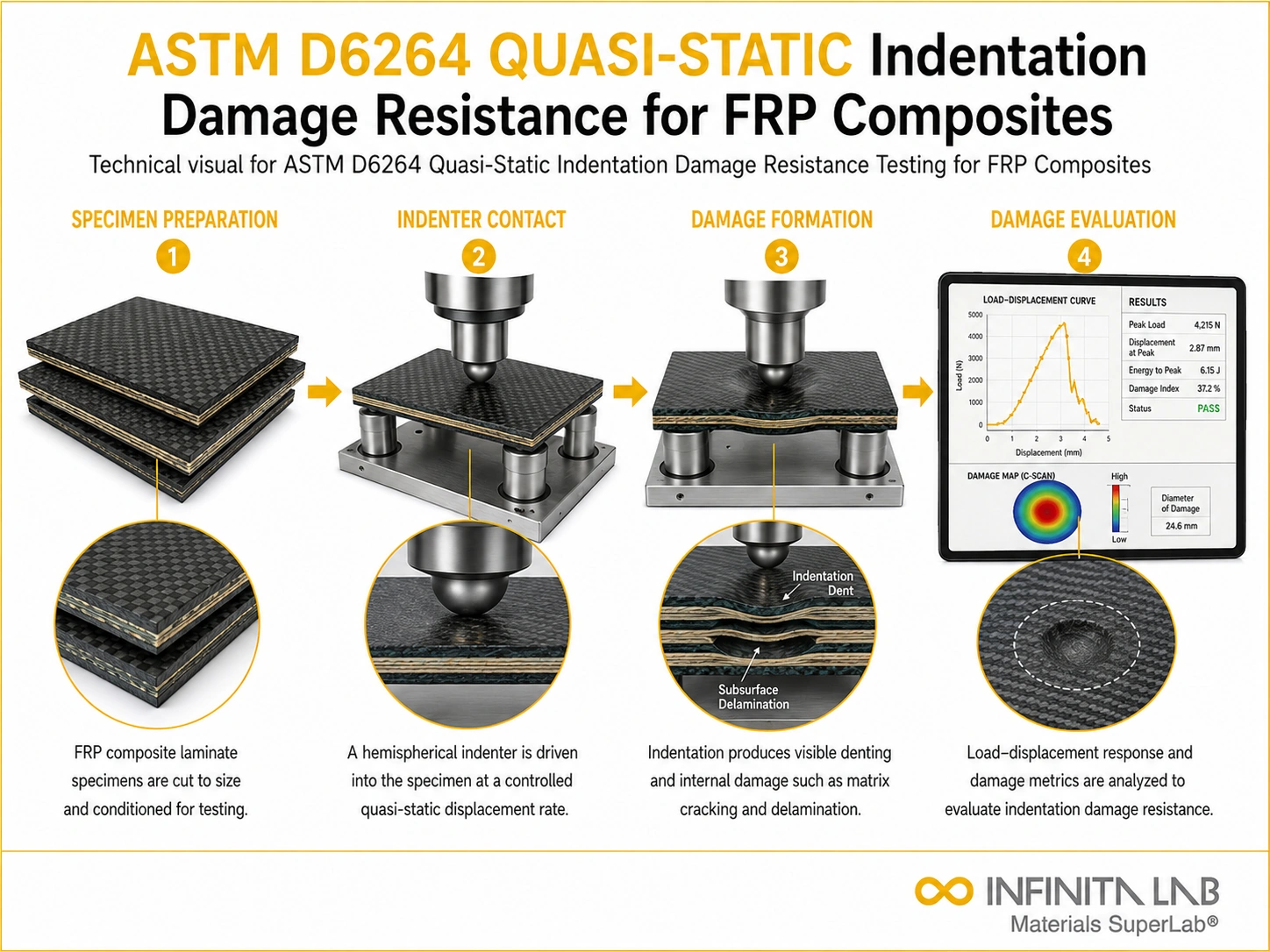
Composite laminate specimens are prepared to standard dimensions.
1Indentation Loading
A concentrated load is applied using an indenter at a controlled rate.
2Damage Observation
Damage such as cracks or delamination is monitored.
3Data Recording & Evaluation
Load-displacement data and damage extent are analyzed.
4ASTM D6264 Test Parameters and Requirements
| Parameter | Details |
|---|---|
| Applicable Materials | Fiber-reinforced polymer composites |
| Indenter Type | Hemispherical indenter |
| Indenter Diameter | Typically 12.7 mm (0.5 in) |
| Loading Rate | Approximately 1–5 mm/min |
| Specimen Thickness | Typically 2 mm to 6 mm |
| Test Temperature | Approximately 23°C ± 2°C |
| Measured Outputs | Load, displacement, damage area, energy absorption |


- Universal testing machine
- Indentation fixture with hemispherical indenter
- Displacement measurement system
- Non-destructive testing tools (ultrasonic or C-scan)
- Optical inspection tools
- Data acquisition system
Equipment and Instrumentation Used for ASTM D6264 Testing
What You Receive: Test Report, Data, and Certification
- Load-displacement curve
- Damage resistance evaluation
- Indentation depth and damage area
- Energy absorption data
- Test condition summary
- ASTM compliance report
ASTM D6264 Composite Quasi Static Indentation Damage FAQs
ASTM D6264-17 is a standard test method used to evaluate the damage resistance of fiber-reinforced polymer-matrix composites when subjected to a concentrated quasi-static indentation force under controlled conditions.
ASTM D6264-17 helps assess how composite materials resist localized damage, ensuring structural reliability and safety in aerospace, automotive, and structural applications where impact-like loads may occur.
ASTM D6264-17 involves applying a controlled indentation force through a hemispherical indenter onto a composite specimen, measuring load and displacement to evaluate damage initiation and progression.
The test requires a universal testing machine, indentation fixture, hemispherical indenter, and data acquisition system to record force-displacement behavior accurately during loading.
Results are evaluated based on load-displacement curves, damage thresholds, and visual or microscopic inspection, indicating the composite’s resistance to indentation-induced damage.
Why Choose Infinita Lab for Composite Quasi Static Indentation Damage Testing?
At the core of this breadth is our network of 2,000+ accredited laboratories across the USA, offering access to over 10,000 testing methods and analytical services. From advanced materials characterization (SEM, TEM, RBS, XPS) to mechanical, chemical, environmental, biological, and standardized ASTM/ISO-compliant testing, we deliver unmatched flexibility, specialization, and scale. You are never limited by geography, facility, or methodology — Infinita Lab connects you to the right expertise and testing solution, every time.

Need ASTM D6264 Composite Quasi Static Indentation Damage Testing You Can Rely On?
Send query us at hello@infinitalab.com or call us at (888) 878-3090 to learn more about our services and how we can support you.



Request a Quote
Submit your material details and receive testing procedures, pricing, and turnaround time within 24 hours.
 Quick Turnaround and Hasslefree process
 Confidentiality Guarantee
 Free, No-obligation Consultation
 100% Customer Satisfaction
