


ASTM D494 Acetone Extraction Testing for Phenolic Molded Products
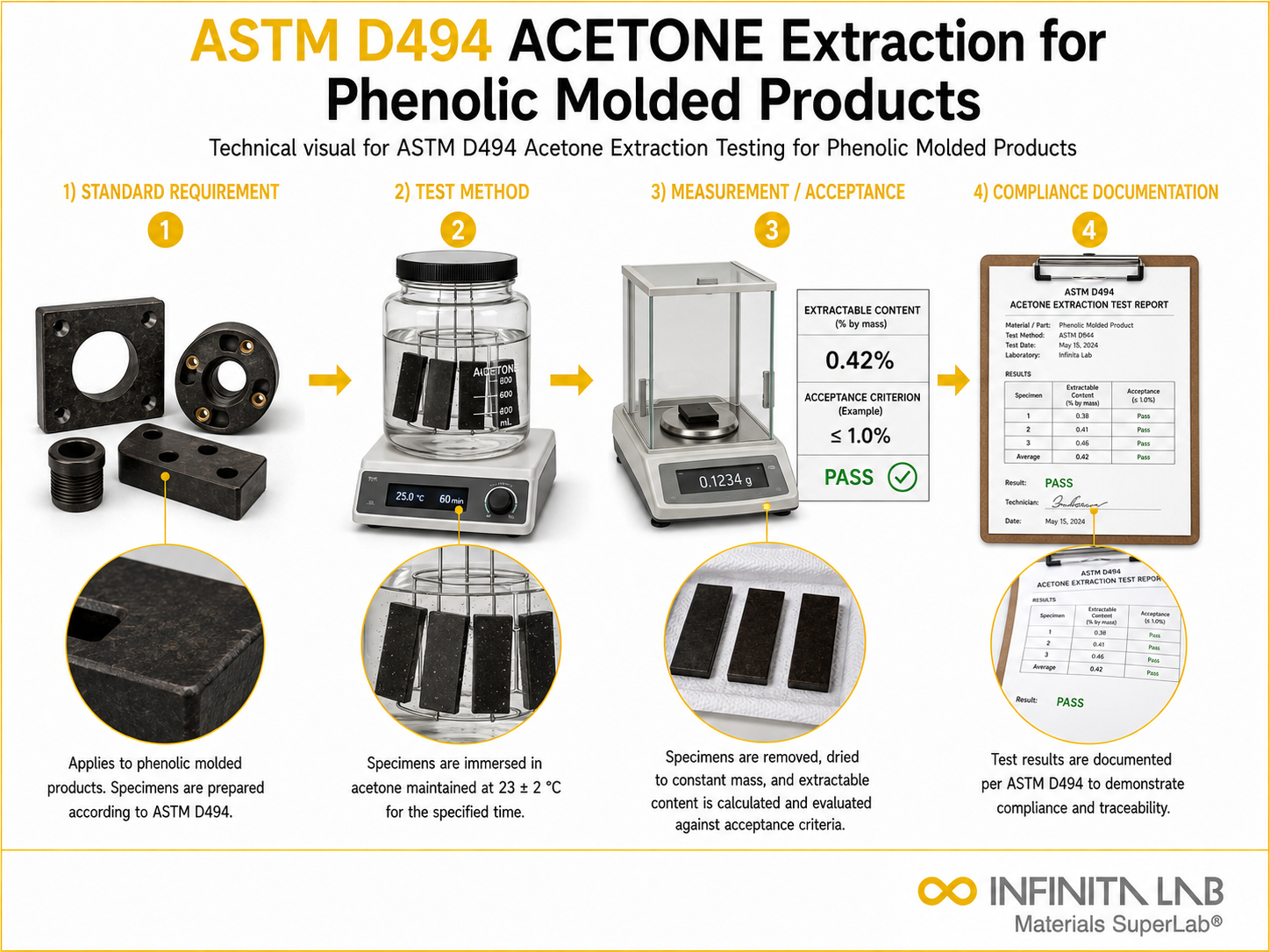
ASTM D494-11 Standard describes the amount of acetone-soluble materials in molded or laminated phenolic goods that can be measured using this test procedure.
TRUSTED BY


Precision-driven testing for dimensional accuracy and compliance
- Overview
- Scope, Applications, and Benefits
- Test Process
- Specifications
- Instrumentation
- Results and Deliverables
Overview
ASTM D494-11 is a standardized test method used to determine the acetone-extractable content in cellulose-based materials, electrical insulation, and polymeric compounds. This method helps identify the presence of resins, plasticizers, oils, waxes, and other soluble impurities that influence product performance and durability.
The innovative approach to ASTM D494-11 enhances extraction efficiency, accuracy, and repeatability through controlled temperature systems and improved solvent handling techniques. It is widely used in quality control, research, and compliance testing to ensure material consistency and detect unwanted additives affecting electrical and mechanical properties.

Scope, Applications, and Benefits
Scope
ASTM D494-11 defines procedures for quantifying acetone-soluble components in insulating materials and polymers. It applies to materials where extractable content impacts performance, reliability, and compliance with industrial standards.
- Applicable to cellulose insulation and polymeric materials
- Determines soluble contaminants and additives
- Supports quality control and product validation
- Used in electrical and industrial material testing
- Ensures compliance with material specifications
Applications
- Electrical insulation material testing
- Polymer and plastic quality evaluation
- Research and development studies
- Raw material verification processes
- Failure and contamination analysis
Benefits
- Improves material purity assessment
- Enhances product reliability and performance
- Detects unwanted additives and contaminants
- Supports regulatory and standard compliance
- Ensures consistency in manufacturing quality
Test Process
Sample Preparation
The sample is cleaned, sized, and accurately weighed for uniform testing.
1Acetone Extraction
The sample is extracted with acetone under controlled temperature conditions.
2Solvent Evaporation
The solvent is evaporated to obtain the extracted residue.
3Residue Weighing
The residue is dried and weighed to determine extractable content.
4Technical Specifications
| Parameter | Details |
|---|---|
| Principle | Gravimetric determination of acetone-soluble extractives |
| Solvent | Analytical grade acetone (high purity) |
| Boiling point | ~56°C (controlled during extraction) |
| Extraction method | Soxhlet continuous extraction technique |
| Extraction duration | Typically 4–8 hours |
| Sample size | Usually 1–10 grams depending on material |


Instrumentation Used for Testing
- Soxhlet extraction apparatus
- Analytical balance
- Heating mantle or extraction unit
- Drying oven
- Desiccator
Results and Deliverables
- Percentage of acetone-extractable content
- Detailed ASTM D494-11 test report
- Compliance and conformity assessment
- Observations on contamination or additives
- Recommendations for material improvement
Frequently Asked Questions
ASTM D494-11 testing determines acetone-soluble substances in materials. It helps identify contaminants such as oils, waxes, and plasticizers that can affect insulation performance, mechanical properties, and long-term durability in industrial and electrical applications.
This test is commonly applied to cellulose-based insulation, paper materials, and polymer compounds. It is particularly useful where extractable impurities may influence electrical properties, structural integrity, or product reliability in demanding operational environments.
Acetone is used due to its strong solvency for organic compounds, low boiling point, and easy evaporation. It efficiently dissolves extractable substances like oils and resins without causing structural damage to most test materials.
High extractable content indicates the presence of excess additives, contamination, or processing residues. This can negatively impact insulation performance, reduce mechanical strength, and affect long-term reliability of the material in service conditions.
Accuracy depends on sample preparation, solvent purity, extraction time, temperature control, and weighing precision. Variations in any of these factors can lead to incorrect measurement of acetone-soluble substances in the material.
Why Choose Infinita Lab for Advanced Materials Testing and Characterization?
At the core of this breadth is our network of 2,000+ accredited laboratories across the USA, offering access to over 10,000 testing methods and analytical services. From advanced materials characterization (SEM, TEM, RBS, XPS) to mechanical, chemical, environmental, biological, and standardized ASTM/ISO-compliant testing, we deliver unmatched flexibility, specialization, and scale. You are never limited by geography, facility, or methodology — Infinita Lab connects you to the right expertise and testing solution, every time.

Looking for a Trusted Partner for Accurate and Reliable Testing Services?
Send query us at hello@infinitalab.com or call us at (888) 878-3090 to learn more about our services and how we can support you.



Request a Quote
Submit your material details and receive testing procedures, pricing, and turnaround time within 24 hours.
 Quick Turnaround and Hasslefree process
 Confidentiality Guarantee
 Free, No-obligation Consultation
 100% Customer Satisfaction
