


ASTM D4832: CLSM Cylinder Testing Services
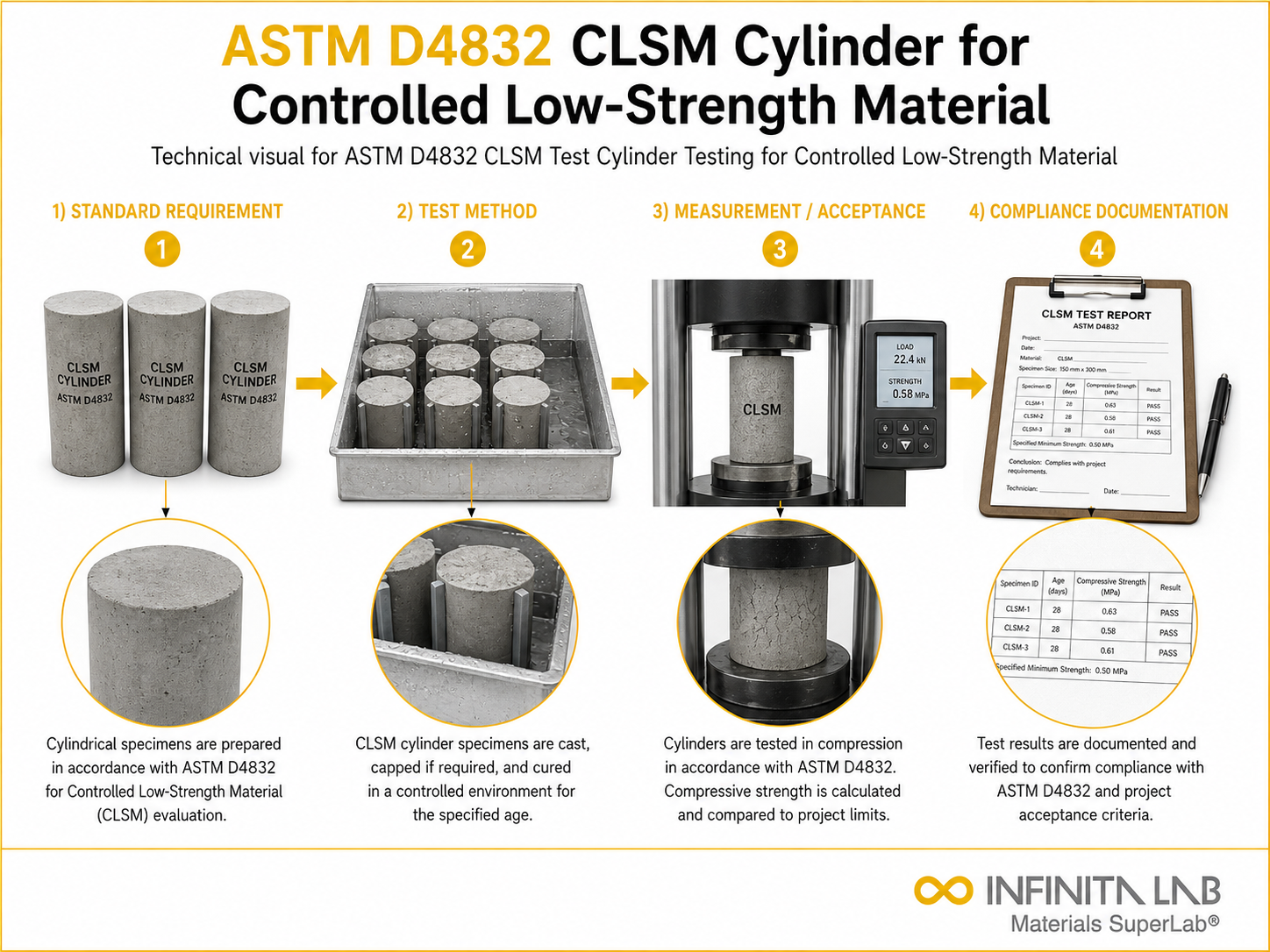
The controlled low-strength material (CLSM) cylindrical test specimens are prepared, cured, transported, and tested to determine compressive strength by ASTM D4832. It is also possible to prepare and test samples of various soil and cementitious material mixes, such as self-cementing fly ashes, using the test method.
TRUSTED BY


Get ASTM D4832 compliant results — request your CLSM cylinder testing quote
- Overview
- Scope, Applications, and Benefits
- Test Process
- Specifications
- Instrumentation
- Results and Deliverables
What Is ASTM D4832 CLSM Cylinder?
ASTM D4832 defines standardized procedures for preparing and testing cylindrical specimens of controlled low-strength material (CLSM) — also known as flowable fill, lean concrete, or soil-cement slurry — to determine their compressive strength. CLSM is a self-compacting cementitious material used as a fill or backfill material in applications where traditional compacted fill is impractical, such as filling utility trenches, abandoned underground structures, and bridge abutment voids.
The test involves casting CLSM into cylindrical molds, curing the specimens under specified conditions, and testing them in unconfined compression at the prescribed age. The compressive strength of CLSM is deliberately kept low (typically 0.3–8.3 MPa / 50–1200 psi) to ensure that the fill can be re-excavated if needed in future utility maintenance operations. ASTM D4832 provides the methodology for both fresh and hardened CLSM characterization.

Applications and Benefits of ASTM D4832 CLSM Cylinder Testing
Scope
ASTM D4832 evaluates:
- Unconfined compressive strength of CLSM at specified ages
- Effect of mix design on CLSM strength development
- Compliance with maximum excavatability strength requirements
- Consistency of CLSM strength across a placement
- Strength gain over time (1, 3, 7, 28 days)
- Quality control of CLSM production and placement
Applications
- Utility trench backfill (water, gas, electrical conduit)
- Abandoned pipeline and structure abandonment fill
- Bridge abutment and retaining wall backfill
- Pavement base and subbase fill
- Mining void fill applications
- Environmental remediation site filling
- Road reconstruction and infrastructure projects
Benefits
- Ensures CLSM meets excavatability strength limits
- Supports consistent CLSM mix design approval
- Provides documentation for construction quality control
- Detects mix design or batching errors before placement
- Enables strength-gain monitoring over curing time
- Supports acceptance testing for CLSM specifications
Our ASTM D4832 Testing Procedure
Specimen Casting
Fresh CLSM is cast into cylindrical molds (75 mm × 150 mm standard) without vibration.
1Curing
Cylinders are cured under specified conditions (moist curing or in-place simulation) for the required period.
2Capping
Specimen ends are capped with sulfur compound or gypsum to ensure flat, parallel bearing surfaces.
3Compression Testing
Specimens are loaded at a controlled rate in a compression machine to failure; peak load is recorded.
4ASTM D4832 Test Parameters and Requirements
| Parameter | Details |
|---|---|
| Test Principle | Unconfined axial compression of cylindrical specimens |
| Specimen Size | 75 mm × 150 mm (standard) |
| Applicable Materials | Controlled low-strength material (CLSM / flowable fill) |
| Output Units | MPa (psi) |
| Measured Outputs | Unconfined compressive strength at specified curing age |


- Cylindrical molds (75 mm × 150 mm)
- Compression testing machine with loading rate control
- Capping compound and capping apparatus
- Curing tank or moist curing room
- Micrometer for specimen dimension measurement
- Data recording system
Equipment and Instrumentation Used for ASTM D4832 Testing
What You Receive: Test Report, Data, and Certification
- Unconfined compressive strength at each test age
- Strength gain vs. curing time curves
- Excavatability compliance evaluation
- Specimen dimension records
- Mix design compliance reports
ASTM D4832 CLSM Cylinder FAQs
ASTM D4832 covers preparation and testing of controlled low strength material test cylinders. It ensures consistent sample formation for evaluating compressive strength and performance of CLSM used in backfill and construction applications.
Key parameters include mold size, curing conditions, sample preparation, compaction method, and testing age. Controlled procedures ensure uniform cylinders for accurate strength evaluation of CLSM materials.
The test measures compressive strength of CLSM specimens. Results indicate load-bearing capacity and suitability for applications requiring controlled strength and easy excavation.
ASTM D4832 applies to controlled low strength materials composed of cement, fly ash, aggregates, and water used in construction backfill, trench fills, and structural support applications.
ASTM D4832 results depend on proper sample preparation and curing. It may not fully represent field placement conditions, requiring additional testing for in-situ performance and variability.
Why Choose Infinita Lab for CLSM Cylinder Testing
At the core of this breadth is our network of 2,000+ accredited laboratories across the USA, offering access to over 10,000 testing methods and analytical services. From advanced materials characterization (SEM, TEM, RBS, XPS) to mechanical, chemical, environmental, biological, and standardized ASTM/ISO-compliant testing, we deliver unmatched flexibility, specialization, and scale. You are never limited by geography, facility, or methodology — Infinita Lab connects you to the right expertise and testing solution, every time.

Need ASTM D4832 CLSM Cylinder Testing You Can Rely On?
Send query us at hello@infinitalab.com or call us at (888) 878-3090 to learn more about our services and how we can support you.



Request a Quote
Submit your material details and receive testing procedures, pricing, and turnaround time within 24 hours.
 Quick Turnaround and Hasslefree process
 Confidentiality Guarantee
 Free, No-obligation Consultation
 100% Customer Satisfaction
